4,068 posters, 219 videos, 101 topics, 69 sessions, 14,365 authors, 6,128 institutions
ePostersLive by SciGen Technologies S.A. All rights reserved.
Alzheimer's Association International Conference 2026
July 12-15, 2026 | London, United Kingdom, and Online

2180
Simplicity For Whom? Caregiver Perspectives On Dementia-friendly Design And Wellbeing
Poster Presenter
Part of Topic
Simplicitiy for Whom? Caregiver Perspectives on Dementia-friendly Design & Wellbeing
Authors
Yixuan (Barbara) Wei1, Dag Aarsland2, Wei Liu1
1 Department of Engineering, NMES, King’s College London, London, United Kingdom
2 Department of Psychological Medicine, IoPPN, King’s College London, London, United Kingdom
Key points
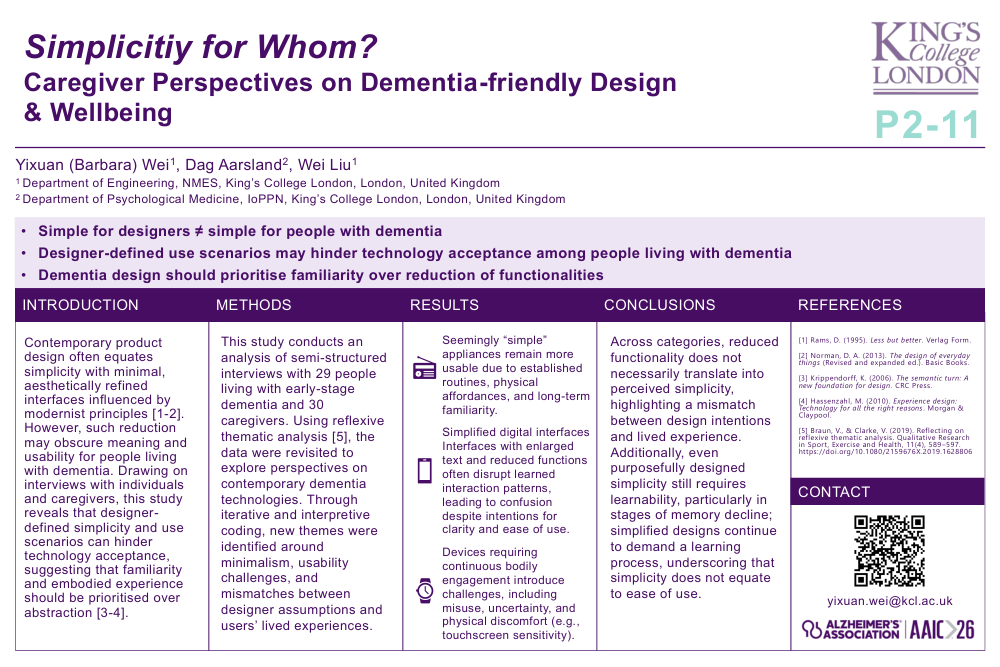
Contemporary product design often equates simplicity with minimal, aesthetically refined interfaces influenced by modernist principles [1-2]. However, such reduction may obscure meaning and usability for people living with dementia. Drawing on interviews with individuals and caregivers, this study reveals that designer-defined simplicity and use scenarios can hinder technology acceptance, suggesting that familiarity and embodied experience should be prioritised over abstraction [3-4].
Methods
This study conducts an analysis of semi-structured interviews with 29 people living with early-stage dementia and 30 caregivers. Using reflexive thematic analysis [5], the data were revisited to explore perspectives on contemporary dementia technologies. Through iterative and interpretive coding, new themes were identified around minimalism, usability challenges, and mismatches between designer assumptions and users’ lived experiences.
Results
Seemingly “simple” appliances remain more usable due to established routines, physical affordances, and long-term familiarity.
Simplified digital interfaces Interfaces with enlarged text and reduced functions often disrupt learned interaction patterns, leading to confusion despite intentions for clarity and ease of use.
Devices requiring continuous bodily engagement introduce challenges, including misuse, uncertainty, and physical discomfort (e.g., touchscreen sensitivity).
Conclusions
Across categories, reduced functionality does not necessarily translate into perceived simplicity, highlighting a mismatch between design intentions and lived experience. Additionally, even purposefully designed simplicity still requires learnability, particularly in stages of memory decline; simplified designs continue to demand a learning process, underscoring that simplicity does not equate to ease of use.
References
[1] Rams, D. (1995). Less but better. Verlag Form.
[2] Norman, D. A. (2013). The design of everyday things (Revised and expanded ed.). Basic Books.
[3] Krippendorff, K. (2006). The semantic turn: A new foundation for design. CRC Press.
[4] Hassenzahl, M. (2010). Experience design: Technology for all the right reasons. Morgan & Claypool.
[5] Braun, V., & Clarke, V. (2019). Reflecting on reflexive thematic analysis. Qualitative Research in Sport, Exercise and Health, 11(4), 589–597. https://doi.org/10.1080/2159676X.2019.1628806
Contact
yixuan.wei@kcl.ac.uk
Comments
Email is required but is not shown publicly.
Loading comments...