4,068 posters, 219 videos, 101 topics, 69 sessions, 14,365 authors, 6,128 institutions
ePostersLive by SciGen Technologies S.A. All rights reserved.
Alzheimer's Association International Conference 2026
July 12-15, 2026 | London, United Kingdom, and Online

5394
A Mixed-methods Process Evaluation Of A Randomized Controlled Trial For Posterior Cortical Atrophy Caregivers
Poster Presenter
Authors
Part of Topic
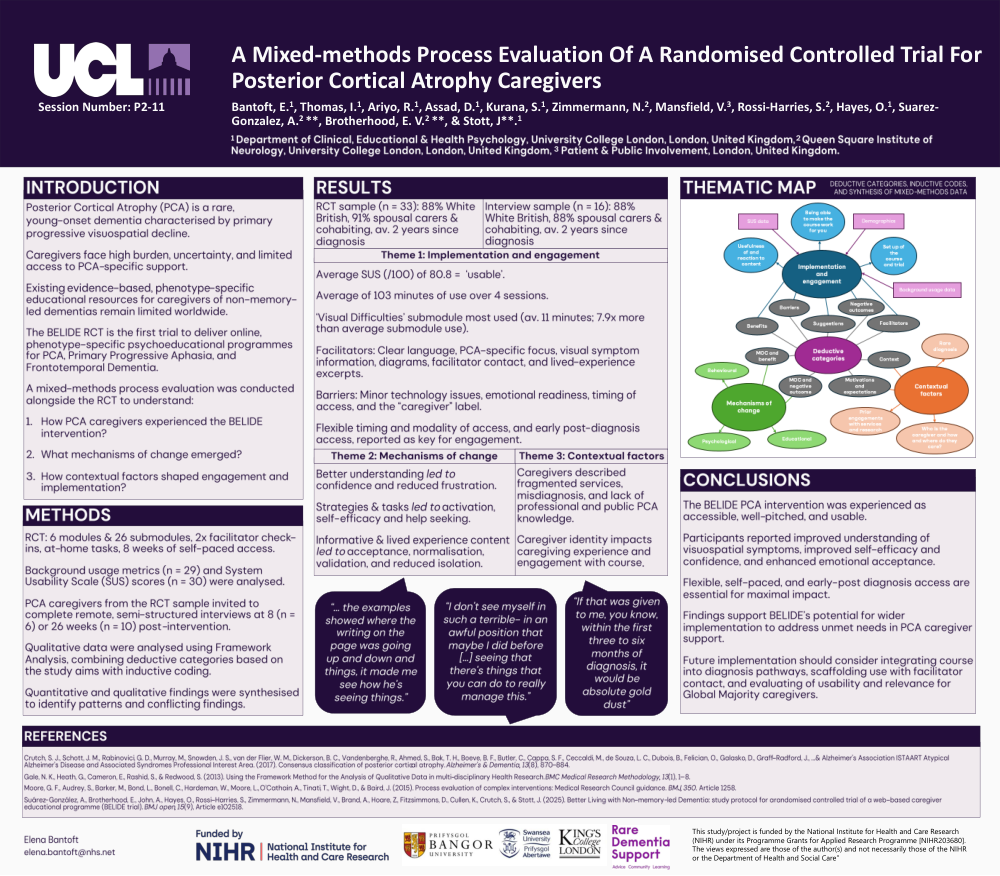
A Mixed-methods Process Evaluation Of A Randomised Controlled Trial For Posterior Cortical Atrophy Caregivers
Session number: P2-11
Bantoft, E.¹, Thomas, I.¹, Ariyo, R.¹, Assad, D.¹, Kurana, S.¹, Zimmermann, N.², Mansfield, V.³, Rossi-Harries, S.², Hayes, O.¹, Suarez-Gonzalez, A.²**, Brotherhood, E. V.²**, & Stott, J**.¹
¹Department of Clinical, Educational & Health Psychology, University College London, London, United Kingdom, ²Queen Square Institute of Neurology, University College London, London, United Kingdom, ³Patient & Public Involvement, London, United Kingdom.
INTRODUCTION
Posterior Cortical Atrophy (PCA) is a rare, young-onset dementia characterised by primary progressive visuospatial decline.
Caregivers face high burden, uncertainty, and limited access to PCA-specific support.
Existing evidence-based, phenotype-specific educational resources for caregivers of non-memory-led dementias remain limited worldwide.
The BELIDE RCT is the first trial to deliver online, phenotype-specific psychoeducational programmes for PCA, Primary Progressive Aphasia, and Frontotemporal Dementia.
A mixed-methods process evaluation was conducted alongside the RCT to understand:
- How PCA caregivers experienced the BELIDE intervention?
- What mechanisms of change emerged?
- How contextual factors shaped engagement and implementation?
METHODS
RCT: 6 modules & 26 submodules, 2x facilitator check-ins, at-home tasks, 8 weeks of self-paced access.
Background usage metrics (n = 29) and System Usability Scale (SUS) scores (n = 30) were analysed.
PCA caregivers from the RCT sample invited to complete remote, semi-structured interviews at 8 (n = 6) or 26 weeks (n = 10) post-intervention.
Qualitative data were analysed using Framework Analysis, combining deductive categories based on the study aims with inductive coding.
Quantitative and qualitative findings were synthesised to identify patterns and conflicting findings.
RESULTS
RCT sample (n = 33): 88% White British, 91% spousal carers & cohabiting, av. 2 years since diagnosis
Interview sample (n = 16): 88% White British, 88% spousal carers & cohabiting, av. 2 years since diagnosis
Theme 1: Implementation and engagement
Average SUS (/100) of 80.8 = 'usable'.
Average of 103 minutes of use over 4 sessions.
'Visual Difficulties' submodule most used (av. 11 minutes; 7.9x more than average submodule use).
Facilitators: Clear language, PCA-specific focus, visual symptom information, diagrams, facilitator contact, and lived-experience excerpts.
Barriers: Minor technology issues, emotional readiness, timing of access, and the "caregiver" label.
Flexible timing and modality of access, and early post-diagnosis access, reported as key for engagement.
Theme 2: Mechanisms of change
Better understanding led to confidence and reduced frustration.
Strategies & tasks led to activation, self-efficacy and help seeking.
Informative & lived experience content led to acceptance, normalisation, validation, and reduced isolation.
Theme 3: Contextual factors
Caregivers described fragmented services, misdiagnosis, and lack of professional and public PCA knowledge.
Caregiver identity impacts caregiving experience and engagement with course.
Quotes:
"… the examples showed where the writing on the page was going up and down and things, it made me see how he's seeing things."
"I don't see myself in such a terrible– in an awful position that maybe I did before […] seeing that there's things that you can do to really manage this."
"If that was given to me, you know, within the first three to six months of diagnosis, it would be absolute gold dust"
CONCLUSIONS
The BELIDE PCA intervention was experienced as accessible, well-pitched, and usable.
Participants reported improved understanding of visuospatial symptoms, improved self-efficacy and confidence, and enhanced emotional acceptance.
Flexible, self-paced, and early-post diagnosis access are essential for maximal impact.
Findings support BELIDE's potential for wider implementation to address unmet needs in PCA caregiver support.
Future implementation should consider integrating course into diagnosis pathways, scaffolding use with facilitator contact, and evaluating of usability and relevance for Global Majority caregivers.
REFERENCES
Crutch, S. J., Schott, J. M., Rabinovici, G. D., Murray, M., Snowden, J. S., van der Flier, W. M., Dickerson, B. C., Vandenberghe, R., Ahmed, S., Bak, T. H., Boeve, B. F., Butler, C., Cappa, S. F., Ceccaldi, M., de Souza, L. C., Dubois, B., Felician, O., Galasko, D., Graff-Radford, J., ...& Alzheimer's Association ISTAART Atypical Alzheimer's Disease and Associated Syndromes Professional Interest Area. (2017). Consensus classification of posterior cortical atrophy. Alzheimer's & Dementia, 13(8), 870–884.
Gale, N. K., Heath, G., Cameron, E., Rashid, S., & Redwood, S. (2013). Using the Framework Method for the Analysis of Qualitative Data in multi-disciplinary Health Research. BMC Medical Research Methodology, 13(1), 1–8.
Moore, G. F., Audrey, S., Barker, M., Bond, L., Bonell, C., Hardeman, W., Moore, L., O'Cathain, A., Tinati, T., Wight, D., & Baird, J. (2015). Process evaluation of complex interventions: Medical Research Council guidance. BMJ, 350. Article 1258.
Suárez-González, A., Brotherhood, E., John, A., Hayes, O., Rossi-Harries, S., Zimmermann, N., Mansfield, V., Brand, A., Hoare, Z., Fitzsimmons, D., Cullen, K., Crutch, S., & Stott, J. (2025). Better Living with Non-memory-led Dementia: study protocol for a randomised controlled trial of a web-based caregiver educational programme (BELIDE trial). BMJ open, 15(9), Article e102518.
Funding acknowledgement:
This study/project is funded by the National Institute for Health and Care Research (NIHR) under its Programme Grants for Applied Research Programme [NIHR203680]. The views expressed are those of the author(s) and not necessarily those of the NIHR or the Department of Health and Social Care
Contact:
Elena Bantoft
elena.bantoft@nhs.net
Logos/affiliations shown: NIHR National Institute for Health and Care Research; Prifysgol Bangor University; Swansea University / Prifysgol Abertawe; King's College London; Rare Dementia Support — Advice. Community. Learning.
Comments
Email is required but is not shown publicly.
Loading comments...