4,068 posters, 219 videos, 101 topics, 69 sessions, 14,365 authors, 6,128 institutions
ePostersLive by SciGen Technologies S.A. All rights reserved.
Alzheimer's Association International Conference 2026
July 12-15, 2026 | London, United Kingdom, and Online

10210
Stories, Symbolic Practices And Social Bonds: Community Practices As Protective Factors In Dementia
Poster Presenter
Part of Topic
Stories, Symbolic Practices and Social Bonds: Community Practices as Protective Factors in Dementia
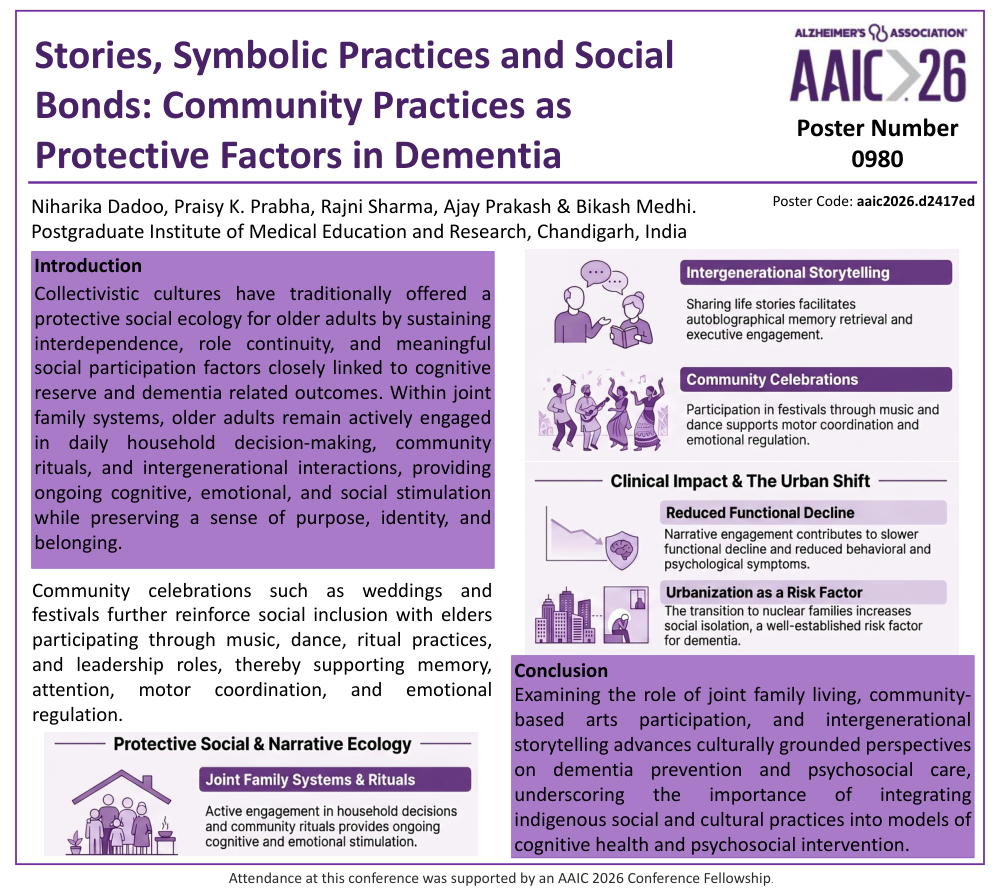
Collectivistic cultures have traditionally offered a protective social ecology for older adults by sustaining interdependence, role continuity, and meaningful social participation factors closely linked to cognitive reserve and dementia related outcomes. Within joint family systems, older adults remain actively engaged in daily household decision-making, community rituals, and intergenerational interactions, providing ongoing cognitive, emotional, and social stimulation while preserving a sense of purpose, identity, and belonging. Community celebrations such as weddings and festivals further reinforce social inclusion with elders participating through music, dance, ritual practices, and leadership roles, thereby supporting memory, attention, motor coordination, and emotional regulation.
Arts-based and narrative practices, particularly storytelling between older adults and grandchildren, play a significant role in maintaining cognitive and psychosocial functioning in later life. Sharing life stories can encourage autobiographical memory retrieval, language use, executive engagement, and identity continuity processes that are often compromised in dementia. For individuals living with or at risk for dementia, such narrative and artistic engagement may contribute to slower functional decline, reduced behavioural and psychological symptoms and improved quality of life by reinforcing a sense of self and social belonging.
Rapid urbanisation and the transition toward nuclear family structures weaken these traditional support systems, contributing to increased social isolation a well-established risk factor for cognitive decline and dementia progression. While biomedical and individual-level psychosocial interventions for dementia are well documented, limited attention has been given to understanding how culturally embedded, collective forms of social participation function as protective, non-pharmacological mechanisms for cognitive health in ageing populations.
Examining the role of joint family living, community-based arts participation, and intergenerational storytelling advances culturally grounded perspectives on dementia prevention and psychosocial care, underscoring the importance of integrating indigenous social and cultural practices into models of cognitive health and psychosocial intervention.
Comments
Email is required but is not shown publicly.
Loading comments...