4,068 posters, 219 videos, 101 topics, 69 sessions, 14,365 authors, 6,128 institutions
ePostersLive by SciGen Technologies S.A. All rights reserved.
Alzheimer's Association International Conference 2026
July 12-15, 2026 | London, United Kingdom, and Online

9354
Quality Of Life Of Older Brazilians Living With Dementia: Findings From The Elsi-Brazil Study
Poster Presenter
Authors
Part of Topic
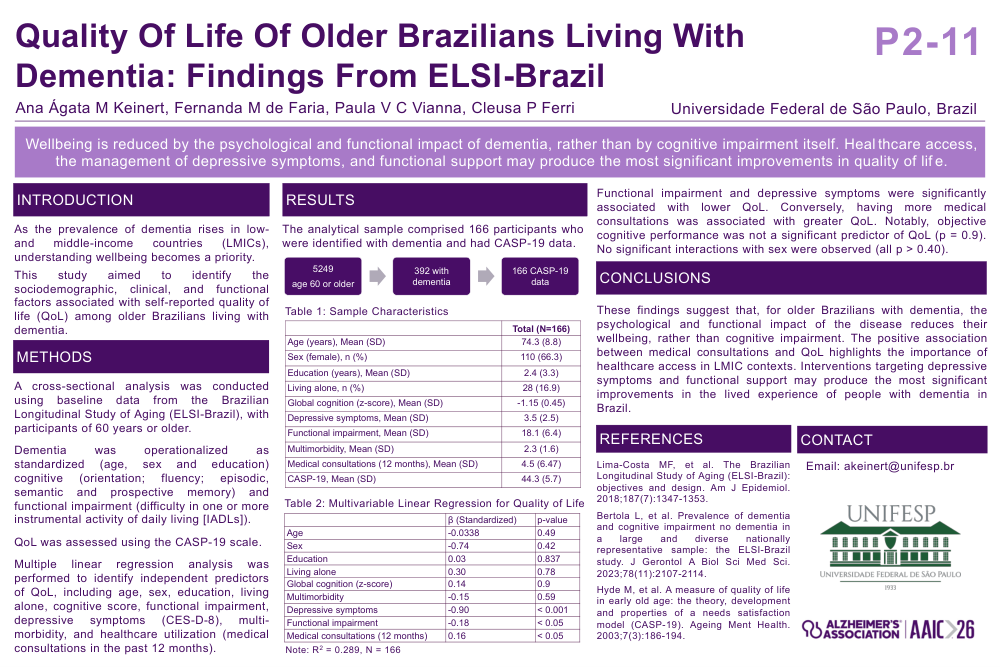
Background: As the prevalence of dementia rises in low- and middle-income countries (LMICs), understanding wellbeing becomes a priority. This study aimed to identify the sociodemographic, clinical, and functional factors associated with self-reported quality of life (QoL) among older Brazilians living with dementia.
Methods: A cross-sectional analysis was conducted using baseline data from the Brazilian Longitudinal Study of Aging (ELSI-Brazil), with participants of 60 years or older. Dementia was operationalized as standardized (age, sex and education) cognitive (orientation; fluency; episodic, semantic and prospective memory) and functional impairment (difficulty in one or more instrumental activity of daily living [IADLs]). QoL was assessed using the CASP-19 scale. Multiple linear regression analysis was performed to identify independent predictors of QoL, including age, sex, education, living alone, cognitive score, functional impairment, depressive symptoms (CES-D-8), multimorbidity, and healthcare utilization (medical consultations in the past 12 months). Finally, interaction with sex was tested for all significant associations.
Results: The analytical sample comprised 166 participants (66.3% female; mean age 74.3 years [SD 8.8]) who were identified with dementia and had CASP-19 data. Functional impairment (β = -0.18, p < 0.05) and depressive symptoms (β = -0.90, p < 0.001) were significantly associated with lower QoL. Conversely, having more medical consultations (β = 0.16, p < 0.05) was associated with greater QoL. Notably, objective cognitive performance was not a significant predictor of QoL (p = 0.9). No significant interactions with sex were observed (all p > 0.40).
Conclusion: These findings suggest that, for older Brazilians with dementia, the psychological and functional impact of the disease reduces their wellbeing, rather than cognitive impairment. The positive association between medical consultations and QoL highlights the importance of healthcare access in LMIC contexts. Interventions targeting depressive symptoms and functional support may produce the most significant improvements in the lived experience of people with dementia in Brazil.
References: Lima-Costa MF, et al. The Brazilian Longitudinal Study of Aging (ELSI-Brazil): objectives and design. Am J Epidemiol. 2018;187(7):1347-1353.
Bertola L, et al. Prevalence of dementia and cognitive impairment no dementia in a large and diverse nationally representative sample: the ELSI-Brazil study. J Gerontol A Biol Sci Med Sci. 2023;78(11):2107-2114.
Hyde M, et al. A measure of quality of life in early old age: the theory, development and properties of a needs satisfaction model (CASP-19). Ageing Ment Health. 2003;7(3):186-194.
Contact information: akeinert@unifesp.br
Comments
Email is required but is not shown publicly.
Loading comments...