4,068 posters, 219 videos, 101 topics, 69 sessions, 14,365 authors, 6,128 institutions
ePostersLive by SciGen Technologies S.A. All rights reserved.
Alzheimer's Association International Conference 2026
July 12-15, 2026 | London, United Kingdom, and Online

2604
Baseline Profile Of Participants In A Psychological Intervention For People With Early-stage Alzheimer’S Disease: A Pilot Study
Poster Presenter
Part of Topic
Background:
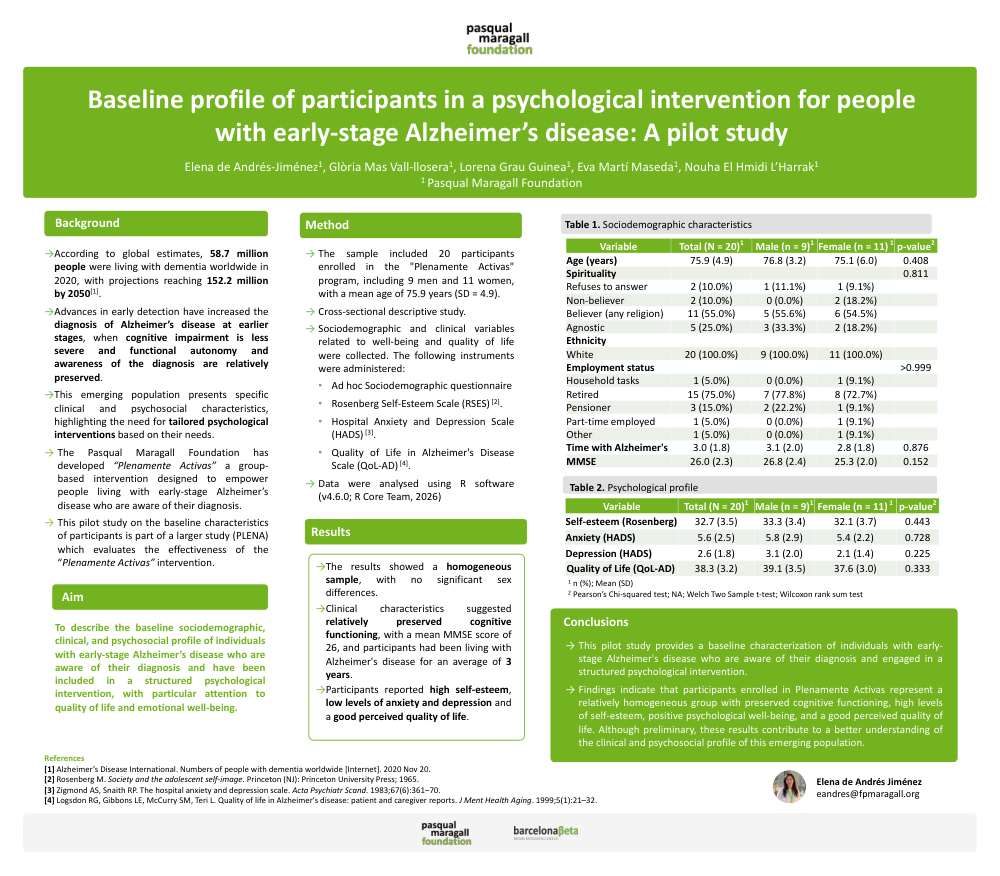
In recent years, advances in early detection and diagnosis of Alzheimer’s disease have enabled theidentification of individuals in early stages of the condition, characterized by lower cognitive impairment, greaterfunctional autonomy, and higher awareness of the disease. This has resulted in a heterogeneous population withdiverse clinical and psychosocial profiles, posing challenges for the design and evaluation of psychologicalinterventions. A detailed characterization of the baseline profile of these participants is essential to understand theirneeds and to contextualize intervention-related findings. The aim of this study is to describe the baselinesociodemographic, clinical, and psychosocial profile of individuals with early-stage Alzheimer’s disease who areaware of their diagnosis and have been included in a structured psychological intervention, with particular attentionto quality of life and emotional well-being.
Methods:
This is a descriptive study including individuals with early-stage Alzheimer’s disease who were enrolled toparticipate in a structured psychological intervention. Prior to the initiation of the intervention, sociodemographicand clinical variables were collected, as well as measures related to quality of life and emotional well-being, whichwere assessed using validated instruments.
Results:
This study focuses on the systematic characterization of the sociodemographic, clinical, and psychosocialprofile of individuals with early-stage Alzheimer’s disease who are aware of their diagnosis and have been includedin a structured psychological intervention. Baseline analyses emphasize quality of life and emotional well-beingvariables assessed using validated instruments, with the aim of contextualizing the target population for this type ofintervention.
Conclusion:
The characterization of the baseline profile of participants provides a clear description of thepopulation included in the psychological intervention. This information constitutes a necessary descriptiveframework for the interpretation and understanding of intervention studies in people with Alzheimer’s disease.
Comments
Email is required but is not shown publicly.
Loading comments...