4,068 posters, 219 videos, 101 topics, 69 sessions, 14,365 authors, 6,128 institutions
ePostersLive by SciGen Technologies S.A. All rights reserved.
Alzheimer's Association International Conference 2026
July 12-15, 2026 | London, United Kingdom, and Online

5672
Disentangling Social Isolation And Loneliness In Aging: Implications For Cognitive And Functional Health
Part of Topic
Introduction
The rising incidence of Alzheimer's Disease intensified research interest in modifiable factors capable of attenuating cognitive decline before clinical onset. Two broad constructs have attracted particular attention: cognitive reserve (CR), the brain's capacity to cope with neuropathological burden through education, occupational complexity, and cognitively stimulating leisure activities; and social connectedness, encompassing both the objective size of one's social network and the subjective experience of loneliness. Whether these dimensions exert domain-specific effects on cognition, functional autonomy, and subjective cognitive decline, and whether they operate through distinct mechanisms, remains poorly characterized.
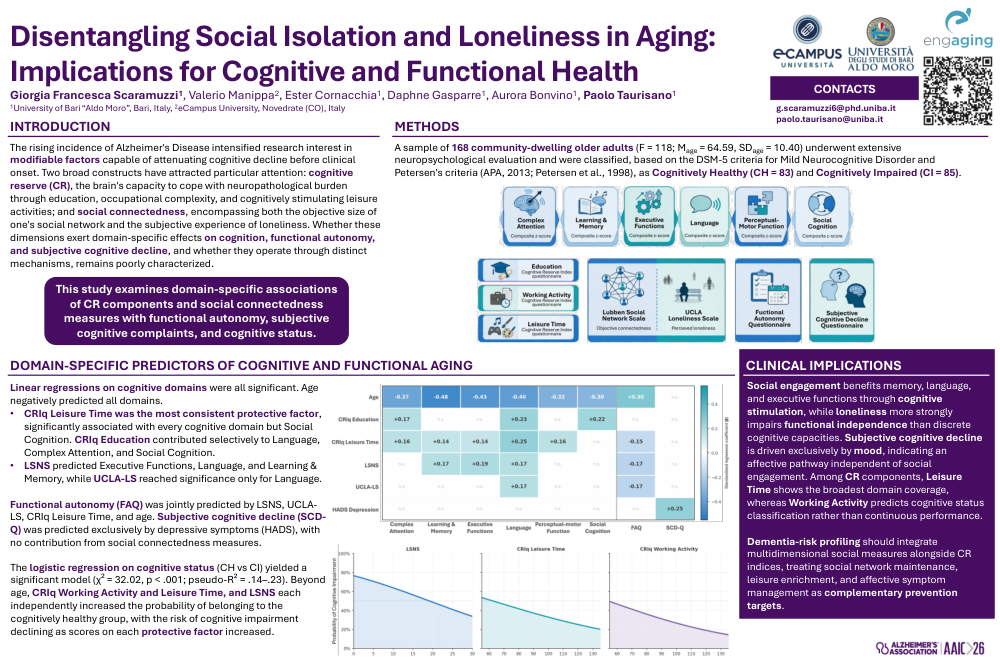
Social engagement benefits memory, language, and executive functions through cognitive stimulation, while loneliness more strongly impairs functional independence than discrete cognitive capacities. Subjective cognitive decline is driven exclusively by mood, indicating an affective pathway independent of social engagement. Among CR components, Leisure Time shows the broadest domain coverage, whereas Working Activity predicts cognitive status classification rather than continuous performance.
Dementia-risk profiling should integrate multidimensional social measures alongside CR indices, treating social network maintenance, leisure enrichment, and affective symptom management as complementary prevention targets.
This study examines domain-specific associations of CR components and social connectedness measures with functional autonomy, subjective cognitive complaints, and cognitive status.
Methods
A sample of 168 community-dwelling older adults (F = 118; Mage = 64.59, SDage = 10.40) underwent extensive neuropsychological evaluation and were classified, based on the DSM-5 criteria for Mild Neurocognitive Disorder and Petersen's criteria (APA, 2013; Petersen et al., 1998), as Cognitively Healthy (CH = 83) and Cognitively Impaired (CI = 85).
Results
Linear regressions on cognitive domains were all significant. Age negatively predicted all domains.
CRIq Leisure Time was the most consistent protective factor, significantly associated with every cognitive domain but Social Cognition. CRIq Education contributed selectively to Language, Complex Attention, and Social Cognition.
LSNS predicted Executive Functions, Language, and Learning & Memory, while UCLA-LS reached significance only for Language.
Functional autonomy (FAQ) was jointly predicted by LSNS, UCLA-LS, CRIq Leisure Time, and age. Subjective cognitive decline (SCD-Q) was predicted exclusively by depressive symptoms (HADS), with no contribution from social connectedness measures.
The logistic regression on cognitive status (CH vs CI) yielded a significant model (χ² = 32.02, p < .001; pseudo-R² = .14–.23). Beyond age, CRIqWorking Activity and Leisure Time, and LSNS each independently increased the probability of belonging to the cognitively healthy group, with the risk of cognitive impairment declining as scores on each protective factor increased.
Discussion
Social engagement benefits memory, language, and executive functions through cognitive stimulation, while loneliness more strongly impairs functional independence than discrete cognitive capacities. Subjective cognitive decline is driven exclusively by mood, indicating an affective pathway independent of social engagement. Among CR components, Leisure Time shows the broadest domain coverage, whereas Working Activity predicts cognitive status classification rather than continuous performance.
Dementia-risk profiling should integrate multidimensional social measures alongside CR indices, treating social network maintenance, leisure enrichment, and affective symptom management as complementary prevention targets.
Comments
Email is required but is not shown publicly.
Loading comments...