4,068 posters, 219 videos, 101 topics, 69 sessions, 14,365 authors, 6,128 institutions
ePostersLive by SciGen Technologies S.A. All rights reserved.
Alzheimer's Association International Conference 2026
July 12-15, 2026 | London, United Kingdom, and Online

10101
Feasibility And Preliminary Mental Health Outcomes Of A 6-week Virtual Support Program For Family Caregivers Of Persons With Dementia
Part of Topic
Family caregivers of persons with dementia experience elevated risk for psychological distress, including symptoms of depression, anxiety, and perceived stress, often related to inadequate social supports and limited dementia-related health literacy. Few culturally inclusive and accessible interventions address caregiver psychosocial health needs. This gap is particularly evident within U.S. Black/African American communities, where younger, non-spousal caregivers comprise the majority of the dementia caregiving population. Virtual interventions may offer an accessible and scalable approach to caregiver support.
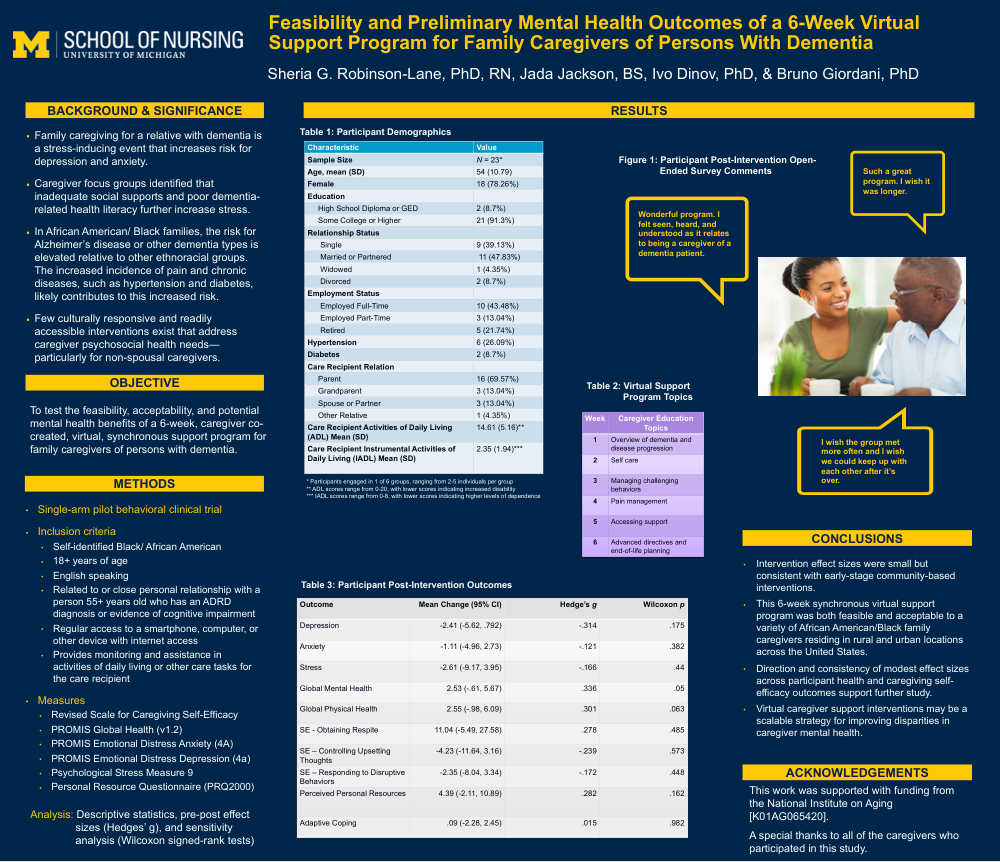
A single-group pilot study was conducted among U.S. caregivers of persons diagnosed with dementia who self-identified as Black/African American. Caregivers (N = 23) participated in a 6-week synchronous virtual support program delivered in small groups (2–4 participants). Weekly one-hour sessions addressed caregiver-prioritized topics identified through prior focus groups, including dementia progression and management, caregiver health promotion, stress management, and coping strategies. Standardized self-report measures assessed mental health, perceived support, coping, and caregiving self-efficacy at baseline and post-intervention. Effect sizes were estimated using Hedges’ g for paired samples, with Wilcoxon signed-rank tests conducted as sensitivity analyses.
Program retention was high, with 23 of 25 caregivers completing baseline and post-intervention assessments. Changes across outcomes were generally observed in the expected direction. Improvements were noted in perceived social resources (Hedges’ g = 0.28), PROMIS Global Mental Health (Hedges’ g = 0.34; p = 0.049), and indicators of caregiver self-efficacy. Reductions were observed in depressive symptoms (PROMIS Depression; negative sum rank = 168.5; Hedges’ g = −0.31), anxiety (PROMIS Anxiety; Hedges’ g = −0.12), and psychological stress (Hedges’ g = −0.17). Coping and adaptive processing demonstrated minimal change (Hedges’ g = 0.02). Effect sizes were small but consistent with early-stage community-based interventions.
Findings suggest that a brief, 6-week synchronous virtual support program is feasible and shows promise for improving global mental health, perceived support, and caregiving self-efficacy among Black/African American dementia caregivers. Although effects were modest, the consistency of change across outcomes supports further evaluation in a larger, controlled trial. Virtual caregiver support interventions may represent a scalable strategy for addressing inequities in caregiver mental health.
Comments
Email is required but is not shown publicly.
Loading comments...