4,068 posters, 219 videos, 101 topics, 69 sessions, 14,365 authors, 6,128 institutions
ePostersLive by SciGen Technologies S.A. All rights reserved.
Alzheimer's Association International Conference 2026
July 12-15, 2026 | London, United Kingdom, and Online

7323
Building A Legacy Through Brain Donation?Gone But Not Forgotten
Poster Presenter
Authors
Lilcelia Williams, Hector Salazar, Kim Biagi, Billie J. Cohen, Lisa Raymond, Sierra Wright, Jaime Perales-Puchalt, Elizabeth Head, Ann Cohen
Affiliations
, University of Pittsburgh, University of California, Irvine, University of Pittsburgh, Department of Psychiatry, School of Medicine & Alzheimer’s Disease Research Center at the University of Pittsburgh, University of Kansas Alzheimer's Disease Research Center
Part of Topic
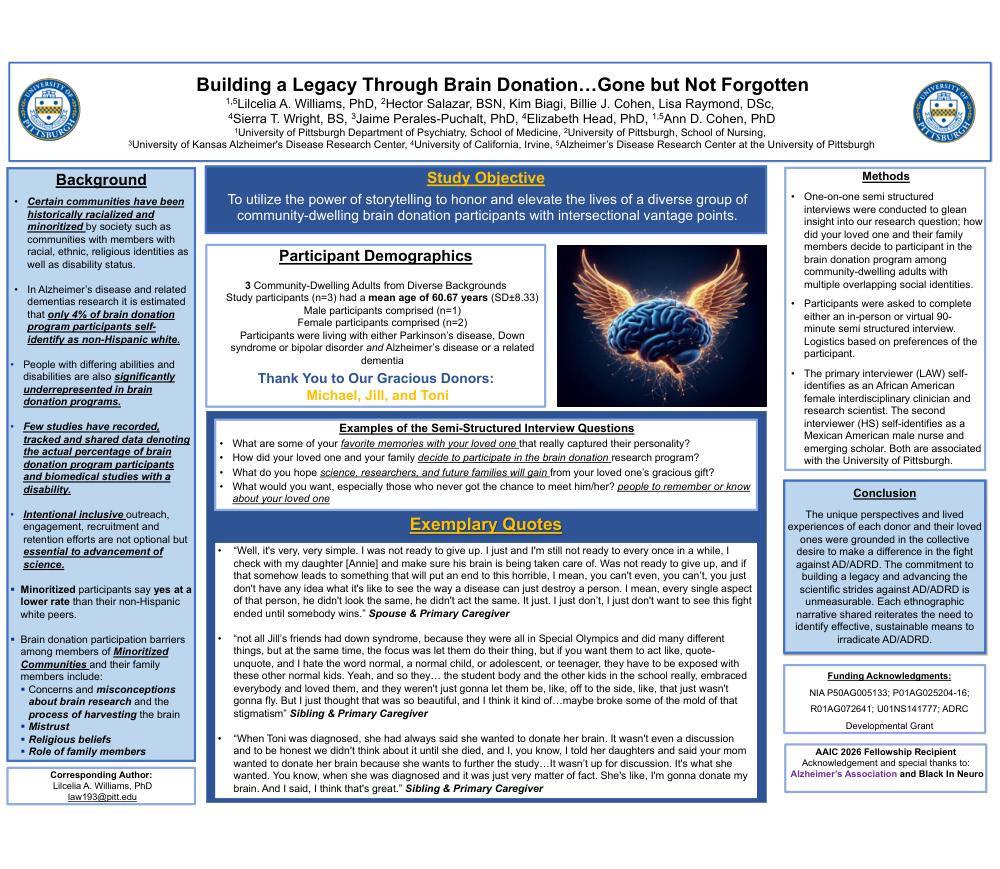
Title: Building a Legacy Through Brain Donation…Gone but Not Forgotten
Authors: Lilcelia A. Williams, PhD, Hector Salazar, BSN, Kim Biagi, Billie J. Cohen, Lisa Raymond, DSc, Sierra T. Wright, BS, Jaime Perales-Puchalt, PhD, Elizabeth Head, PhD, Ann D. Cohen, PhD
Background: Historically certain communities have been minoritized by society, especially based on their racial, ethnic, religious, and sexual and gender identities as well as socioeconomic and disability status. For decades society has assumed that persons living with an intellectual developmental disability are incapable of making independent decisions much less health or medical related decisions. Likewise, women have been assigned the role of caregiving and frequently referred to as the invisible laborers. Further, persons with multiple overlapping social characteristics (e.g., racial/ethnic/religious minority, female, disabilities) have been simply ignored. Mounting evidence documents the paucity of representation of persons from such communities in research. Few researchers have documented the lived experiences of persons at the intersection of social characteristics, disabilities, and participation in a brain donation program. Using a person-centered lens of intersectionality, we offer an ethnographic narrative of the legacies established by the gracious brain donations of a diverse cohort of individuals.
Methods: Semi-structured one-on-one individual interviews were conducted with three family members whose loved ones agreed to participate in a brain donation program. An interview script of open-ended questions used in conjunction with follow up prompts interjected into the natural flow of conversation. For the present analysis, emergent thematic themes were gleaned by coding transcripts from each semi-structured interview.
Results: The interviewees were composed of a diverse group (racially, ethnically, (dis)ability) of individuals who offered unparalleled insight into their loved ones’ decision to participate in a brain donation program, as well as their personal perspectives. All interviewees self-identified female (n=3) with a mean age of 64 years (SD±9.46). Interviewees included the older sister of sibling living with Down Syndrome and Alzheimer disease (AD), the wife of a spouse living with dementia, and the younger sister of a sibling living with schizophrenia and AD.
Conclusions: The unique perspectives and lived experiences of each donor and their loved ones were grounded in the collective desire to make a difference in the fight against AD/ADRD. Their commitment to building a legacy and advancing scientific strides against AD/ADRD is unmeasurable. Each ethnographic narrative shared reiterates the need to identify effective, sustainable means to irradicate AD/ADRD.
Comments
Email is required but is not shown publicly.
Loading comments...