4,068 posters, 219 videos, 101 topics, 69 sessions, 14,365 authors, 6,128 institutions
ePostersLive by SciGen Technologies S.A. All rights reserved.
Alzheimer's Association International Conference 2026
July 12-15, 2026 | London, United Kingdom, and Online

3325
Effects Of An Algorithmically Enhanced Personalized Music-based Intervention In Patients With Dementia
Poster Presenter
Authors
Rebecca Eilish Irvine, MBBS, BSc, Madhuri Sangam, PharmD, MS, Matthew Sunda, BS, Justin Grant, Dr. Okeanis Vaou, MD, FAAN, Dr. Anna DePold Hohler, MD, FAAN
Affiliations
Imperial College London, Boston Medical Centre-Brighton, Tufts University School of Medicine, Boston University Chobanian & Avedisian School of Medicine, University of Texas Health Sciences San Antonio
Part of Topic
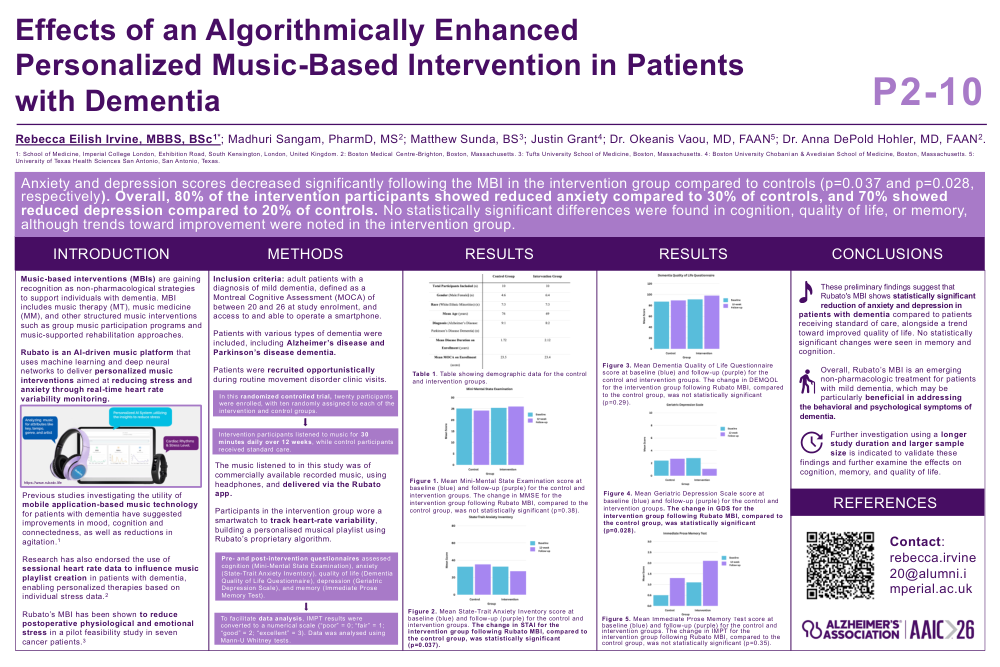
Anxiety and depression scores decreased significantly following the MBI in the intervention group compared to controls (p=0.037 and p=0.028, respectively). Overall, 80% of the intervention participants showed reduced anxiety compared to 30% of controls, and 70% showed reduced depression compared to 20% of controls. No statistically significant differences were found in cognition, quality of life, or memory, although trends toward improvement were noted in the intervention group.
Music-based interventions (MBIs) are gaining recognition as non-pharmacological strategies to support individuals with dementia. MBI includes music therapy (MT), music medicine (MM), and other structured music interventions such as group music participation programs and music-supported rehabilitation approaches.
Rubato is an AI-driven music platform that uses machine learning and deep neural networks to deliver personalized music interventions aimed at reducing stress and anxiety through real-time heart rate variability monitoring.
Previous studies investigating the utility of mobile application-based music technology for patients with dementia have suggested improvements in mood, cognition and connectedness, as well as reductions in agitation (1)
Research has also endorsed the use of sessional heart rate data to influence music playlist creation in patients with dementia, enabling personalized therapies based on individual stress data (2)
Rubato’s MBI has been shown to reduce postoperative physiological and emotional stress in a pilot feasibility study in seven cancer patients (3)
Inclusion criteria: adult patients with a diagnosis of mild dementia, defined as a Montreal Cognitive Assessment (MOCA) of between 20 and 26 at study enrolment, and access to and able to operate a smartphone.
Patients with various types of dementia were included, including Alzheimer’s disease and Parkinson’s disease dementia.
Patients were recruited opportunistically during routine movement disorder clinic visits.
In this randomized controlled trial, twenty participants were enrolled, with ten randomly assigned to each of the intervention and control groups.
Intervention participants listened to music for 30 minutes daily over 12 weeks, while control participants received standard care.
The music listened to in this study was of commercially available recorded music, using headphones, and delivered via the Rubato app.
Participants in the intervention group wore a smartwatch to track heart-rate variability, building a personalised musical playlist using Rubato’s proprietary algorithm.
Pre- and post-intervention questionnaires assessed cognition (Mini-Mental State Examination), anxiety (State-Trait Anxiety Inventory), quality of life (Dementia Quality of Life Questionnaire), depression (Geriatric Depression Scale), and memory (Immediate Prose Memory Test).
To facilitate data analysis, IMPT results were converted to a numerical scale (“poor” = 0; “fair” = 1; “good” = 2; “excellent” = 3). Data was analysed using Mann-U Whitney tests.
Table 1. Table showing demographic data for the control and intervention groups.
Figure 1. Mean Mini-Mental State Examination score at baseline (blue) and follow-up (purple) for the control and intervention groups. The change in MMSE for the intervention group following Rubato MBI, compared to the control group, was not statistically significant (p=0.38).
Figure 2. Mean State-Trait Anxiety Inventory score at baseline (blue) and follow-up (purple) for the control and intervention groups. The change in STAI for the intervention group following Rubato MBI, compared to the control group, was statistically significant (p=0.037).
Figure 3. Mean Dementia Quality of Life Questionnaire score at baseline (blue) and follow-up (purple) for the control and intervention groups. The change in DEMQOL for the intervention group following Rubato MBI, compared to the control group, was not statistically significant (p=0.29).
Figure 4. Mean Geriatric Depression Scale score at baseline (blue) and follow-up (purple) for the control and intervention groups. The change in GDS for the intervention group following Rubato MBI, compared to the control group, was statistically significant (p=0.028).
Figure 5. Mean Immediate Prose Memory Test score at baseline (blue) and follow-up (purple) for the control and intervention groups. The change in IMPT for the intervention group following Rubato MBI, compared to the control group, was not statistically significant (p=0.35).
These preliminary findings suggest that Rubato's MBI shows statistically significant reduction of anxiety and depression in patients with dementia compared to patients receiving standard of care, alongside a trend toward improved quality of life. No statistically significant changes were seen in memory and cognition.
Overall, Rubato’s MBI is an emerging non-pharmacologic treatment for patients with mild dementia, which may be particularly beneficial in addressing the behavioral and psychological symptoms of dementia.
Further investigation using a longer study duration and larger sample size is indicated to validate these findings and further examine the effects on cognition, memory, and quality of life.
Comments
Email is required but is not shown publicly.
Loading comments...