4,068 posters, 219 videos, 101 topics, 69 sessions, 14,365 authors, 6,128 institutions
ePostersLive by SciGen Technologies S.A. All rights reserved.
Alzheimer's Association International Conference 2026
July 12-15, 2026 | London, United Kingdom, and Online

9495
Community Perspectives On Digital Dementia Risk Assessment And Artificial Intelligence: A Qualitative Study
Poster Presenter
Authors
Part of Topic
Title
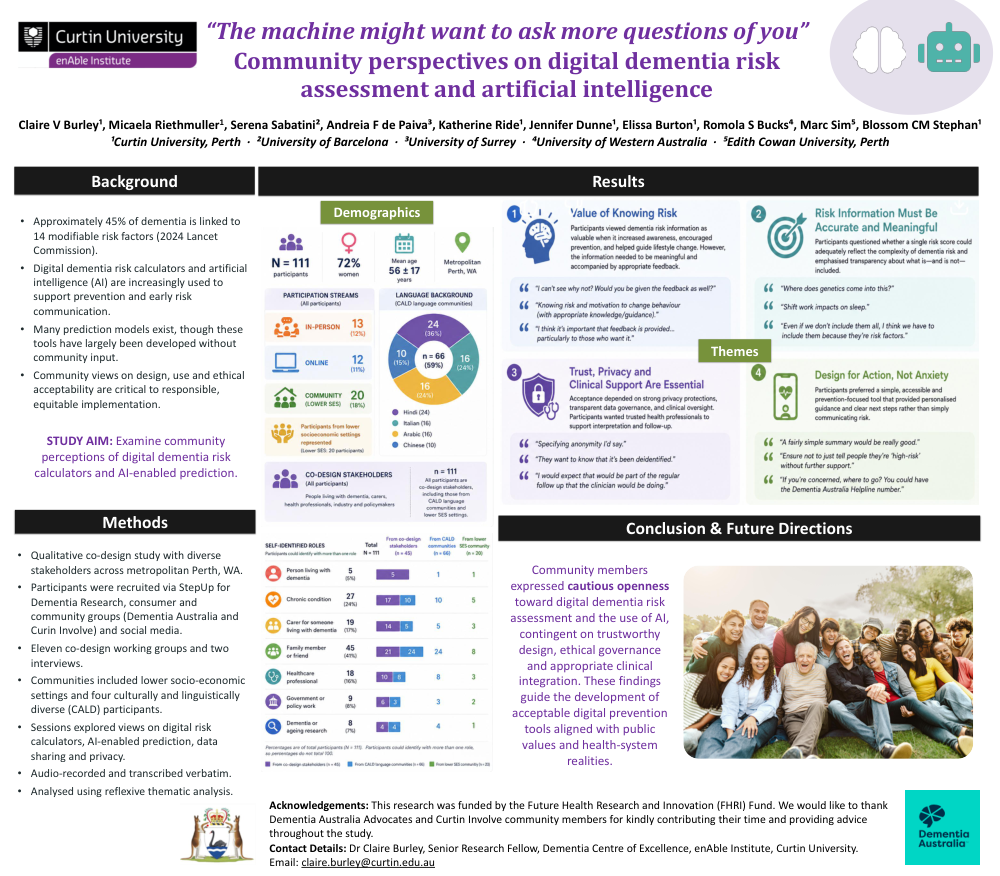
"The machine might want to ask more questions of you"
Community perspectives on digital dementia risk assessment and artificial intelligence
Authors
Claire V Burley¹, Micaela Riethmuller¹, Serena Sabatini², Andreia F de Paiva³, Katherine Ride¹, Jennifer Dunne¹, Elissa Burton¹, Romola S Bucks⁴, Marc Sim⁵, Blossom CM Stephan¹
¹Curtin University, Perth · ²University of Barcelona · ³University of Surrey · ⁴University of Western Australia · ⁵Edith Cowan University, Perth
Background
- Approximately 45% of dementia is linked to 14 modifiable risk factors (2024 Lancet Commission).
- Digital dementia risk calculators and artificial intelligence (AI) are increasingly used to support prevention and early risk communication.
- Many prediction models exist, though these tools have largely been developed without community input.
- Community views on design, use and ethical acceptability are critical to responsible, equitable implementation.
Study aim: Examine community perceptions of digital dementia risk calculators and AI-enabled prediction.
Methods
- Qualitative co-design study with diverse stakeholders across metropolitan Perth, WA.
- Recruited via StepUp for Dementia Research, consumer and community groups (Dementia Australia and Curtin Involve) and social media.
- Eleven co-design working groups and two interviews.
- Communities included lower socio-economic settings and four culturally and linguistically diverse (CALD) participants.
- Sessions explored views on digital risk calculators, AI-enabled prediction, data sharing and privacy.
- Audio-recorded and transcribed verbatim.
- Analysed using reflexive thematic analysis.
Results: Demographics
N = 111 participants · 72% women · Mean age 56 ± 17 years · Metropolitan Perth, WA
Participation streams (all participants): In-person 13 (12%); Online 12 (11%); Community, lower SES 20 (18%). Participants from lower socioeconomic settings represented (lower SES: 20 participants).
Language background (CALD language communities): n = 66 (59%), comprising Hindi 24 (36%), Italian 16 (24%), Arabic 16 (24%), Chinese 10 (15%).
Co-design stakeholders (all participants): n = 111. People living with dementia, carers, health professionals, industry and policymakers. All participants are co-design stakeholders, including those from CALD language communities and lower SES settings.
Self-identified roles (participants could identify with more than one role)
| Role | Total (N=111) | Co-design stakeholders (n=45) | CALD communities (n=66) | Lower SES community (n=20) |
|---|---|---|---|---|
| Person living with dementia | 5 (5%) | 5 | 1 | 1 |
| Chronic condition | 27 (24%) | 17 | 10 | 5 |
| Carer for someone living with dementia | 19 (17%) | 14 | 5 | 3 |
| Family member or friend | 45 (41%) | 21 | 24 | 8 |
| Healthcare professional | 18 (16%) | 10 | 8 | 3 |
| Government or policy work | 9 (8%) | 6 | 3 | 2 |
| Dementia or ageing research | 8 (7%) | 4 | 4 | 1 |
Percentages are of total participants (N=111). Participants could identify with more than one role, so percentages do not total 100.
Results: Themes
1. Value of Knowing Risk
Participants viewed dementia risk information as valuable when it increased awareness, encouraged prevention, and helped guide lifestyle change. However, the information needed to be meaningful and accompanied by appropriate feedback.
- "I can't see why not? Would you be given the feedback as well?"
- "Knowing risk and motivation to change behaviour (with appropriate knowledge/guidance)."
- "I think it's important that feedback is provided... particularly to those who want it."
2. Risk Information Must Be Accurate and Meaningful
Participants questioned whether a single risk score could adequately reflect the complexity of dementia risk and emphasised transparency about what is, and is not, included.
- "Where does genetics come into this?"
- "Shift work impacts on sleep."
- "Even if we don't include them all, I think we have to include them because they're risk factors."
3. Trust, Privacy and Clinical Support Are Essential
Acceptance depended on strong privacy protections, transparent data governance, and clinical oversight. Participants wanted trusted health professionals to support interpretation and follow-up.
- "Specifying anonymity I'd say."
- "They want to know that it's been deidentified."
- "I would expect that would be part of the regular follow up that the clinician would be doing."
4. Design for Action, Not Anxiety
Participants preferred a simple, accessible and prevention-focused tool that provided personalised guidance and clear next steps rather than simply communicating risk.
- "A fairly simple summary would be really good."
- "Ensure not to just tell people they're 'high-risk' without further support."
- "If you're concerned, where to go? You could have the Dementia Australia Helpline number."
Conclusion & Future Directions
Community members expressed cautious openness toward digital dementia risk assessment and the use of AI, contingent on trustworthy design, ethical governance and appropriate clinical integration. These findings guide the development of acceptable digital prevention tools aligned with public values and health-system realities.
Acknowledgements: This research was funded by the Future Health Research and Innovation (FHRI) Fund. We would like to thank Dementia Australia Advocates and Curtin Involve community members for kindly contributing their time and providing advice throughout the study.
Contact: Dr Claire Burley, Senior Research Fellow, Dementia Centre of Excellence, enAble Institute, Curtin University. Email: claire.burley@curtin.edu.au
Comments
Email is required but is not shown publicly.
Loading comments...