4,068 posters, 219 videos, 101 topics, 69 sessions, 14,365 authors, 6,128 institutions
ePostersLive by SciGen Technologies S.A. All rights reserved.
Alzheimer's Association International Conference 2026
July 12-15, 2026 | London, United Kingdom, and Online

2949
Brain Health Score: A Culturally Adapted Modifiable Risk Assessment Tool For Cognitive Impairment
Part of Topic
Background:
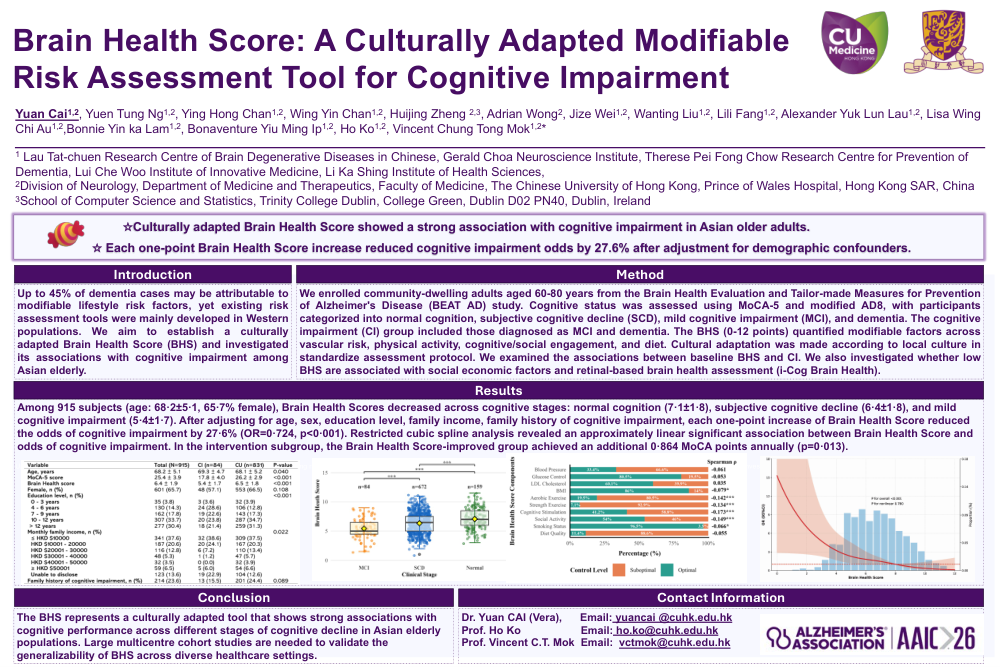
Up to 45% of dementia cases may be attributable to modifiable lifestyle risk factors, yet existing risk assessment tools were mainly developed in Western populations. We aim to establish a culturally adapted Brain Health Score (BHS) and investigated its associations with cognitive impairment among Asian elderly.
Methods:
We enrolled community-dwelling adults aged 60-80 years from the Brain Health Evaluation and Tailor-made Measures for Prevention of Alzheimer's Disease (BEAT AD) study. Cognitive status was assessed using MoCA-5 and modified AD8, with participants categorized into normal cognition, subjective cognitive decline (SCD), mild cognitive impairment (MCI), and dementia. The cognitive impairment (CI) group included those diagnosed as MCI and dementia. The BHS (0-12 points) quantified modifiable factors across vascular risk, physical activity, cognitive/social engagement, and diet. Cultural adaptation was made according to local culture in standardize assessment protocol. We examined the associations between baseline BHS and CI. We also investigated whether low BHS are associated with social economic factors and retinal-based brain health assessment (i-Cog Brain Health).
Results:
Among 915 subjects (age: 68·2±5·1, 65·7% female), Brain Health Scores decreased across cognitive stages: normal cognition (7·1±1·8), subjective cognitive decline (6·4±1·8), and mild cognitive impairment (5·4±1·7). After adjusting for age, sex, education level, family income, family history of cognitive impairment, each one-point increase of Brain Health Score reduced the odds of cognitive impairment by 27·6% (OR=0·724, p<0·001).
Conclusions:
The BHS represents a culturally adapted tool that shows strong associations with cognitive performance across different stages of cognitive decline in Asian elderly populations. Large multicentre cohort studies are needed to validate the generalizability of BHS across diverse healthcare settings.
Comments
Email is required but is not shown publicly.
Loading comments...