4,068 posters, 219 videos, 101 topics, 69 sessions, 14,365 authors, 6,128 institutions
ePostersLive by SciGen Technologies S.A. All rights reserved.
Alzheimer's Association International Conference 2026
July 12-15, 2026 | London, United Kingdom, and Online

3146
Participant Attitudes Towards Returning Individual Results From Observational Research In CADASIL
Poster Presenter
Authors
Affiliations
Part of Topic
Background
•Problem: disagreement about returning individual research results (IRR).
•Aim: explore research participant attitudes toward returning IRR from the United States CADASIL Consortium (USCC), an observational study.
Methods
•4-item survey: three 5-point Likert items; one open-ended item about IRR.
•Quantitative: Descriptive statistics (means, percentages).
•Quantitative: Independent samples Mann-Whitney U test (SPSS, v. 30.0) to compare results with Clark et al. (2022) “Anticipated reactions to learning Alzheimer’s disease biomarker results”.
•Qualitative: Deductive codebook → pilot coding → calibration → deductive & inductive coding → consensus & theming.
Highlights
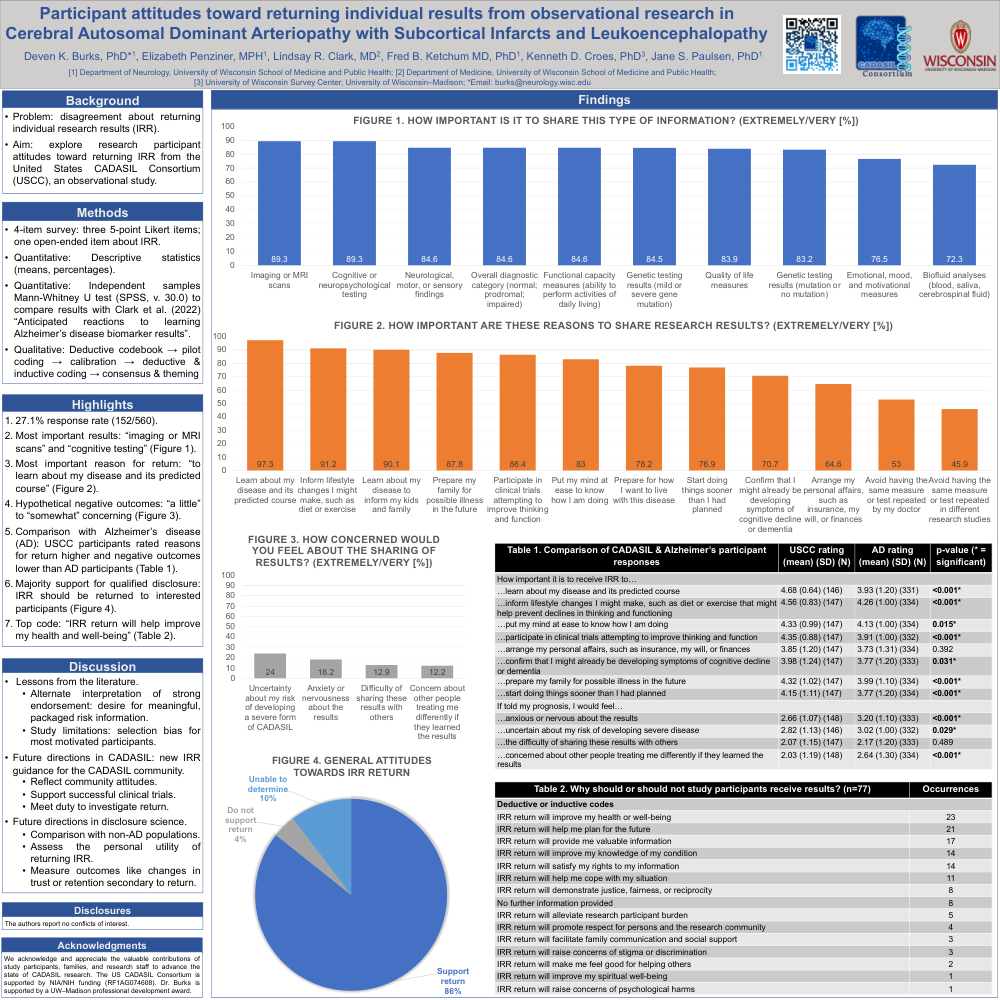
1.27.1% response rate (152/560).
2.Most important results: “imaging or MRI scans” and “cognitive testing” (Figure 1).
3.Most important reason for return: “to learn about my disease and its predicted course” (Figure 2).
4.Hypothetical negative outcomes: “a little” to “somewhat” concerning (Figure 3).
5.Comparison with Alzheimer’s disease (AD): USCC participants rated reasons for return higher and negative outcomes lower than AD participants (Table 1).
6.Majority support for qualified disclosure: IRR should be returned to interested participants (Figure 4).
7.Top code: “IRR return will help improve my health and well-being” (Table 2).
Discussion
•Lessons from the literature.
•Alternate interpretation of strong endorsement: desire for meaningful, packaged risk information.
•Study limitations: selection bias for most motivated participants.
•Future directions in CADASIL: new IRR guidance for the CADASIL community.
•Reflect community attitudes.
•Support successful clinical trials.
•Meet duty to investigate return.
•Future directions in disclosure science.
•Comparison with non-AD populations.
•Assess the personal utility of returning IRR.
•Measure outcomes like changes in trust or retention secondary to return.
Disclosures
The authors report no conflicts of interest.
The authors report no conflicts of interest.
Acknowledgments
We acknowledge and appreciate the valuable contributions of study participants, families, and research staff to advance the state of CADASIL research. The US CADASIL Consortium is supported by NIA/NIH funding (RF1AG074608). Dr. Burks is supported by a UW–Madison professional development award.
We acknowledge and appreciate the valuable contributions of study participants, families, and research staff to advance the state of CADASIL research. The US CADASIL Consortium is supported by NIA/NIH funding (RF1AG074608). Dr. Burks is supported by a UW–Madison professional development award.
Comments
Email is required but is not shown publicly.
Loading comments...