4,068 posters, 219 videos, 101 topics, 69 sessions, 14,365 authors, 6,128 institutions
ePostersLive by SciGen Technologies S.A. All rights reserved.
Alzheimer's Association International Conference 2026
July 12-15, 2026 | London, United Kingdom, and Online

3002
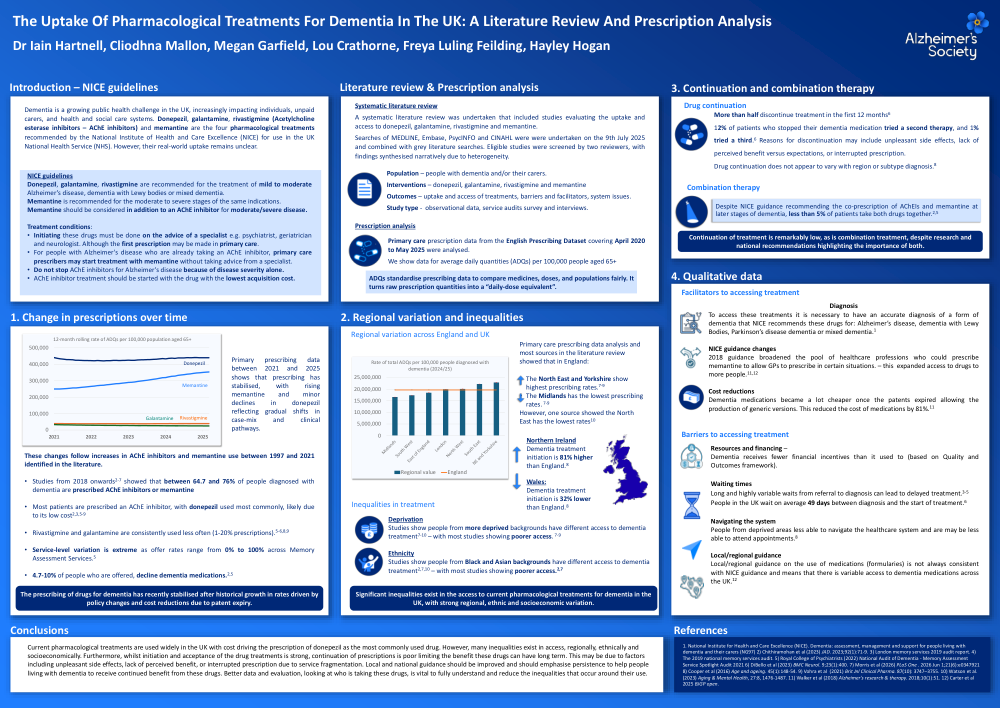
The Uptake Of Pharmacological Treatments For Dementia In The UK: A Literature Review And Prescription Analysis
Poster Presenter
Authors
Iain Hartnell, Cliodhna Mallon, Megan Garfield, Lou Crathorne, Freya Luling Feilding, Hayley Hogan
Affiliations
Part of Topic
The Uptake Of Pharmacological Treatments For Dementia In The UK: A Literature Review And Prescription Analysis
Dr Iain Hartnell, Cliodhna Mallon, Megan Garfield, Lou Crathorne, Freya Luling Feilding, Hayley Hogan
Introduction – NICE guidelines
Dementia is a growing public health challenge in the UK, increasingly impacting individuals, unpaid carers, and health and social care systems. Donepezil, galantamine, rivastigmine (Acetylcholine esterase inhibitors – AChE inhibitors) and memantine are the four pharmacological treatments recommended by the National Institute of Health and Care Excellence (NICE) for use in the UK National Health Service (NHS). However, their real-world uptake remains unclear.
NICE guidelines
Donepezil, galantamine, rivastigmine are recommended for the treatment of mild to moderate Alzheimer’s disease, dementia with Lewy bodies or mixed dementia.
Memantine is recommended for the moderate to severe stages of the same indications. Memantine should be considered in addition to an AChE inhibitor for moderate/severe disease.
Treatment conditions:
• Initiating these drugs must be done on the advice of a specialist e.g. psychiatrist, geriatrician and neurologist. Although the first prescription may be made in primary care. • For people with Alzheimer’s disease who are already taking an AChE inhibitor, primary care prescribers may start treatment with memantine without taking advice from a specialist. • Do not stop AChE inhibitors for Alzheimer’s disease because of disease severity alone. • AChE inhibitor treatment should be started with the drug with the lowest acquisition cost.
1. Change in prescriptions over time
Primary prescribing data between 2021 and 2025 shows that prescribing has stabilised, with rising memantine and minor declines in donepezil reflecting gradual shifts in case-mix and clinical pathways.
These changes follow increases in AChE inhibitors and memantine use between 1997 and 2021 identified in the literature.
• Studies from 2018 onwards showed that between 64.7 and 76% of people diagnosed with dementia are prescribed AChE inhibitors or memantine. • Most patients are prescribed an AChE inhibitor, with donepezil used most commonly, likely due to its low cost. • Rivastigmine and galantamine are consistently used less often (1–20% prescriptions). • Service-level variation is extreme as offer rates range from 0% to 100% across Memory Assessment Services. • 4.7–10% of people who are offered, decline dementia medications.
The prescribing of drugs for dementia has recently stabilised after historical growth in rates driven by policy changes and cost reductions due to patent expiry.
Literature review & Prescription analysis
Systematic literature review
A systematic literature review was undertaken that included studies evaluating the uptake and access to donepezil, galantamine, rivastigmine and memantine.
Searches of MEDLINE, Embase, PsycINFO and CINAHL were undertaken on 9 July 2025 and combined with grey literature searches. Eligible studies were screened by two reviewers, with findings synthesised narratively due to heterogeneity.
Population: people with dementia and/or their carers Interventions: donepezil, galantamine, rivastigmine and memantine Outcomes: uptake and access of treatments, barriers and facilitators, system issues Study type: observational data, service audits, surveys and interviews
Prescription analysis
Primary care prescription data from the English Prescribing Dataset covering April 2020 to May 2025 were analysed.
ADQs (average daily quantities) per 100,000 people aged 65+ were used to standardise prescribing data to compare medicines, doses, and populations fairly.
2. Regional variation and inequalities
Primary care prescribing data analysis, and most sources in the literature review, showed that in England:
• The North East and Yorkshire show highest prescribing rates. • The Midlands has the lowest prescribing rates. • However, one source showed the North East has the lowest rates.
Northern Ireland
Dementia treatment initiation is 81% higher than England.
Wales
Dementia treatment initiation is 32% lower than England.
Inequalities in treatment
Deprivation: Studies show people from more deprived backgrounds have different access to dementia treatment — with most studies showing poorer access.
Ethnicity: Studies show people from Black and Asian backgrounds have different access to dementia treatment — with most studies showing poorer access.
Significant inequalities exist in access to current pharmacological treatments for dementia in the UK, with strong regional, ethnic and socioeconomic variation.
3. Continuation and combination therapy
Drug continuation
More than half discontinue treatment in the first 12 months.
12% of patients who stopped their dementia medication tried a second therapy, and 1% tried a third. Reasons for discontinuation were not captured, but may include unpleasant side effects, lack of perceived benefit versus expectations, or interrupted prescription.
Drug continuation does not appear to vary with region or subtype diagnosis.
Combination therapy
Despite NICE guidance recommending the co-prescription of AChEIs and memantine at later stages of dementia, less than 5% of patients take both drugs together.
Continuation of treatment is remarkably low, as is combination treatment, despite research and national recommendations highlighting the importance of both.
4. Qualitative data
Facilitators to accessing treatment
Diagnosis To access these treatments it is necessary to have an accurate diagnosis of a form of dementia that NICE recommends these drugs for: Alzheimer’s disease, dementia with Lewy Bodies, Parkinson’s disease dementia or mixed dementia.
NICE guidance changes
2018 guidance broadened the pool of healthcare professions who could prescribe memantine to allow GPs to prescribe in certain situations — expanding access.
Cost reductions Dementia medications became much cheaper once patents expired, reducing costs by 81%.
Barriers to accessing treatment
Resources and financing Dementia receives fewer financial incentives than it used to (Quality and Outcomes Framework).
Waiting times Long and highly variable waits from referral to diagnosis can delay treatment. People in the UK wait on average 49 days between diagnosis and the start of treatment.
Navigating the system People from deprived areas may be less able to navigate the healthcare system and attend appointments.
Local/regional guidance Local/regional formularies are not always consistent with NICE guidance, creating variable access across the UK.
5. Conclusions
Current pharmacological treatments are used widely in the UK, with cost driving the prescription of donepezil as the most commonly used drug. However, many inequalities exist in access — regionally, ethnically and socioeconomically.
Whilst initiation and acceptance of drug treatments is strong, continuation is poor, limiting long-term benefit. This may be due to unpleasant side effects, lack of perceived benefit, or interrupted prescription due to service fragmentation.
Comments
Email is required but is not shown publicly.
Loading comments...