4,068 posters, 219 videos, 101 topics, 69 sessions, 14,365 authors, 6,128 institutions
ePostersLive by SciGen Technologies S.A. All rights reserved.
Alzheimer's Association International Conference 2026
July 12-15, 2026 | London, United Kingdom, and Online

1117
Pilot Study Of Satisfaction With The Plenament Actives Psychological Intervention For People With Early Stage Alzheimers Disease
Poster Presenter
Part of Topic
Pilot study on satisfaction with the Plenament Actives psychological intervention for people with early-stage Alzheimer’s disease
Glòria Mas Vall-llosera¹, Elena de Andrés Jiménez¹, Lorena Grau Guinea¹, Eva Martí Maseda¹, Nouha El Hmidi L'Harrak¹
¹ Pasqual Maragall Foundation
Contact: Glòria Mas Vall-llosera, gmas@fpmaragall.org
Background
Dementia is a growing global health challenge, with an estimated 69 million people expected to be affected by 2025[1].
Early detection and intervention allow timely action to reinforce habits, routines, and self-care strategies that help preserve abilities and delay the functional impact of disease progression.
After receiving the diagnosis, people living with Alzheimer’s disease (AD) often lack information on how to adapt to daily changes and challenges.
Plenament Actives is configured as a group, in-person psychological intervention, aimed at people with early-stage Alzheimer’s disease.
The model focuses on five key dimensions: psychoeducation, emotional elaboration and coping strategies, promotion of informed autonomy, preservation of identity and abilities, and active participation in improving support systems and social awareness around AD.
Aim
To evaluate participants’ satisfaction with the proposed intervention, considering satisfaction as a relevant component in the assessment of psychological interventions, especially among those who are aware of their diagnosis.
Method
Eight-session intervention.
Sample of 17 participants (10 women, 7 men) of the Plenament Actives psychological intervention.
Mean age = 75,87 years.
Targets individuals with early-stage Alzheimer’s disease (GDS stages 3-4).
20-item ad hoc survey including Likert-type scales (1-10) and multiple-choice questions administered after the intervention to assess perceptions, usefulness and overall satisfaction.
Pilot study focuses on the evaluation of overall satisfaction with the intervention, expectation satisfaction and its impact on individuals’ overall well-being.
Results
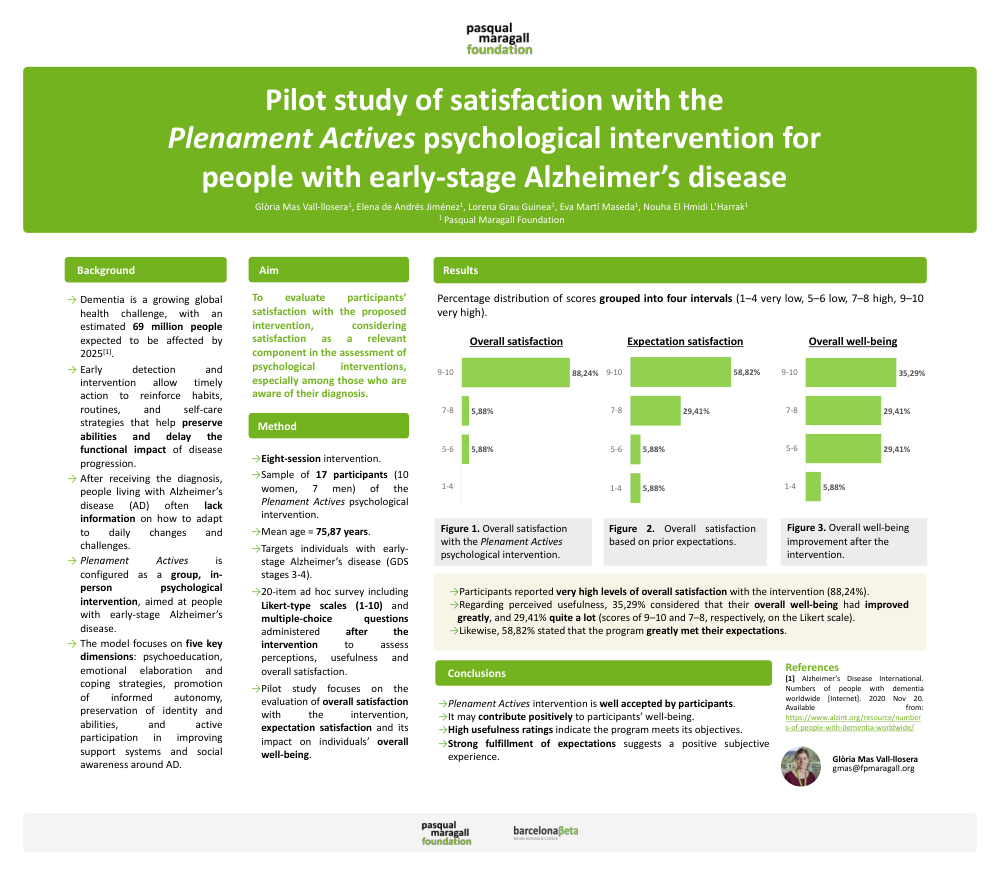
Percentage distribution of scores grouped into four intervals (1–4 very low, 5–6 low, 7–8 high, 9–10 very high).
Participants reported very high levels of overall satisfaction with the intervention (88,24%).
Regarding perceived usefulness, 35,29% considered that their overall well-being had improved greatly, and 29,41% quite a lot (scores of 9–10 and 7–8, respectively, on the Likert scale).
Likewise, 58,82% stated that the program greatly met their expectations.
Figure 1. Overall satisfaction with the Plenament Actives psychological intervention.
Figure 2. Overall satisfaction based on prior expectations.
Figure 3. Overall well-being improvement after the intervention.
Conclusions
Plenament Actives intervention is well accepted by participants.
It may contribute positively to participants’ well-being.
High usefulness ratings indicate the program meets its objectives.
Strong fulfillment of expectations suggests a positive subjective experience.
Reference
[1] Alzheimer’s Disease International. Numbers of people with dementia worldwide [Internet]. 2020 Nov 20. Available from: https://www.alzint.org/resource/numbers-of-people-with-dementia-worldwide/
Comments
Email is required but is not shown publicly.
Loading comments...