4,068 posters, 219 videos, 101 topics, 69 sessions, 14,365 authors, 6,128 institutions
ePostersLive by SciGen Technologies S.A. All rights reserved.
Alzheimer's Association International Conference 2026
July 12-15, 2026 | London, United Kingdom, and Online

5234
Virtual Cognitive Stimulation Therapy For People With Rare Dementias: An Adaptation And Feasibility Study
Poster Presenter
Authors
Suman Kurana, Céline El Baou, Andrew Brand, Katherine Cullen, Deborah Fitzsimmons, Nikki Zimmermann, Anastasia Tsipa, Aysha Mohamed Rafik Patel, Dorothy Boggs, Caroline Fearn, Sam Rossi-Harries, Dominika Valacsay, Elizabeth Fordham, Aphrodite Eshetu, Mia VanDevelde, Sebastian Crutch, Valerie Mansfield, Zoe Hoare, Ollie Hayes, Emilie Brotherhood, Joshua Stott, Aimee Spector
Affiliations
University College London, London, United Kingdom, Department of Clinical, Educational, and Health Psychology, University College London, London, United Kingdom, Bangor University, Bangor, United Kingdom, Swansea Centre for Health Economics, Swansea University, Swansea Wales, United Kingdom, Dementia Research Centre, University College London, London, United Kingdom, Rare Dementia Support Service, University College London, London, United Kingdom
Part of Topic
Abstract
Background:
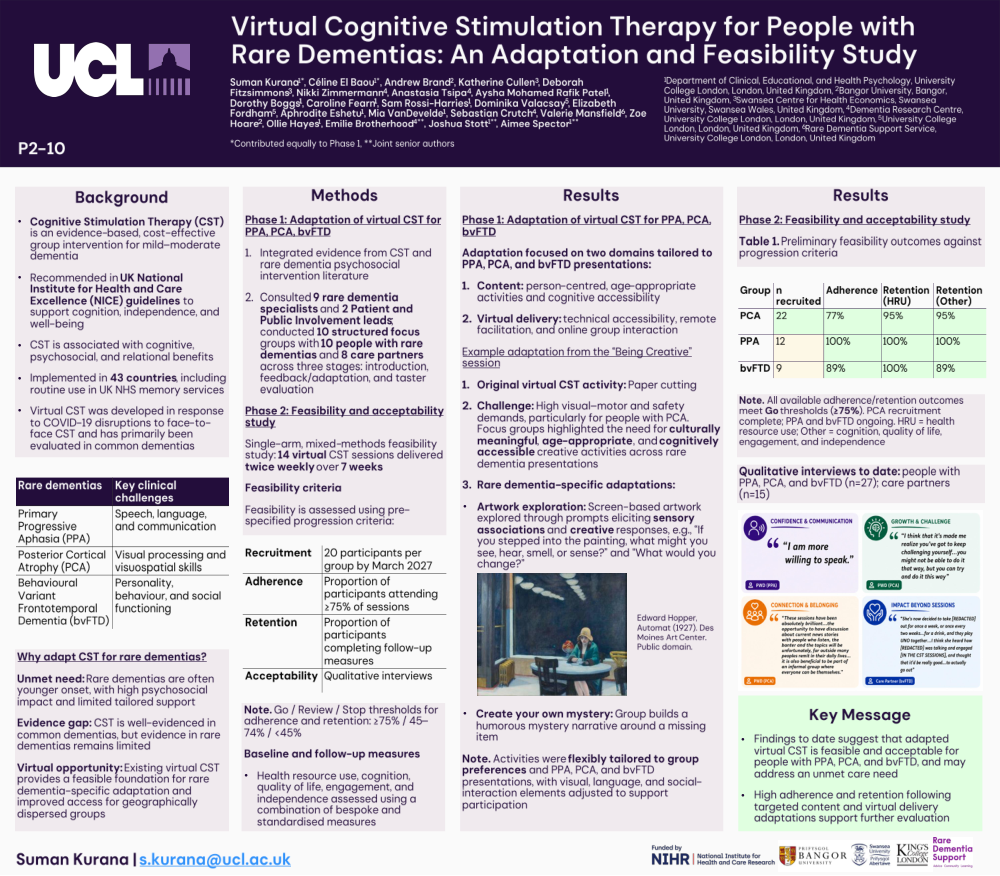
Cognitive Stimulation Therapy (CST) is an evidence-based group intervention for people with mild-to-moderate dementia. Rare dementias (RDs), including Primary Progressive Aphasia (PPA), Posterior Cortical Atrophy (PCA), and behavioural variant Frontotemporal Dementia (bvFTD), are often associated with earlier onset and distinct cognitive and psychosocial profiles, yet tailored support remains limited. Therefore, we aimed to adapt virtual CST for people with PPA, PCA, and bvFTD and evaluate feasibility and acceptability.
Methods:
CST was adapted through an iterative process combining evidence from CST and rare dementia psychosocial intervention literature, consultation with nine rare dementia specialists and two Patient and Public Involvement leads, and 10 structured focus groups involving 10 people with RDs and eight care partners. Focus groups were conducted across three stages: introduction, feedback and adaptation, and taster-session evaluation. An ongoing single-arm, mixed-methods feasibility study aims to recruit 60 participants (20 per diagnosis). Participants receive 14 virtual CST sessions over seven weeks, delivered twice weekly in diagnosis-specific groups. Feasibility outcomes include recruitment, adherence (session attendance), retention (completion of follow-up measures), and acceptability. Adherence and retention rates of ≥75% indicate feasibility. Health resource use, cognition, quality of life, and engagement/independence are assessed pre- and post-intervention.
Results:
Adaptation focused on two domains across diagnostic presentations: content, including person-centred, age-appropriate activities and cognitive accessibility; and virtual delivery, including technical accessibility, remote facilitation, and online group interaction.
Nine groups have been completed, comprising participants with PCA (n=22), PPA (n=12), and bvFTD (n=9). Adherence (session attendance) was high across diagnostic groups, with 77% of PCA participants, 100% of PPA participants, and 89% of bvFTD participants attending ≥75% of sessions. Retention was also high for the health resource use measure (PCA: 95%; PPA: 100%; bvFTD: 100%) and for cognition, quality of life, and engagement/independence measures (PCA: 95%; PPA: 100%; bvFTD: 89%).
To date, qualitative interviews have been completed with people with RDs (n=27) and care partners (n=15), with further interviews ongoing. Preliminary qualitative findings suggest benefits in confidence, communication, and social engagement.
Conclusion:
Adapted virtual CST appears feasible, acceptable, and responsive to unmet care needs in RDs, supporting further evaluation.
Comments
Email is required but is not shown publicly.
Loading comments...