4,068 posters, 219 videos, 101 topics, 69 sessions, 14,365 authors, 6,128 institutions
ePostersLive by SciGen Technologies S.A. All rights reserved.
Alzheimer's Association International Conference 2026
July 12-15, 2026 | London, United Kingdom, and Online

1454
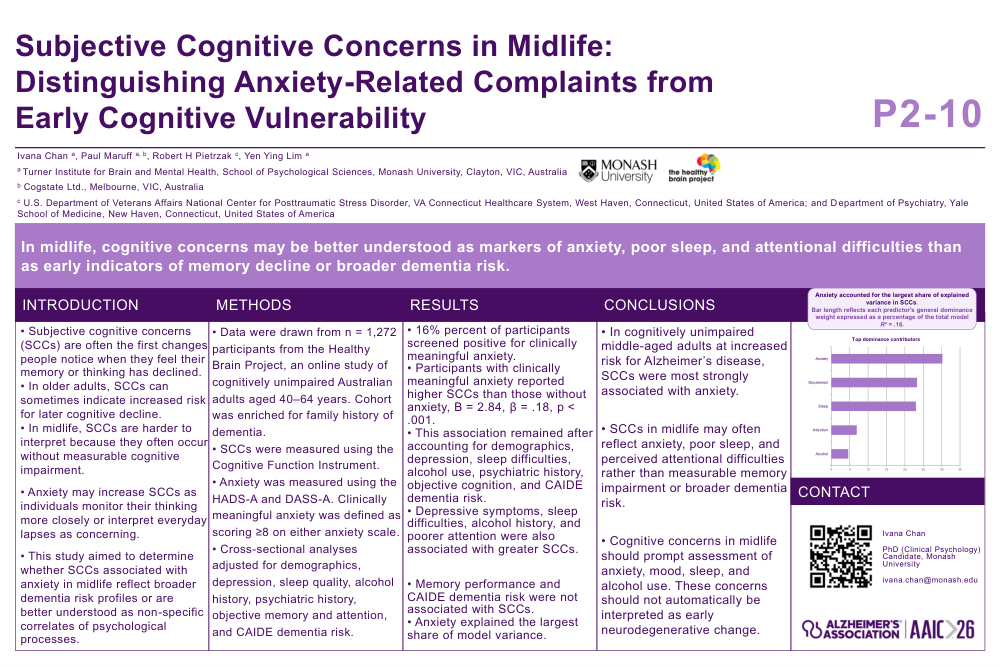
Subjective Cognitive Concerns In Midlife: Distinguishing Anxiety-related Complaints From Early Cognitive Vulnerability
Poster Presenter
Authors
Affiliations
Turner Institute for Brain and Mental Health, School of Psychological Sciences, Monash University, Clayton, VIC, Australia, cU.S. Department of Veterans Affairs National Centerfor Posttraumatic Stress Disorder, VA Connecticut Healthcare System, West Haven, Connecticut, United States of America; and Department of Psychiatry, Yale School of Medicine, New Haven, Connecticut, United States of America
Part of Topic
In midlife, cognitive concerns may be better understood as markers of anxiety, poor sleep, and attentional difficulties than as early indicators of memory decline or broader dementia risk.
INTRODUCTION
• Subjective cognitive concerns (SCCs) are often the first changes people notice when they feel their memory or thinking has declined.• In older adults, SCCs can sometimes indicate increased risk for later cognitive decline.• In midlife, SCCs are harder to interpret because they often occur without measurable cognitive impairment.
• Anxiety may increase SCCs as individuals monitor their thinking more closely or interpret everyday lapses as concerning.
• This study aimed to determine whether SCCs associated with anxiety in midlife reflect broader dementia risk profiles or are better understood as non-specific correlates of psychological processes.
METHODS
• Data were drawn from n = 1,272 participants from the Healthy Brain Project, an online study of cognitively unimpaired Australian adults aged 40–64 years. Cohort was enriched for family history of dementia.• SCCs were measured using the Cognitive Function Instrument.• Anxiety was measured using the HADS-A and DASS-A. Clinically meaningful anxiety was defined as scoring ≥8 on either anxiety scale.• Cross-sectional analyses adjusted for demographics, depression, sleep quality, alcohol history, psychiatric history, objective memory and attention, and CAIDE dementia risk.
RESULTS
• 16% percent of participants screened positive for clinically meaningful anxiety.• Participants with clinically meaningful anxiety reported higher SCCs than those without anxiety, B = 2.84, β = .18, p < .001.• This association remained after accounting for demographics, depression, sleep difficulties, alcohol use, psychiatric history, objective cognition, and CAIDE dementia risk.• Depressive symptoms, sleep difficulties, alcohol history, and poorer attention were also associated with greater SCCs.
• Memory performance and CAIDE dementia risk were not associated with SCCs.• Anxiety explained the largest share of model variance.
CONCLUSIONS
• In cognitively unimpaired middle-aged adults at increased risk for Alzheimer’s disease, SCCs were most strongly associated with anxiety.
• SCCs in midlife may often reflect anxiety, poor sleep, and perceived attentional difficulties rather than measurable memory impairment or broader dementia risk.
• Cognitive concerns in midlife should prompt assessment of anxiety, mood, sleep, and alcohol use. These concerns should not automatically be interpreted as early neurodegenerative change.
Comments
Email is required but is not shown publicly.
Loading comments...