4,068 posters, 219 videos, 101 topics, 69 sessions, 14,365 authors, 6,128 institutions
ePostersLive by SciGen Technologies S.A. All rights reserved.
Alzheimer's Association International Conference 2026
July 12-15, 2026 | London, United Kingdom, and Online

1687
Unmet Supportive Care Needs And Quality Of Life Of Family Caregivers For Home-Dwelling People With Dementia In Korea
Poster Presenter
Authors
Affiliations
null,
Part of Topic
Unmet Supportive Care Needs and Quality of Life of Family Caregivers for Home-Dwelling People with Dementia in Korea
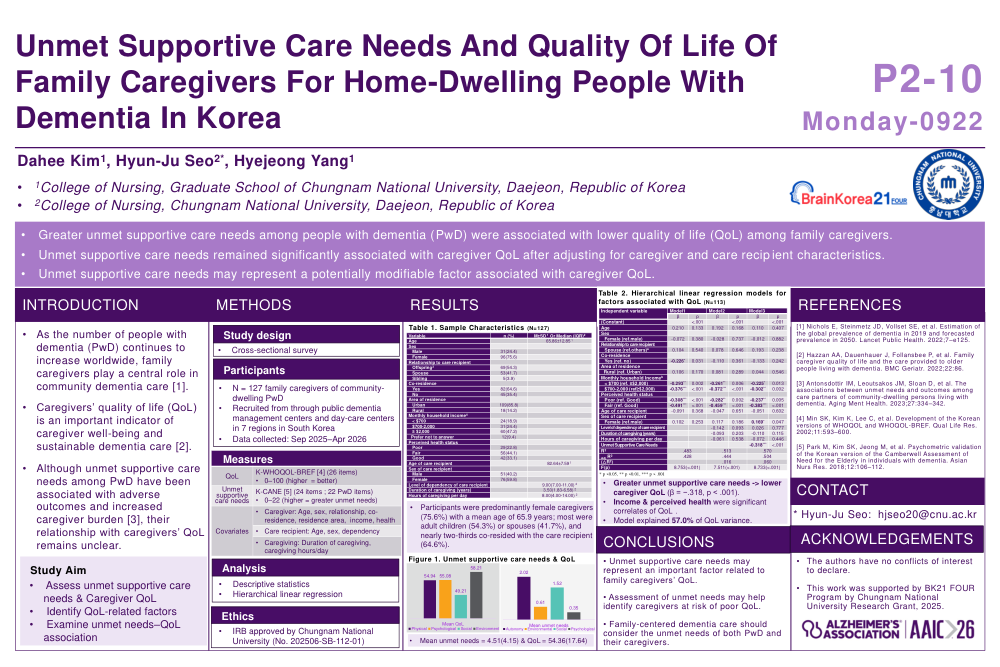
INTRODUCTION As the number of people with dementia (PwD) continues to increase worldwide, family caregivers play a central role in supporting community-dwelling PwD. Family caregivers' quality of life (QoL) is essential for sustainable dementia care. Although unmet supportive care needs among PwD have been linked to adverse outcomes and increased caregiver burden, their association with caregivers' QoL remains unclear. Therefore, this study aimed to examine caregiver-reported unmet supportive care needs of home-dwelling PwD and their association with family caregivers' QoL.
Methods A cross-sectional survey was conducted among 127 family caregivers of home -dwelling people with dementia recruited through public dementia management centers and day-care centers in seven regions of Korea between September 2025 and April 2026. Data were collected using self-administered questionnaires in paper-based or online formats. quality of life was measured using the Korean version of the WHOQOL-BREF, and unmet supportive care needs were assessed using the Korean version of the Camberwell Assessment of Need for the Elderly (K-CANE). Hierarchical multiple regression analysis was performed to examine factors associated with caregiver outcomes.
Results: The mean overall QoL score was 54.36 (SD = 17.64). Higher QoL was observed among caregivers who did not co-reside with the care recipient, had higher household income, reported better health status, and cared for female care recipients. In the final model, greater unmet supportive care needs were independently associated with lower QoL (β = −0.318, p < .001), explaining 57.0% of the variance.
Conclusion: Greater caregiver-reported unmet supportive care needs of people with dementia were associated with lower QoL among family caregivers. Routine assessment of unmet supportive care needs may help identify caregivers at risk of poor QoL and inform family-centered interventions to support sustainable community dementia care.
Keywords Dementia · Family caregivers · Unmet Supportive Care Needs · Quality of Life · A Cross-Sectional Study
Comments
Email is required but is not shown publicly.
Loading comments...