4,068 posters, 219 videos, 101 topics, 69 sessions, 14,365 authors, 6,128 institutions
ePostersLive by SciGen Technologies S.A. All rights reserved.
Alzheimer's Association International Conference 2026
July 12-15, 2026 | London, United Kingdom, and Online

7219
Does Routine Computer Use Affect Test Performance On Video-administered Cognitive Tests?
Poster Presenter
Authors
Affiliations
Part of Topic
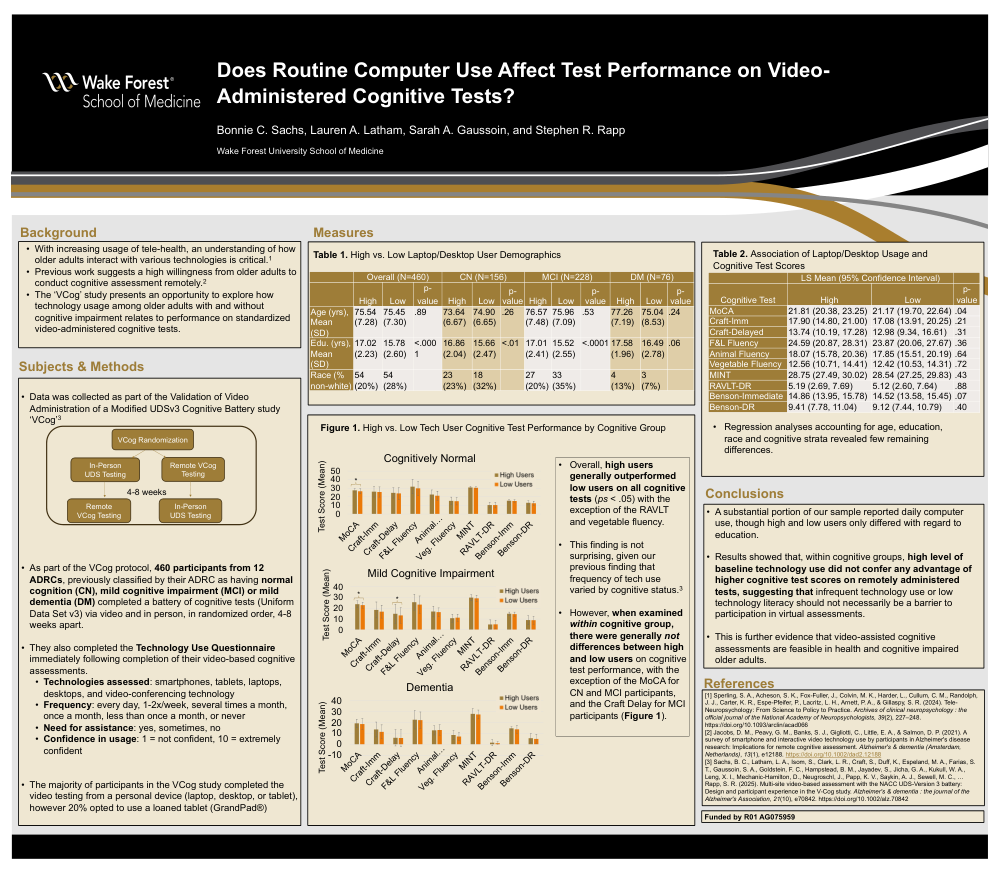
Background: With increasing usage of tele-health, an understanding of how older adults interact with various technologies is critical. The ‘VCog’ study presents an opportunity to explore how technology usage among older adults with and without cognitive impairment relates to performance on standardized video-administered cognitive tests.
Methods: Four-hundred-sixty participants, adjudicated previously as having normal cognition (NC), mild cognitive impairment (MCI) or mild dementia (DM), were enrolled in the VCog study from 12 Alzheimer’s Disease Research Centers (ADRCs). Participants completed technology use questionnaires assessing frequency of computer use, along with a video-adapted Uniform Data Set Version-3 (UDSv3) cognitive battery. Participants were divided into high (everyday usage) and low (less than everyday usage-to-no usage) users of technology. High and low users were compared on key demographic variables and performance on video-administered tests using ANOVA and chi-square tests. Subsequent regression models were used to examine variance accounted for by demographic variables and baseline cognitive diagnosis.
Results: Of 460 participants, 264 reported using a desktop or laptop daily and 196 reported less than daily use. Higher users tended to be slightly more educated (17.02 (2.2) vs 15.78 (2.6) yrs; p <.05), a trend that remained when examining participants within their cognitive strata. Participants did not otherwise differ on demographics (Table 1). In the overall sample, scores were higher among high users on 8 of 10 cognitive tests; however, when examined within cognitive strata, differences disappeared (Table 2). Regression analyses accounting for age, education, race and cognitive strata revealed few remaining differences (Table 3). Specifically, only MoCA scores differed between high and low users, with high users having slightly higher scores (MoCA = 21.8 vs 21.1; p=.04).
Conclusion: A substantial portion of our sample reported daily computer use, though high and low users only differed with regard to education. Results showed that, within cognitive groups, high level of baseline technology use did not confer any advantage of higher cognitive test scores on remotely administered tests. Infrequent technology use/low technology literacy should not necessarily be a barrier to participation in virtual assessments. This is further evidence that video-assisted cognitive assessments are feasible and valid.
Comments
Email is required but is not shown publicly.
Loading comments...