4,068 posters, 219 videos, 101 topics, 69 sessions, 14,365 authors, 6,128 institutions
ePostersLive by SciGen Technologies S.A. All rights reserved.
Alzheimer's Association International Conference 2026
July 12-15, 2026 | London, United Kingdom, and Online

4833
Personalized diagnostic pathway of Alzheimer’s disease through a multimodal diagnostic algorithm
Poster Presenter
Authors
Affiliations
Part of Topic
Recent regulatory approvals of anti-amyloid treatments and blood tests for AD necessitate changes in the current diagnostic pathway to improve the diagnostic rate and accuracy of AD diagnosis. We developed an algorithm for optimizing the diagnostic pathway at the individual patient level, taking into accountthe performance, cost and availability of new diagnostic test. Our clinical case was a 70-year-old female with MCI and known results from neurocognitive assessments. The diagnostic outcome of interest was cerebral amyloid pathology ascertained by amyloid PET.
A multimodal diagnostic algorithm was developed using data from ADNI participants, including plasma pTau 217 and cerebrospinal fluid (CSF) biomarkers (pTau181, Amyloid Beta 1-42). Multiple imputation by chained equations was used to create a synthetic dataset with complete test results conditional on known characteristics and any prior test results for a patient of interest. We recursively generated decision trees representing all potential sequences of diagnostic tests, their results and diagnostic outcomes, and selected the optimal path using a goal function that incorporates the costs of the different tests and the value of correct diagnosis.
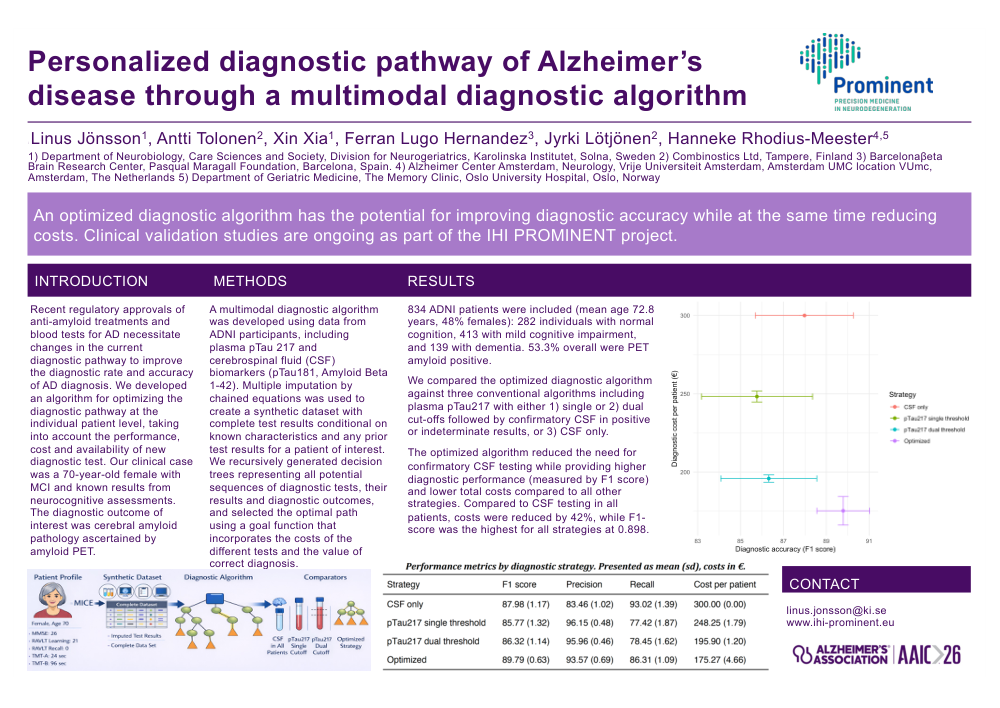
834 ADNI patients were included (mean age 72.8 years, 48% females): 282 individuals with normal cognition, 413 with mild cognitive impairment, and 139 with dementia. 53.3% overall were PET amyloid positive.
We compared the optimized diagnostic algorithm against three conventional algorithms including plasma pTau217 with either 1) single or 2) dual cut-offs followed by confirmatory CSF in positive or indeterminate results, or 3) CSF only.
The optimized algorithm reduced the need for confirmatory CSF testing while providing higher diagnostic performance (measured by F1 score) and lower total costs compared to all other strategies. Compared to CSF testing in all patients, costs were reduced by 42%, while F1-score was the highest for all strategies at 0.898.
Comments
Email is required but is not shown publicly.
Loading comments...