4,068 posters, 219 videos, 101 topics, 69 sessions, 14,365 authors, 6,128 institutions
ePostersLive by SciGen Technologies S.A. All rights reserved.
Alzheimer's Association International Conference 2026
July 12-15, 2026 | London, United Kingdom, and Online

5531
Alzheimer’S Care Access, And Amyloid Therapies In Alabama: Patient And Care Partner Perspectives
Poster Presenter
Part of Topic
Background:
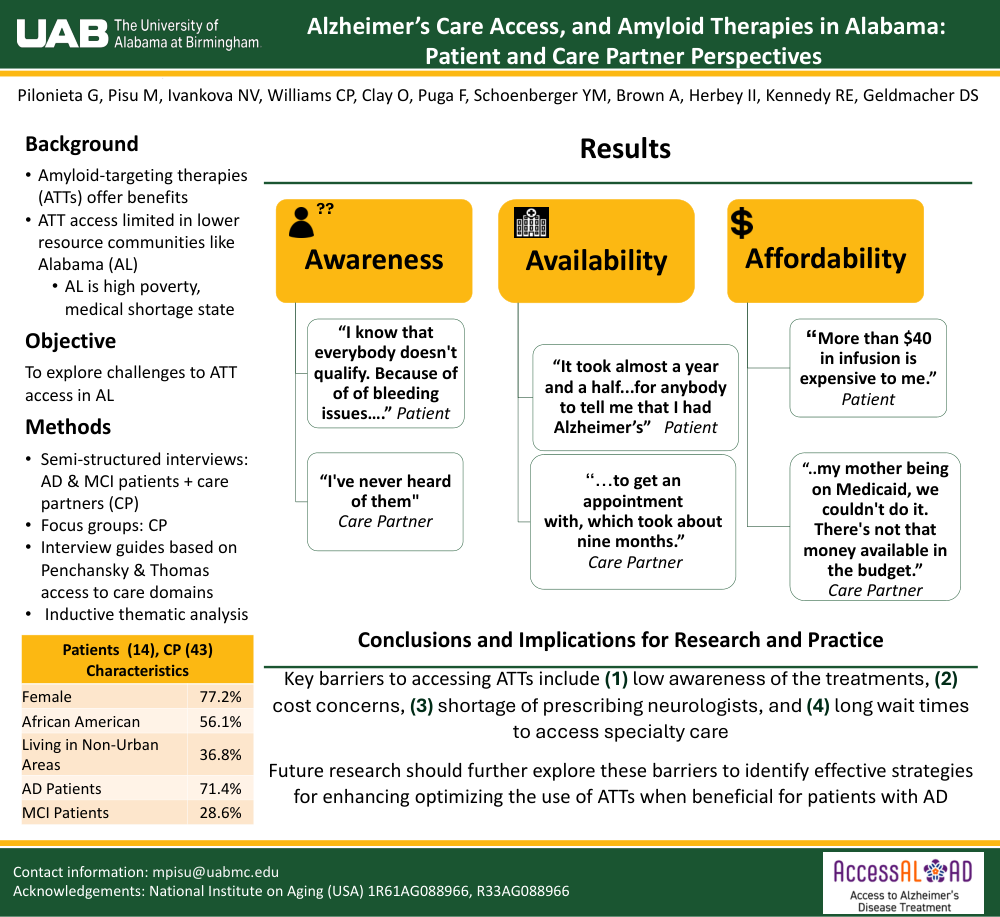
Alabama, one of the poorest US states, has one of the highest rates of Alzheimer’s disease (AD) among adults aged 65 and older, affecting approximately 12% of this population. AD is also the seventh leading cause of death in the state. Amyloid targeting therapies (ATTs) may be a tool to improve this health statistic, but their use may prove challenging for Alabama patients. As a part of a mixed methods study, we explored challenges to access and preferences for ATTs among people with AD dementia and Mild Cognitive Impairment (MCI) due AD, and people who care for a person with AD symptoms.
Methods:
We conducted semi-structured interviews with 10 AD patients, 4 MCI patients, and 27 care partners, and additional 3 focus groups with 16 care partners. Interview guides were developed based on the Penchansky and Thomas framework with questions focusing on barriers across six domains of access to care: awareness, availability, accessibility, affordability, accommodation and acceptability. Interviews and focus groups were recorded, transcribed verbatim, then verified and coded by the study team using inductive thematic analysis .
Results:
Participants were 77.2% female, 43.9% White and 56.1% African American, 63.2% from urban and 36.8% from non-urban areas. We identified barriers across all domains of access to AD care, including the availability of neurologists and transportation to care. Specific to ATTs, low awareness of ATTs and affordability concerns related to ATTs, limited access to and long waiting times for neurologists, and lack of local diagnostic and infusions centers, emerged as important barriers to their use.
Conclusions:
Our findings underscore significant challenges to the use of ATTs in Alabama, which is representative of the US Deep South as a whole. Results suggest that addressing these gaps may require increasing awareness and availability of specialists and treatment centers. Future research should further investigate these challenges to identify the best strategies to improve access to care and use of ATTs when appropriate and beneficial for AD patients.
Comments
Email is required but is not shown publicly.
Loading comments...