4,068 posters, 219 videos, 101 topics, 69 sessions, 14,365 authors, 6,128 institutions
ePostersLive by SciGen Technologies S.A. All rights reserved.
Alzheimer's Association International Conference 2026
July 12-15, 2026 | London, United Kingdom, and Online

6452
Performance Of Chulalongkorn Episodic Memory Score In Detecting Early Alzheimer’S Disease Defined By Pet In Amnestic Mci And Mild Dementia
Poster Presenter
Authors
Part of Topic
Background
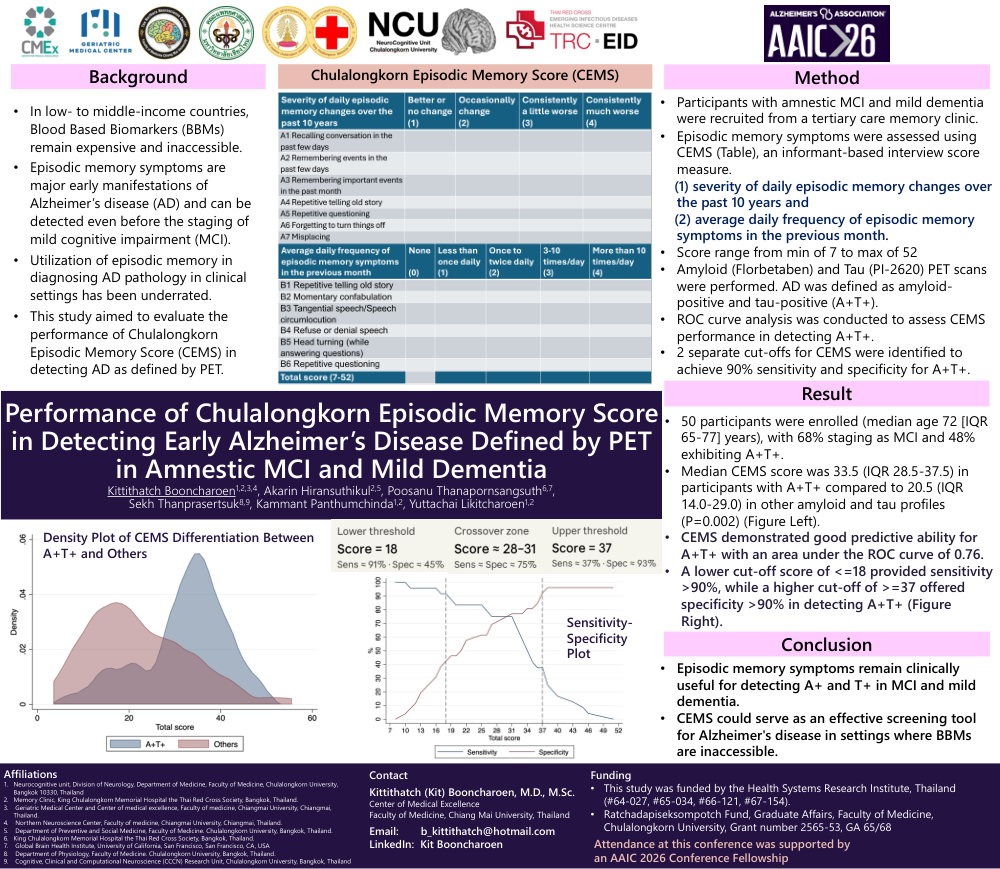
Blood biomarkers (BBMs) are increasingly valuable for screening and diagnosing Alzheimer’s disease (AD) in clinical practice. However, in low- to middle-income countries, BBMs remain expensive and inaccessible. Episodic memory symptoms are major early manifestations of AD and can be detected even before the staging of mild cognitive impairment (MCI). The utilization of episodic memory in diagnosing AD pathology in clinical settings has been underrated. This study aimed to evaluate the performance of Chulalongkorn Episodic Memory Score (CEMS) in detecting AD as defined by PET.
Method
Participants with amnestic MCI and mild dementia were recruited from a tertiary care memory clinic in Bangkok, Thailand. Episodic memory symptoms were assessed using CEMS (Figure 1), an informant-based interview score designed to measure (1) severity of daily episodic memory changes over the past 10 years and (2) average daily frequency of episodic memory symptoms in the previous month. Scores range from a minimum of 7 to a maximum of 52. Following data collection, amyloid (Florbetaben) and tau (PI-2620) PET scans were performed. AD was defined as amyloid-positive and tau-positive (A+T+), as all patients were symptomatic at presentation. ROC curve analysis was conducted to assess CEMS performance in detecting A+T+. Two separate cut-offs for CEMS were identified to achieve 90% sensitivity and specificity for A+T+.
Result
Fifty participants were enrolled (median age 72 [IQR 65-77] years), with thirty-four (68%) staging as MCI and twenty-four (48%) exhibiting A+T+. The median CEMS score was 33.5 (IQR 28.5-37.5) in participants with A+T+ compared to 20.5 (IQR 14.0-29.0) in other amyloid and tau profiles (P=0.002) (Figure 2). CEMS demonstrated good predictive ability for A+T+ with an area under the ROC curve of 0.76. A lower cut-off score of <=18 provided sensitivity >90%, while a higher cut-off of >=37 offered specificity >90% in detecting A+T+ (Figure 3).
Conclusion
Episodic memory symptoms remain clinically useful for detecting amyloid and tau pathology in MCI and mild dementia. CEMS could serve as an effective screening tool for Alzheimer's disease in settings where blood biomarkers are inaccessible.
Comments
Email is required but is not shown publicly.
Loading comments...