4,068 posters, 219 videos, 101 topics, 69 sessions, 14,365 authors, 6,128 institutions
ePostersLive by SciGen Technologies S.A. All rights reserved.
Alzheimer's Association International Conference 2026
July 12-15, 2026 | London, United Kingdom, and Online

10885
Social Determinants Of Brain Health In Frontotemporal Dementia In A Low- And Middle-income Country: Preliminary Evidence From Peru
Poster Presenter
Authors
Part of Topic
Background: Frontotemporal dementia (FTD) is a major cause of early-onset dementia, yet little is known about the social determinants of brain health (SDOH) influencing FTD in low- and middle-income countries (LMICs). Peru is characterized by pronounced socioeconomic inequities, rural-urban disparities, and cumulative social adversity, which may shape dementia vulnerability and outcomes. Understanding SDOH across the life course is critical to contextualizing FTD in LMIC settings. This study aimed to describe the social determinants of brain health among individuals with FTD in Peru.
Methods: We conducted a cross-sectional descriptive study in individuals with a clinical diagnosis of FTD as part of LimaFTD network, using an adapted Social Determinants of Brain Health Questionnaire (SDOBH-Q), comprising 15 sections and 80 items. The questionnaire assessed early-life conditions, education, income, migration, trauma, discrimination, stress, and access to health care. Descriptive statistics were used to summarize participant characteristics and SDOH exposures. The study was approved by the Ethics Committee of the Instituto Nacional de Ciencias Neurológicas (INCN), Peru.
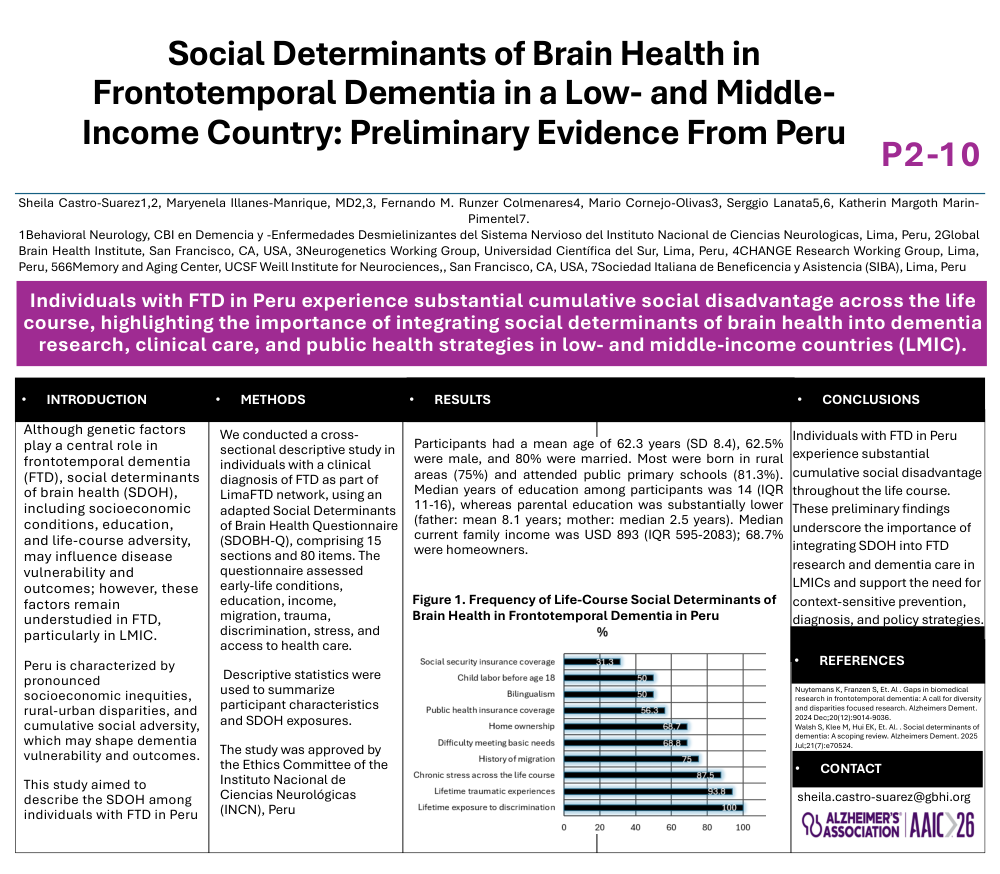
Results: Participants had a mean age of 62.3 years (SD 8.4), 62.5% were male, and 80% were married. Most were born in rural areas (75%) and attended public primary schools (81.3%). Median years of education among participants was 14 (IQR 11-16), whereas parental education was substantially lower (father: mean 8.1 years; mother: median 2.5 years). Median current family income was USD 893 (IQR 595-2083); 68.7% were homeowners. Public health insurance covered 56.3%, and 31.3% had social security insurance. Migration history was reported by 75%, and 50% were bilingual. High levels of cumulative social adversity were observed, including difficulty meeting basic needs (68.8%), traumatic experiences (93.8%), child labor before age 18 (50%), lifetime exposure to discrimination (100%), and chronic stress across the life course (87.5%).
Conclusion: Individuals with FTD in Peru experience substantial cumulative social disadvantage throughout the life course. These preliminary findings underscore the importance of integrating SDOH into FTD research and dementia care in LMICs and support the need for context-sensitive prevention, diagnosis, and policy strategies.
Comments
Email is required but is not shown publicly.
Loading comments...