4,068 posters, 219 videos, 101 topics, 69 sessions, 14,365 authors, 6,128 institutions
ePostersLive by SciGen Technologies S.A. All rights reserved.
Alzheimer's Association International Conference 2026
July 12-15, 2026 | London, United Kingdom, and Online

4187
Implementing Specialist-level Cognitive Evaluations In Primary Care Using A Structured Cognitive Assessment Visit
Poster Presenter
Authors
Jennifer Woodward, Jill K. Morris, Ryan Townley, Ryan Smith, Eric Vidoni, Lindsey Gillen, Allen Greiner, Clare Brady, Denton Shanks, Erin Corriveau, Joel Hake, Kalee Kirmer-Voss, Kate Rampon, Laurel Witt, Miles Crowley, Tahira Zufer, Janel Jones, Jeffrey M. Burns
Affiliations
Department of Family Medicine and Community Health, University of Kansas Health System, Kansas City, KS, USA, University of Kansas Health System, Kansas City, KS, USA, Department of Neurology, University of Kansas Health System, Kansas City, KS, USA, Department of Pediatrics, University of Kansas Health System, Kansas City, KS, USA
Part of Topic
Control/Tracking Number: 2026-A-4187-AAIC
Activity: Abstract
Current Date/Time: 1/12/2026 8:40:43 PM
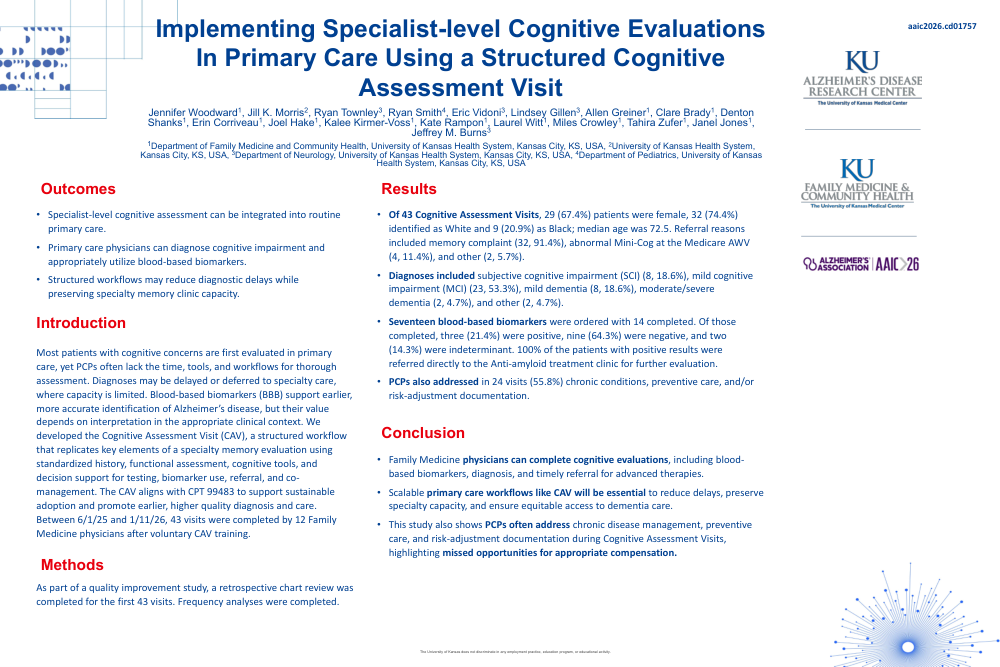
Implementing Specialist-level Cognitive Evaluations In Primary Care Using a Structured Cognitive Assessment Visit
Author Block: Jennifer Woodward1, Jill K. Morris2, Ryan Townley3, Ryan Smith4, Eric Vidoni5, Lindsey Gillen3, Allen Greiner1, Clare Brady1, Denton Shanks1, Erin Corriveau1, Joel Hake1, Kalee Kirmer-Voss1, Kate Rampon1, Laurel Witt1, Miles Crowley1, Tahira Zufer1, Janel Jones1, Jeffrey M. Burns5.
1Department of Family Medicine and Community Health, University of Kansas Health System, Kansas City, KS, USA, 2University of Kansas Health System, Kansas City, KS, USA, 3Department of Neurology, University of Kansas Health System, Kansas City, KS, USA, 4Department of Pediatrics, University of Kansas Health System, Kansas City, KS, USA, 3
Abstract:
Background: Most patients with cognitive concerns are first evaluated in primary care, yet PCPs often lack the time, tools, and workflows for thorough assessment. Diagnoses may be delayed or deferred to specialty care, where capacity is limited. Blood-based biomarkers (BBB) support earlier, more accurate identification of Alzheimer’s disease, but their value depends on interpretation in the appropriate clinical context. We developed the Cognitive Assessment Visit (CAV), a structured workflow that replicates key elements of a specialty memory evaluation using standardized history, functional assessment, cognitive tools, and decision support for testing, biomarker use, referral, and co-management. The CAV aligns with CPT 99483 to support sustainable adoption and promote earlier, higher quality diagnosis and care. Between 6/1/25 and 1/11/26, 43 visits were completed by 12 Family Medicine physicians after voluntary CAV training.
Methods: As part of a quality improvement study, a retrospective chart review was completed for the first 43 visits. Frequency analyses were completed.
Results: Of 43 CAVs, 29 (67.4%) patients were female, 32 (74.4%) identified as White and 9 (20.9%) as Black; median age was 72.5. Referral reasons included memory complaint (32, 91.4%), abnormal Mini‑Cog at the Medicare AWV (4, 11.4%), and other (2, 5.7%). Diagnoses included subjective cognitive impairment (SCI) (8, 18.6%), mild cognitive impairment (MCI) (23, 53.3%), mild dementia (8, 18.6%), moderate/severe dementia (2, 4.7%), and other (2, 4.7%). Seventeen BBB were ordered with 14 completed. Of those completed, three (21.4%) were positive, nine (64.3%) were negative, and two (14.3%) were indeterminant. 100% of the patients with positive results were referred directly to the Anti-amyloid treatment clinic for further evaluation. In 24 visits (55.8%), the PCP also addressed chronic conditions, preventive care, and/or risk-adjustment documentation.
Conclusion: Family Medicine physicians can complete cognitive evaluations, including BBB, diagnosis, and timely referral for advanced therapies. Scalable primary care workflows like CAV will be essential to reduce delays, preserve specialty capacity, and ensure equitable access to dementia care. This study also shows PCPs often address chronic disease management, preventive care, and risk-adjustment documentation during CAVs, highlighting missed opportunities for appropriate compensation.
Comments
Email is required but is not shown publicly.
Loading comments...