4,068 posters, 219 videos, 101 topics, 69 sessions, 14,365 authors, 6,128 institutions
ePostersLive by SciGen Technologies S.A. All rights reserved.
Alzheimer's Association International Conference 2026
July 12-15, 2026 | London, United Kingdom, and Online

3880
Sphingomyelin Affects Cognitive Function In Neurodegenerative Diseases Through Neuroinflammation
Poster Presenter
Part of Topic
Intioduction: With the rapid aging of the global population, neurodegenerative diseases (NDs) have become a major public health burden [1]. Emerging evidence suggests that sphingomyelin (SM), a major structural and signaling lipid, plays a critical role in neurodegeneration and cognitive impairment [2,3]. However, the relationships between SM species, neuroinflammatory processes, and cognitive decline in neurodegenerative diseases remain unclear.
Methods: Using two independent longitudinal cohorts, the Parkinson’s Progression Markers Initiative (PPMI) and the Alzheimer’s Disease Neuroimaging Initiative (ADNI), we employed multivariable regression, linear mixed-effects, mediation, and Cox proportional hazards models to examine both cross-sectional and longitudinal associations of cerebrospinal fluid (CSF) and plasma sphingomyelins with neurodegenerative and neuroinflammatory biomarkers, cognition, and incident AD risk.
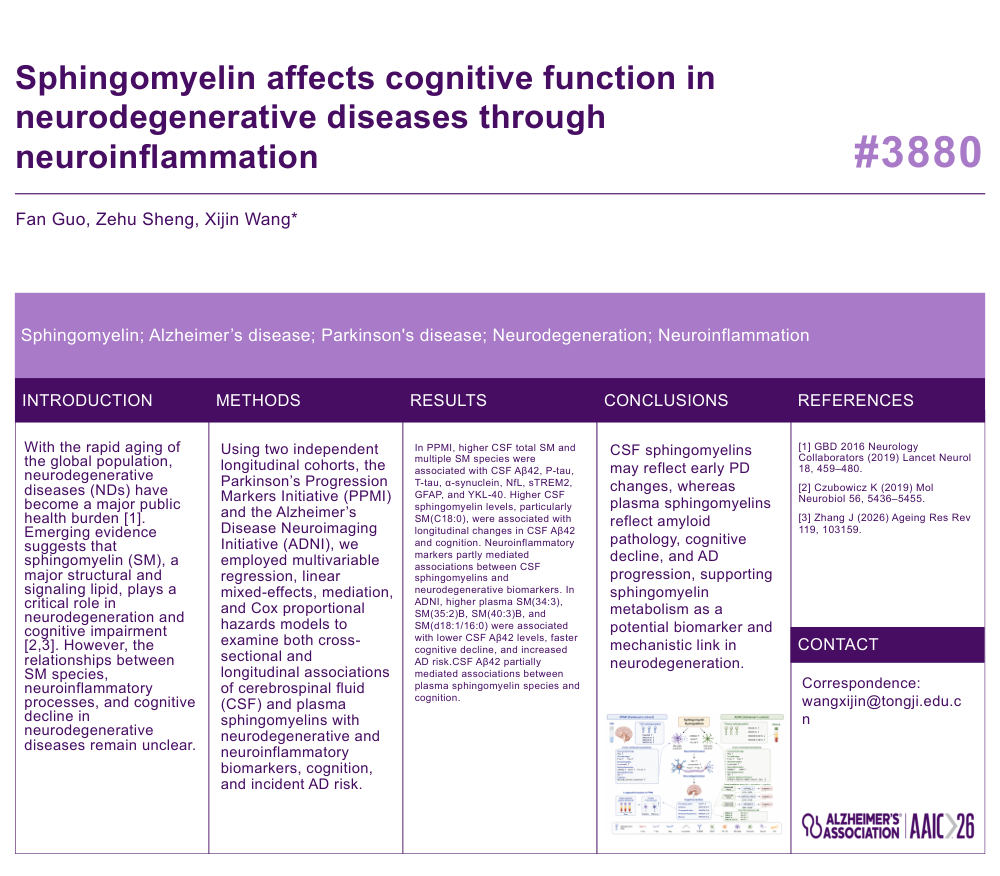
Results: In PPMI, higher CSF total SM and multiple SM species were associated with CSF Aβ42, P-tau, T-tau, α-synuclein, NfL, sTREM2, GFAP, and YKL-40. Higher CSF sphingomyelin levels, particularly SM(C18:0), were associated with longitudinal changes in CSF Aβ42 and cognition. Neuroinflammatory markers partly mediated associations between CSF sphingomyelins and neurodegenerative biomarkers. In ADNI, higher plasma SM(34:3), SM(35:2)B, SM(40:3)B, and SM(d18:1/16:0) were associated with lower CSF Aβ42 levels, faster cognitive decline, and increased AD risk.CSF Aβ42 partially mediated associations between plasma sphingomyelin species and cognition.
Conclusions: CSF sphingomyelins may reflect early PD changes, whereas plasma sphingomyelins reflect amyloid pathology, cognitive decline, and AD progression, supporting sphingomyelin metabolism as a potential biomarker and mechanistic link in neurodegeneration.
References: [1] GBD 2016 Neurology Collaborators (2019) Lancet Neurol 18, 459–480. [2] Czubowicz K (2019) Mol Neurobiol 56, 5436–5455. [3] Zhang J (2026) Ageing Res Rev 119, 103159.
Comments
Email is required but is not shown publicly.
Loading comments...