4,068 posters, 219 videos, 101 topics, 69 sessions, 14,365 authors, 6,128 institutions
ePostersLive by SciGen Technologies S.A. All rights reserved.
Alzheimer's Association International Conference 2026
July 12-15, 2026 | London, United Kingdom, and Online

2075
Detecting Core Features Of Dementia With Lewy Bodies Using Natural Language Processing
Poster Presenter
Part of Topic
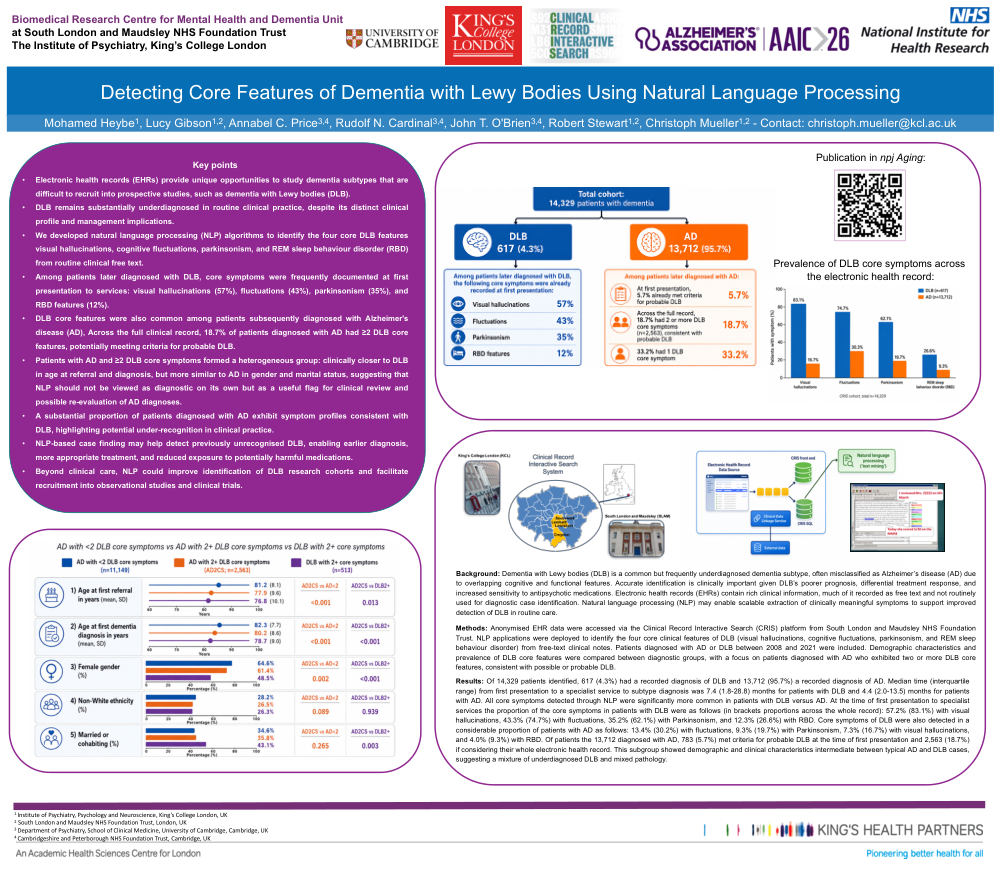
Detecting Core Features of Dementia with Lewy Bodies Using Natural Language Processing
Key points
Background: Dementia with Lewy bodies (DLB) is a common but frequently underdiagnosed dementia subtype, often misclassified as Alzheimer’s disease (AD) due to overlapping cognitive and functional features. Accurate identification is clinically important given DLB’s poorer prognosis, differential treatment response, and increased sensitivity to antipsychotic medications. Electronic health records (EHRs) contain rich clinical information, much of it recorded as free text and not routinely used for diagnostic case identification. Natural language processing (NLP) may enable scalable extraction of clinically meaningful symptoms to support improved detection of DLB in routine care.
Methods: Anonymised EHR data were accessed via the Clinical Record Interactive Search (CRIS) platform from South London and Maudsley NHS Foundation Trust. NLP applications were deployed to identify the four core clinical features of DLB (visual hallucinations, cognitive fluctuations, parkinsonism, and REM sleep behaviour disorder) from free-text clinical notes. Patients diagnosed with AD or DLB between 2008 and 2021 were included. Demographic characteristics and prevalence of DLB core features were compared between diagnostic groups, with a focus on patients diagnosed with AD who exhibited two or more DLB core features, consistent with possible or probable DLB.
Results: Of 14,329 patients identified, 617 (4.3%) had a recorded diagnosis of DLB and 13,712 (95.7%) a recorded diagnosis of AD. Median time (interquartile range) from first presentation to a specialist service to subtype diagnosis was 7.4 (1.8-28.8) months for patients with DLB and 4.4 (2.0-13.5) months for patients with AD. All core symptoms detected through NLP were significantly more common in patients with DLB versus AD. At the time of first presentation to specialist services the proportion of the core symptoms in patients with DLB were as follows (in brackets proportions across the whole record): 57.2% (83.1%) with visual hallucinations, 43.3% (74.7%) with fluctuations, 35.2% (62.1%) with Parkinsonism, and 12.3% (26.6%) with RBD. Core symptoms of DLB were also detected in a considerable proportion of patients with AD as follows: 13.4% (30.2%) with fluctuations, 9.3% (19.7%) with Parkinsonism, 7.3% (16.7%) with visual hallucinations, and 4.0% (9.3%) with RBD. Of patients the 13,712 diagnosed with AD, 783 (5.7%) met criteria for probable DLB at the time of first presentation and 2,563 (18.7%) if considering their whole electronic health record. This subgroup showed demographic and clinical characteristics intermediate between typical AD and DLB cases, suggesting a mixture of underdiagnosed DLB and mixed pathology.
Comments
Email is required but is not shown publicly.
Loading comments...