4,068 posters, 219 videos, 101 topics, 69 sessions, 14,365 authors, 6,128 institutions
ePostersLive by SciGen Technologies S.A. All rights reserved.
Alzheimer's Association International Conference 2026
July 12-15, 2026 | London, United Kingdom, and Online

9880
Preliminary Outcomes Of A Culinary Medicine Intervention To Promote MIND Diet Adherence In Older Adults With Type 2 Diabetes
Poster Presenter
Authors
Mirnova E. Ceide, Atul Bhattiprolu, Isabelle Ilan, Akhil Upad, Julia Caldropoli, Katie Burchfield, Jessica Shapiro, Lilian Correa, Samantha Johnson, Paola Ogando, Mairim Melecio-Vazquez, Jessica L. Zwerling
Affiliations
Department of Psychiatry and Behavioral Sciences, Albert Einstein College of Medicine, Bronx, New York, USA, Medical Degree Program, Albert Einstein College of Medicine, Bronx, New York, USA, Registered Dietician and Certified Diabetes Educator, Independent Contractor, Registered Dietician, Independent Contractor, Department of Medicine, Montefiore Einstein, Bronx, New York, USA, Department of Neurology, Montefiore Einstein, Bronx, New York, USA, Department of Neurology, Albert Einstein College of Medicine, Bronx, New York, USA
Part of Topic
Video
Background: Type 2 Diabetes (T2DM) is one of the 14 modifiable risk factors highlighted in the 2024 Lancet Commission on Dementia Prevention. Even prediabetes was associated with cognitive decline and smaller global brain volume. In a review of the Mediterranean diet, a whole food plant forward dietary pattern; adherence to this pattern was associated with lower HbA1c levels. The Mediterranean-DASH diet intervention for neurodegenerative delay (MIND) diet has been linked to improved cognitive function in older adults. Culinary medicine combines the art of preparing and presenting food with the science of medicine to target underlying disease processes, by promoting more whole foods, skill building, and self-efficacy. The aim of this study is to evaluate the effect of a 5-weeks culinary medicine intervention to promote the MIND diet and improve diabetes management, mood, and cognition in older adults with T2DM.
Methods: The Strengthening, Engaging, and Empowering Dyads Through Nutrition & Wellness pilot (SEED) was conducted between 2024-2025. Each session consisted of 20 mins of nutrition education by a registered dietician, 40 mins of culinary demonstration by a culinary medicine provider, and 30 min for food tasting and socialization. The effect of the SEED pilot on MIND diet adherence, diabetes management, depression, and cognition was evaluated using paired samples T-Tests.
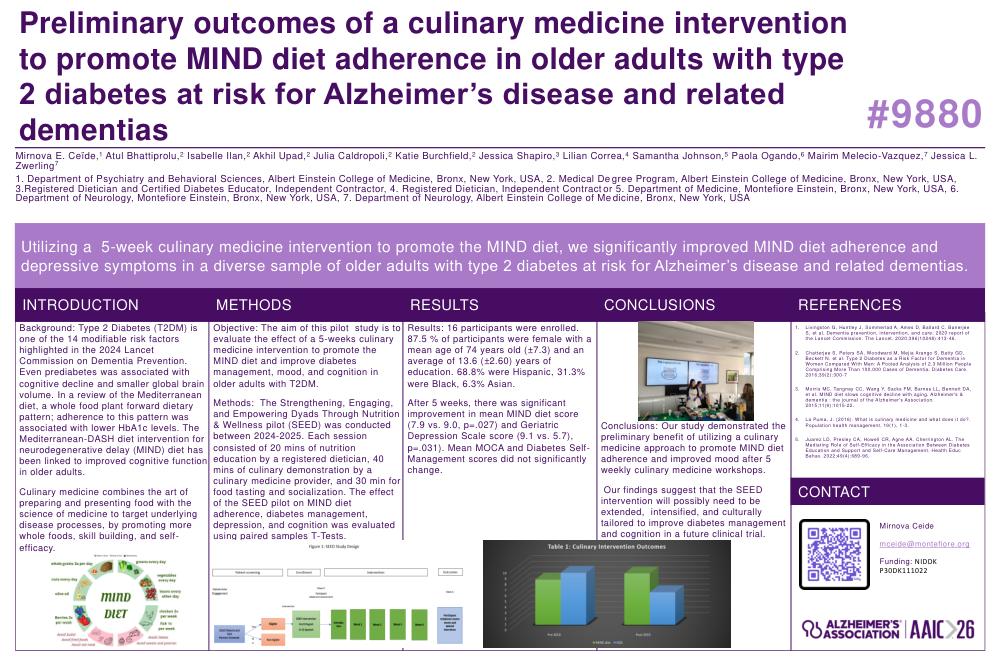
Results: 16 participants were enrolled. 87.5 % of participants were female with a mean age of 74 years old (±7.3) and an average of 13.6 (±2.60) years of education. 68.8% were Hispanic, 31.3% were Black, 6.3% Asian. After 5 weeks, there was significant improvement in mean MIND diet score (7.9 vs. 9.0, p=.027) and Geriatric Depression Scale score (9.1 vs. 5.7), p=.031). Mean MOCA and Diabetes Self-Management scores did not significantly change.
Conclusions: Our study demonstrated the preliminary benefit of utilizing a culinary medicine approach to promote MIND diet adherence and improved mood after 5 weekly culinary medicine workshops. Our findings suggest that the SEED intervention will possibly need to be extended, intensified, and culturally tailored to improve diabetes management and cognition for a future randomized controlled trial.
Comments
Email is required but is not shown publicly.
Loading comments...