4,068 posters, 219 videos, 101 topics, 69 sessions, 14,365 authors, 6,128 institutions
ePostersLive by SciGen Technologies S.A. All rights reserved.
Alzheimer's Association International Conference 2026
July 12-15, 2026 | London, United Kingdom, and Online

1608
A Qualitative Study Of The Dementia-care Experiences And Educational Needs Of General Practitioners (GP) And GP Team Members In Lithuania
Poster Presenter
Part of Topic
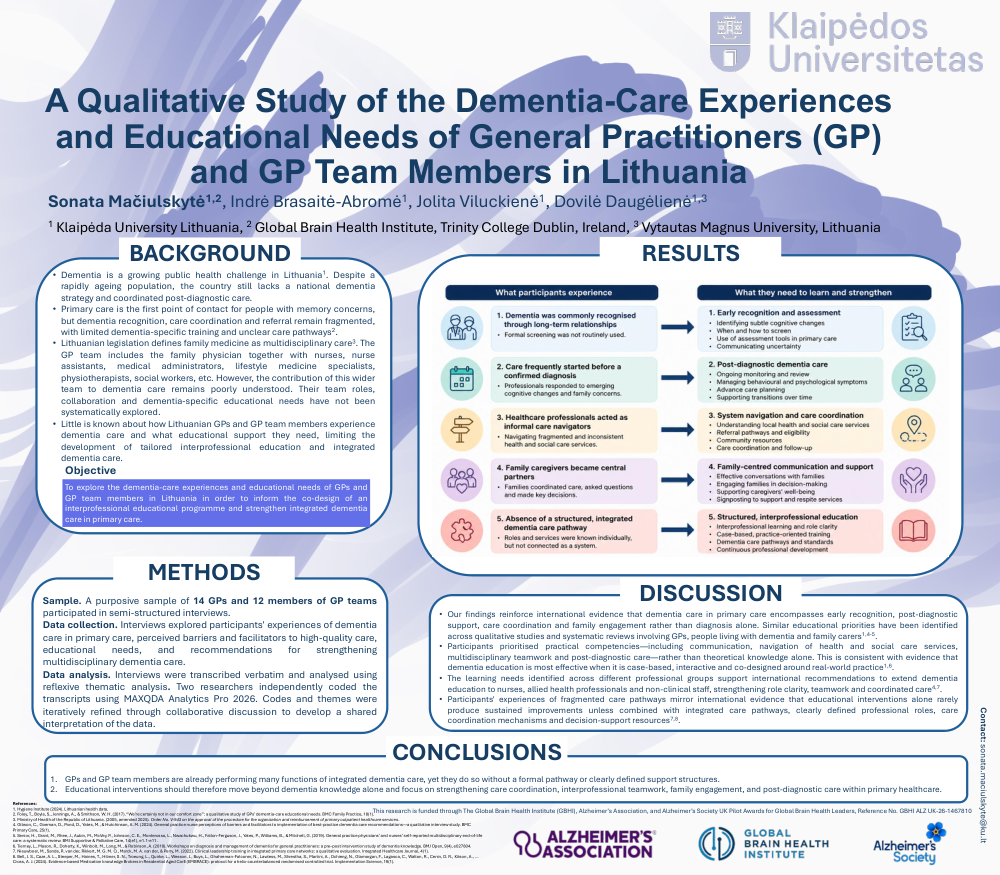
Background: Dementia prevalence is rapidly increasing in Lithuania, yet primary healthcare remains underprepared to address the complex clinical, psychosocial, and coordination needs of people living with dementia and their families. General practitioners (GPs) and GP team members play a central role in early detection, ongoing management, and post-diagnostic support; however, Lithuania currently lacks a national dementia strategy, standardized care pathways, and structured dementia-specific training for primary care teams. International evidence suggests that interprofessional education and clearly defined care pathways can significantly improve dementia care quality, but little is known about the specific educational needs and systemic challenges faced by primary care professionals in the Lithuanian context.
Methods: This qualitative study is part of a broader project aimed at developing a tailored interprofessional dementia education intervention for Lithuanian general practice. Semi-structured interviews are being conducted with GPs and GP team members, including nurses, social workers, and care coordinators. The study explores experiences of dementia diagnosis and management, interdisciplinary collaboration, communication with patients and family caregivers, perceived system barriers, and unmet educational needs. Interviews are audio-recorded, transcribed verbatim, and analyzed using reflexive thematic analysis, combining inductive and deductive coding. Ethical approval has been obtained, and recruitment is ongoing at the time of abstract submission.
Results: Preliminary analysis indicates several emerging themes. Participants from pilot interviews describe uncertainty and lack of confidence in dementia diagnosis and progression management, particularly regarding behavioral and psychological symptoms of dementia. Fragmented care pathways, limited access to specialist support, and weak integration between health and social care services are reported as major systemic barriers. Both GPs and team members highlight insufficient training in post-diagnostic support, caregiver communication, and role clarity within the multidisciplinary team. Strong interest is expressed in practical, case-based, and role-specific dementia education, preferably delivered through flexible blended-learning formats.
Conclusion: Early findings suggest substantial gaps in dementia-related knowledge, skills, and system support within Lithuanian primary healthcare. Addressing these gaps through context-specific, interprofessional dementia education may strengthen care coordination, professional confidence, and patient and caregiver experiences. Final results will inform the development of a scalable educational intervention and provide evidence to support future national dementia care strategies.
Comments
Email is required but is not shown publicly.
Loading comments...