4,068 posters, 219 videos, 101 topics, 69 sessions, 14,365 authors, 6,128 institutions
ePostersLive by SciGen Technologies S.A. All rights reserved.
Alzheimer's Association International Conference 2026
July 12-15, 2026 | London, United Kingdom, and Online

1127
Patient Experiences Of Persons Living With Dementia With Limited English Proficiency: Implications For Palliative Care
Poster Presenter
Authors
Leah Estrada, Nathan Goldstein, Lihua Li, Karen McKendrick, Melissa Aldridge
Affiliations
Department of Geriatrics and Palliative Medicine, Icahn School of Medicine at Mount Sinai; Center for Nursing Research and Innovation, Mount Sinai Hospital; Center for Improving Care Delivery for the Aging, University of Pennsylvania Leonard Davis Institute;, Department of Medicine, Geisel School of Medicine at Dartmouth; Dartmouth Health, Department of Geriatrics and Palliative Medicine, Icahn School of Medicine at Mount Sinai
Part of Topic
Background: High-quality dementia care requires effective, person-centered communication between clinicians and persons living with dementia (PLWD). Language barriers may inhibit communication and contribute to disparities in care quality. Palliative care, with its emphasis on person-centered care aligned with patient goals, may mitigate these challenges. The aim of this study was to describe patient-reported experiences among limited English proficient (LEP) and non-LEP PLWD.
Methods: We conducted a cross-sectional study of a representative sample of U.S. Medicare beneficiaries from the 2022 Medicare Current Beneficiary Survey (MCBS). We identified PLWD using the Bynum-Standard 1-year algorithm for identifying Alzheimer’s disease and related dementias, MCBS survey questions, and prescription drug use. We identified LEP individuals through MCBS survey questions on English language proficiency. We assessed patient experience with providers (e.g., asked about life, explained things clearly). All analyses incorporate MCBS survey weight and design variables.
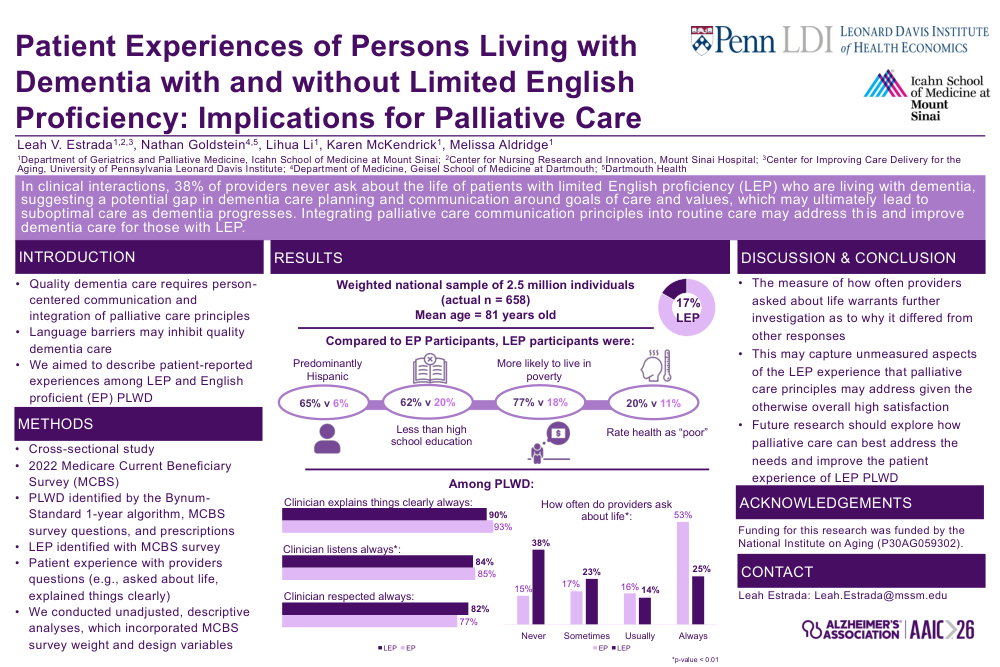
Results: We identified 658 PLWD, of whom 13.6% had LEP. Mean participant age was 81.1 years. LEP participants were predominantly Hispanic (65.3%) and had less than a high school education (62.3%). Compared to non-LEP participants, those with LEP were more likely to live in poverty (76.8% v. 18.0%; p<0.001) and rate their health as “poor” (19.5% v. 11.1%, p<0.001). In unadjusted analyses, both groups reported favorable patient experiences: 83.7% of LEP v. 84.6% of non-LEP stated that the provider “always” listens, and over 80% reported the provider “always” “explains things clearly” and “respected participant”. One exception was how often the provider “asks about life” where 38.4% of LEP v. 14.6% of non-LEP stated that the provider “never asks about life”, while 24.6% of LEP v. 52.6% of non-LEP reported provider “always asks about life” (p<0.001).
Conclusion: Although LEP and non-LEP PLWD reported similar patient experiences with providers, the measure of when “asked about it life” warrants further investigation as to why it differed from other responses. This may capture unmeasured aspects of the LEP patient experience that palliative care may be able to address given the otherwise overall high satisfaction. Future research should explore how palliative care can best address the needs and improve the patient experience of LEP PLWD.
Comments
Email is required but is not shown publicly.
Loading comments...