4,068 posters, 219 videos, 101 topics, 69 sessions, 14,365 authors, 6,128 institutions
ePostersLive by SciGen Technologies S.A. All rights reserved.
Alzheimer's Association International Conference 2026
July 12-15, 2026 | London, United Kingdom, and Online

1375
A Culturally Adapted Cognitive Activation Program For Cognitive Impairment In Older Adults
Poster Presenter
Authors
Affiliations
1Division of Geriatric Psychiatry, Department of Psychiatry, MacKay Memorial Hospital, Taipei, Taiwan. 2 Dementia Prevention and Treatment Center, MacKay Memorial Hospital, Taipei, Taiwan. 3 Dementia Prevention and Treatment Center, MacKay Memorial Hospital, Taipei, Taiwan, 4 Department of Research and Development, Taoyuan General Hospital, Ministry of Health and Welfare, Taoyuan, Taiwan. 5 Department of Nursing, Taoyuan General Hospital, Ministry of Health and Welfare, Taoyuan, Taiwan., 6 Institute of Long-Term Care, MacKay Medical University, New Taipei City, Taiwan
Part of Topic
Dementia Care and Psychosocial Factors from Taiwan
Title: A Culturally Adapted Cognitive Activation Program for Older Adults with Cognitive Impairment in Taiwan
Chen-Ju Lin1, 2, 3, Shu-Hui Wu4, 5, Min-Li Yeh6
1 Division of Geriatric Psychiatry, Department of Psychiatry, MacKay Memorial Hospital, Taipei, Taiwan
2 Dementia Prevention and Treatment Center, MacKay Memorial Hospital, Taipei, Taiwan
3 Department of Medicine, MacKay Medical University, New Taipei City, Taiwan
4 Department of Research and Development, Taoyuan General Hospital, Ministry of Health and Welfare, Taoyuan, Taiwan
5 Department of Nursing, Taoyuan General Hospital, Ministry of Health and Welfare, Taoyuan, Taiwan
6 Institute of Long-Term Care, MacKay Medical University, New Taipei City, Taiwan
Abstract
Background
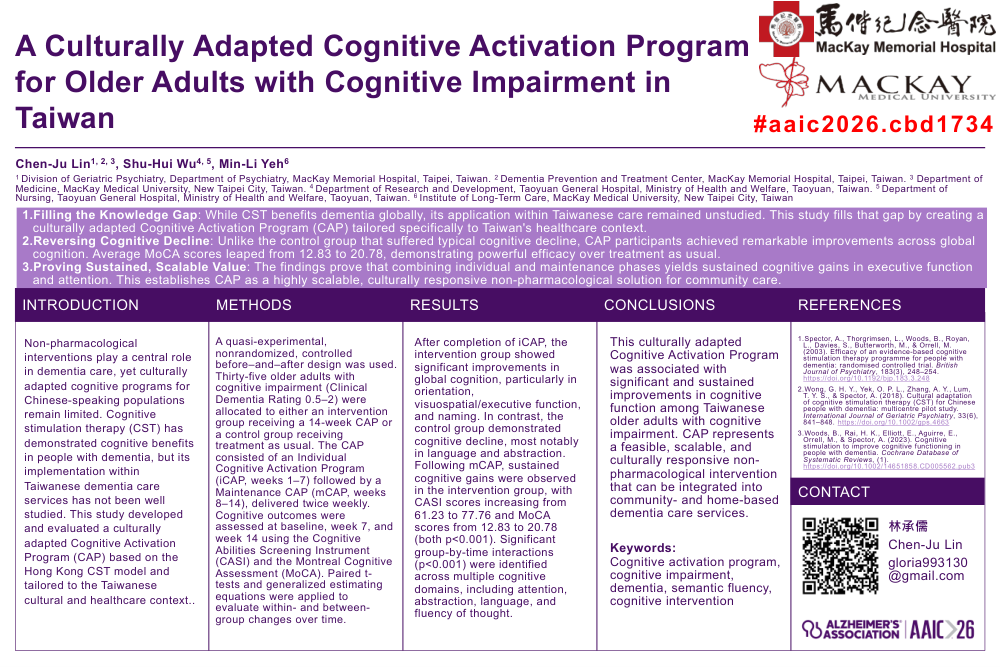
Non-pharmacological interventions play a central role in dementia care, yet culturally adapted cognitive programs for Chinese-speaking populations remain limited. Cognitive stimulation therapy (CST) has demonstrated cognitive benefits in people with dementia, but its implementation within Taiwanese dementia care services has not been well studied. This study developed and evaluated a culturally adapted Cognitive Activation Program (CAP) based on the Hong Kong CST model and tailored to the Taiwanese cultural and healthcare context.
Methods
A quasi-experimental, nonrandomized, controlled before–and–after design was used. Thirty-five older adults with cognitive impairment (Clinical Dementia Rating 0.5–2) were allocated to either an intervention group receiving a 14-week CAP or a control group receiving treatment as usual. The CAP consisted of an Individual Cognitive Activation Program (iCAP, weeks 1–7) followed by a Maintenance CAP (mCAP, weeks 8–14), delivered twice weekly. Cognitive outcomes were assessed at baseline, week 7, and week 14 using the Cognitive Abilities Screening Instrument (CASI) and the Montreal Cognitive Assessment (MoCA). Paired t-tests and generalized estimating equations were applied to evaluate within- and between-group changes over time.
Results
After completion of iCAP, the intervention group showed significant improvements in global cognition, particularly in orientation, visuospatial/executive function, and naming. In contrast, the control group demonstrated cognitive decline, most notably in language and abstraction. Following mCAP, sustained cognitive gains were observed in the intervention group, with CASI scores increasing from 61.23 to 77.76 and MoCA scores from 12.83 to 20.78 (both p<0.001). Significant group-by-time interactions (p<0.001) were identified across multiple cognitive domains, including attention, abstraction, language, and fluency of thought.
Conclusions
This culturally adapted Cognitive Activation Program was associated with significant and sustained improvements in cognitive function among Taiwanese older adults with cognitive impairment. CAP represents a feasible, scalable, and culturally responsive non-pharmacological intervention that can be integrated into community- and home-based dementia care services.
Keywords:
Cognitive activation program, cognitive impairment, dementia, semantic fluency, cognitive intervention
Reference:
- Spector, A., Thorgrimsen, L., Woods, B., Royan, L., Davies, S., Butterworth, M., & Orrell, M. (2003). Efficacy of an evidence-based cognitive stimulation therapy programme for people with dementia: randomised controlled trial. British Journal of Psychiatry, 183(3), 248–254. https://doi.org/10.1192/bjp.183.3.248
- Wong, G. H. Y., Yek, O. P. L., Zhang, A. Y., Lum, T. Y. S., & Spector, A. (2018). Cultural adaptation of cognitive stimulation therapy (CST) for Chinese people with dementia: multicentre pilot study. International Journal of Geriatric Psychiatry, 33(6), 841–848. https://doi.org/10.1002/gps.4663
- Woods, B., Rai, H. K., Elliott, E., Aguirre, E., Orrell, M., & Spector, A. (2023). Cognitive stimulation to improve cognitive functioning in people with dementia. Cochrane Database of Systematic Reviews, (1). https://doi.org/10.1002/14651858.CD005562.pub3
Comments
Email is required but is not shown publicly.
Loading comments...