4,068 posters, 219 videos, 101 topics, 69 sessions, 14,365 authors, 6,128 institutions
ePostersLive by SciGen Technologies S.A. All rights reserved.
Alzheimer's Association International Conference 2026
July 12-15, 2026 | London, United Kingdom, and Online

11043
Influence Of Dementia Duration And Apoe4 Genotype On Brain Weight Indices In Psen1 E280a Mutation Carriers
Poster Presenter
Authors
Brian Vicaño Metaute, María José Hidalgo Ramírez, Juan Camilo Becerra Mateus, Alejandro Ardila Gil, Jonathan Ruiz-Triviño, Jan Karlo Rodas, Johana Gomez Ramirez, David Fernando Aguillón Niño, Carlos Andrés Villegas Lanau
Affiliations
Neurosciences Group of Antioquia, School of Medicine, University of Antioquia, Medellín, Neurosciences Group of Antioquia, School of Medicine, University of Antioquia, Medellín, Colombia
Part of Topic
Backgroung
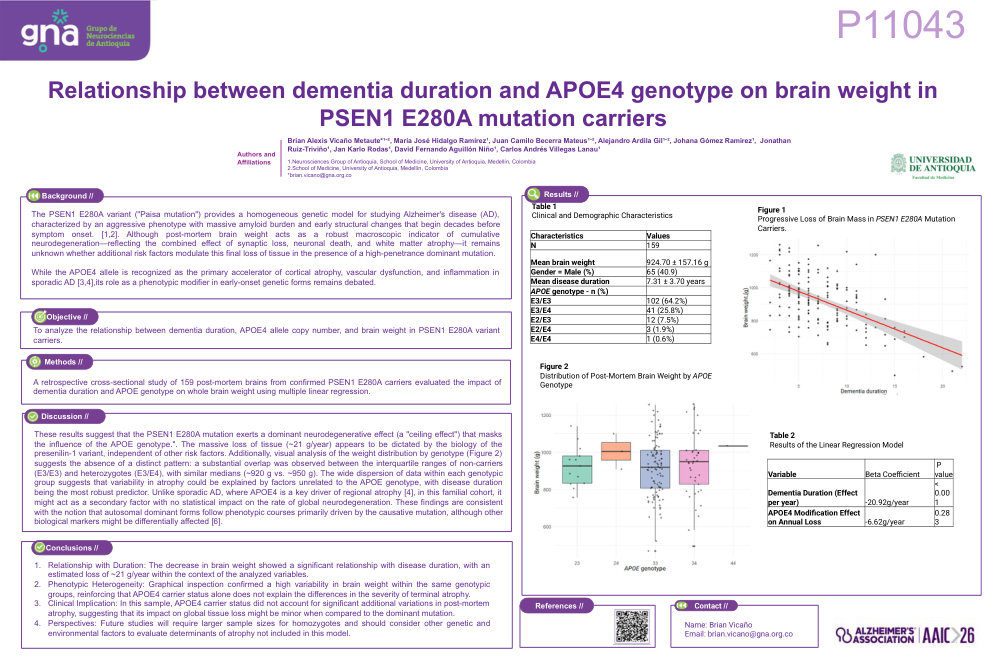
The PSEN1 E280A variant ("Paisa mutation") provides a homogeneous genetic model for studying Alzheimer's disease (AD), characterized by an aggressive phenotype with massive amyloid burden and early structural changes that begin decades before symptom onset. [1,2]. Although post-mortem brain weight acts as a robust macroscopic indicator of cumulative neurodegeneration—reflecting the combined effect of synaptic loss, neuronal death, and white matter atrophy—it remains unknown whether additional risk factors modulate this final loss of tissue in the presence of a high-penetrance dominant mutation. While the APOE4 allele is recognized as the primary accelerator of cortical atrophy, vascular dysfunction, and inflammation in sporadic AD [3,4],its role as a phenotypic modifier in early-onset genetic forms remains debated.
Objetive
To analyze the relationship between dementia duration, APOE4 allele copy number, and brain weight in PSEN1 E280A variant carriers.
Methods
A retrospective cross-sectional study of 159 post-mortem brains from confirmed PSEN1 E280A carriers evaluated the impact of dementia duration and APOE genotype on whole brain weight using multiple linear regression.
Discussion
These results suggest that the PSEN1 E280A mutation exerts a dominant neurodegenerative effect (a "ceiling effect") that masks the influence of the APOE genotype.". The massive loss of tissue (~21 g/year) appears to be dictated by the biology of the presenilin-1 variant, independent of other risk factors. Additionally, visual analysis of the weight distribution by genotype (Figure 2) suggests the absence of a distinct pattern: a substantial overlap was observed between the interquartile ranges of non-carriers (E3/E3) and heterozygotes (E3/E4), with similar medians (~920 g vs. ~950 g). The wide dispersion of data within each genotypic group suggests that variability in atrophy could be explained by factors unrelated to the APOE genotype, with disease duration being the most robust predictor. Unlike sporadic AD, where APOE4 is a key driver of regional atrophy [4], in this familial cohort, it might act as a secondary factor with no statistical impact on the rate of global neurodegeneration. These findings are consistent with the notion that autosomal dominant forms follow phenotypic courses primarily driven by the causative mutation, although other biological markers might be differentially affected [6].
Conclusions
1. Relationship with Duration: The decrease in brain weight showed a significant relationship with disease duration, with an estimated loss of ~21 g/year within the context of the analyzed variables. 2. Phenotypic Heterogeneity: Graphical inspection confirmed a high variability in brain weight within the same genotypic groups, reinforcing that APOE4 carrier status alone does not explain the differences in the severity of terminal atrophy. 3. Clinical Implication: In this sample, APOE4 carrier status did not account for significant additional variations in post-mortem atrophy, suggesting that its impact on global tissue loss might be minor when compared to the dominant mutation. 4. Perspectives: Future studies will require larger sample sizes for homozygotes and should consider other genetic and environmental factors to evaluate determinants of atrophy not included in this model.
Comments
Email is required but is not shown publicly.
Loading comments...