4,068 posters, 219 videos, 101 topics, 69 sessions, 14,365 authors, 6,128 institutions
ePostersLive by SciGen Technologies S.A. All rights reserved.
Alzheimer's Association International Conference 2026
July 12-15, 2026 | London, United Kingdom, and Online

1395
Correlation Between Functional Dependence And Semantic Tasks In Brazilians With Mild Alzheimer's Disease: An Exploratory Study
Poster Presenter
Authors
Part of Topic
Background
Functional dependence in Alzheimer's disease (AD) refers to the loss of ability to perform daily activities, while semantic biomarkers help track cognitive decline. In Brazil, these factors are crucial for understanding mild AD progression. Thus, this study aimed to correlate the relationship between functional dependence and semantic tasks and metrics in Brazilians with mild AD.
Method
Individuals over 60 years, diagnosed with AD according to NINCDS-ADRDA criteria and rated CDR 1, attending in a dementia ambulatory, were invited to participate in the study. During data collection, participants completed a socioeconomic questionnaire, the Addenbrooke’s Cognitive Examination Revised (ACE-R), a semantic verbal fluency task, and the Brazilian functional dependence scale. Semantic biomarkers (granularity and ongoing semantic variability) were obtained through spontaneous and semi-spontaneous speech tasks using the Toolkit to Examine Lifelike Language (TELL) under standardized recording conditions. Spearman’s correlation assessed associations between variables, and linear regression models were performed.
Result
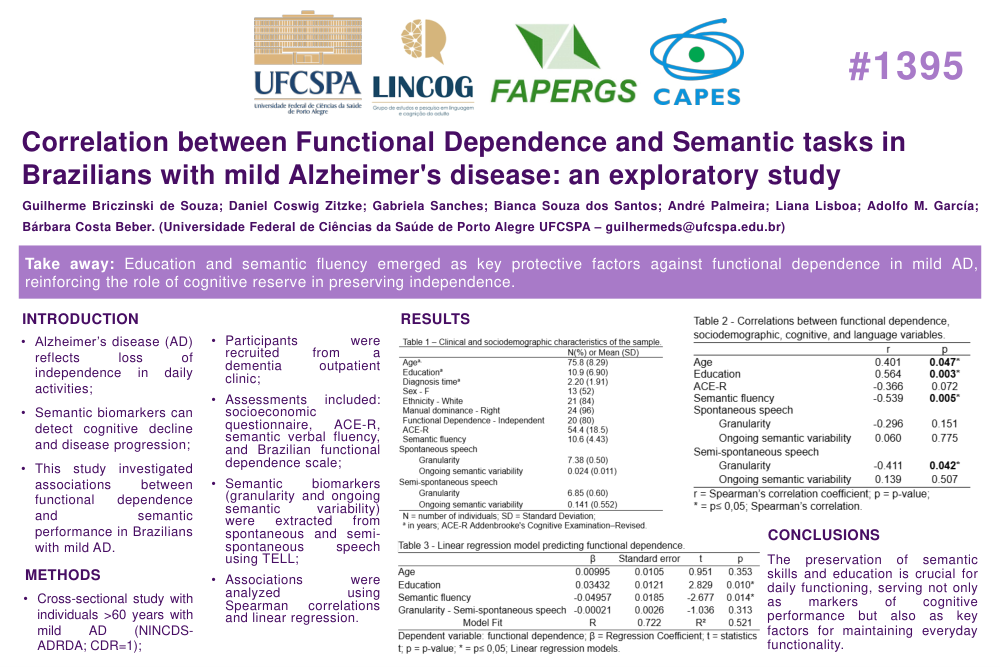
We obtained 25 individuals with mild AD (mean age 75.8 ± 8.29 years; education 10.9 ± 6.9 years). Mean time since diagnosis was 2.20 ± 1.91 years, and the average ACE-R score was 54.4 ± 18.5 (Table 1). The sample was mostly female (52%), white (84%) and right-handed (95%). Significant correlations (Table 2) were observed between functional dependence and age (r = 0.401, p = 0.047), education (r = 0.564, p = 0.003), semantic fluency (r = -0.539, p = 0.005), and granularity (r = -0.411 p = 0.042) in the semi-spontaneous speech task. The linear regression model (Table 3) shows that education and semantic verbal fluency have a significant impact (p <0.015) on functional dependence, with a moderate relation between the variations (R² = 0.521).
Conclusion
These findings highlight the central role of education and semantic fluency in the functional dependency of individuals with mild AD. The preservation of semantic skills and education is crucial for daily functioning, serving not only as markers of cognitive performance but also as key factors for maintaining everyday functionality.
Comments
Email is required but is not shown publicly.
Loading comments...