4,068 posters, 219 videos, 101 topics, 69 sessions, 14,365 authors, 6,128 institutions
ePostersLive by SciGen Technologies S.A. All rights reserved.
Alzheimer's Association International Conference 2026
July 12-15, 2026 | London, United Kingdom, and Online

6682
Association between Age of Migration and Odds of Cognitive Impairment Among Older Mexican Immigrants to the US
Poster Presenter
Authors
Lily Kamalyan, Zachary Kunicki, Madeleine Snider, Adina Zeki Al Hazzouri, Nicholas Bishop, Fernando Riosmena, Emily Briceño, Miguel Arce Rentería
Affiliations
Columbia University Medical Center, Warren Alpert Medical School of Brown University, Mailman School of Public Health, Columbia University, Norton School of Human Ecology, The University of Arizona, Center for AD/ADRD Population and Aging Social Studies (CAPAS), University of Texas, San Antonio, University of Michigan Medical School
Part of Topic
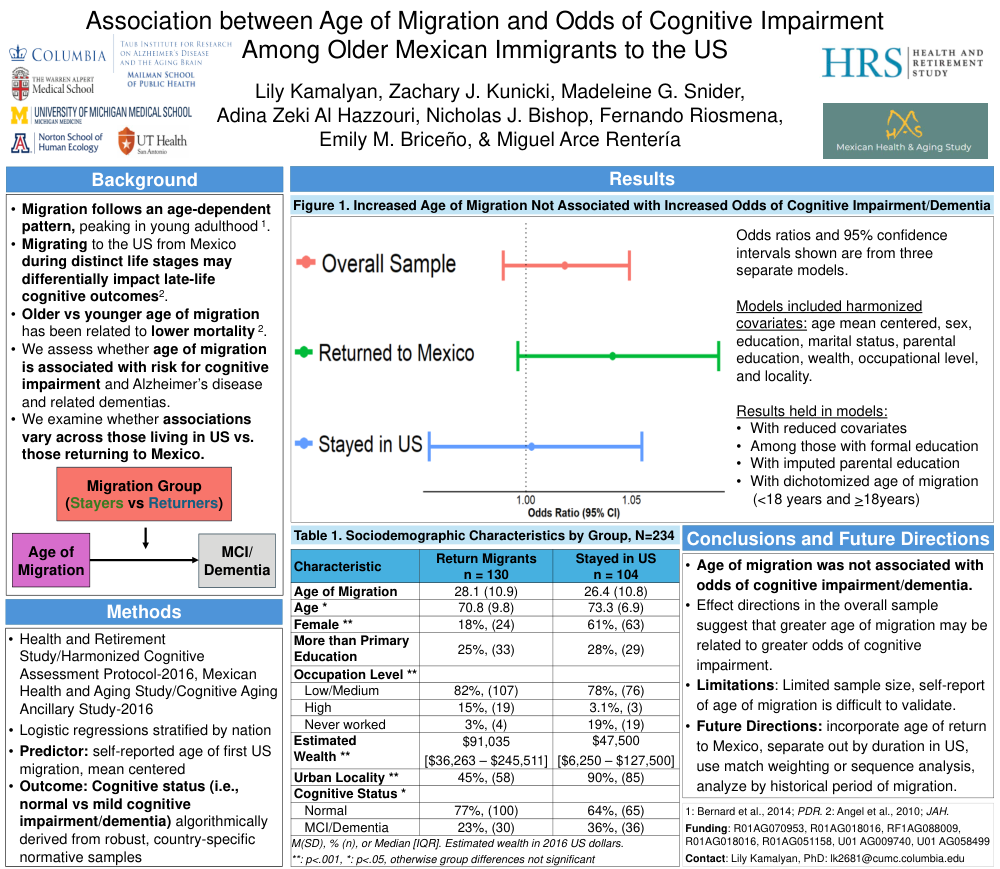
Background: Migration follows an age-dependent pattern, peaking in young adulthood before declining. As a significant life event, migration during distinct life stages may differentially impact cognitive aging. Older age of migration (AoM) from Mexico to the US, compared to younger, has been associated with lower mortality. However, it remains unclear whether AoM influences risk for cognitive impairment and Alzheimer’s disease and related dementias, and if associations vary across stayers and returnees. Our preliminary work has shown that migrants who stayed in the US have worse cognitive outcomes vs returnees to Mexico. Cross-national studies are needed to clarify whether aspects of migration (i.e., AoM) differentially impact cognitive outcomes within migrants.
Methods: Cross-national harmonized data were from the 2016 Mexican Health and Aging Study ancillary study on cognitive aging (Mex-Cog) and the 2016 Health and Retirement Study Harmonized Cognitive Assessment Protocol (HRS-HCAP). A culturally and statistically harmonized cognitive battery was administered. Cognitive status (i.e., normal vs mild cognitive impairment/dementia) was algorithmically derived using robust, country-specific normative samples. Participants were born in Mexico (N=292, Mean age=72.7[SD=8.7]; 63% male; 59% < primary education; 62% urban-dwelling), migrated to the US and stayed (n=110) or returned (n=182). AoM was self-reported. Multinomial logistic regressions evaluated the association of linear AoM with cognitive status among a) all migrants, then b) stratified by migrant group (stayers vs. returnees). Models adjusted for age, sex, education, parental education, and marital status.
Results: Those who stayed in the US were more likely to be female than returners (p<.001). Amongst all migrants, AoM was not associated with cognitive impairment/dementia (OR AoM=1.01, 95%CI=0.99–1.04). Stratified models by migrant group also did not show significant associations between AoM and cognitive impairment/dementia risk (returners OR AoM=1.04; [0.99-1.08]; stayers OR AoM=1.00; [0.96-1.05]).
Conclusion: In a cross-national and well-characterized sample of older Mexican adults with a history of US migration, AoM was not associated with cognitive impairment/dementia when using culturally and statistically harmonized data. Effect directions suggest that greater AoM may be related to greater odds of cognitive impairment, however, replication is needed in larger samples and/or using more sophisticated epidemiological approaches to better analyze migrant group differences.
Comments
Email is required but is not shown publicly.
Loading comments...