4,068 posters, 219 videos, 101 topics, 69 sessions, 14,365 authors, 6,128 institutions
ePostersLive by SciGen Technologies S.A. All rights reserved.
Alzheimer's Association International Conference 2026
July 12-15, 2026 | London, United Kingdom, and Online

7201
Late-life Depression As A Neuropsychiatric Symptom In The Oldest Old: Evidence From A Nationwide Study
Poster Presenter
Authors
Affiliations
Part of Topic
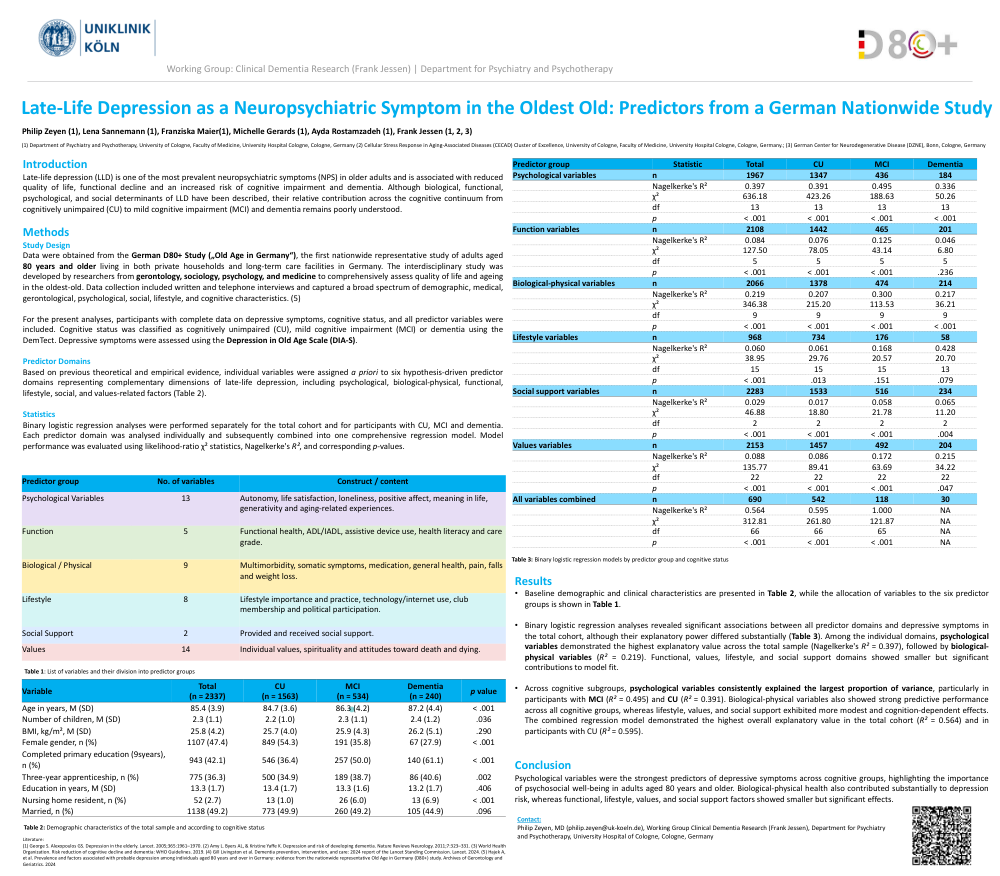
Late-Life Depression as a Neuropsychiatric Symptom in the Oldest Old: Predictors from a German Nationwide Study
Introduction
Late-life depression (LLD) is one of the most prevalent neuropsychiatric symptoms (NPS) in older adults and is associated with reduced quality of life, functional decline and an increased risk of cognitive impairment and dementia. Although biological, functional, psychological, and social determinants of LLD have been described, their relative contribution across the cognitive continuum from cognitively unimpaired (CU) to mild cognitive impairment (MCI) and dementia remains poorly understood.
Methods
Study Design
Data were obtained from the German D80+ Study („Old Age in Germany“), the first nationwide representative study of adults aged 80 years and older living in both private households and long-term care facilities in Germany. The interdisciplinary study was developed by researchers from gerontology, sociology, psychology, and medicine to comprehensively assess quality of life and ageing in the oldest-old. Data collection included written and telephone interviews and captured a broad spectrum of demographic, medical, gerontological, psychological, social, lifestyle, and cognitive characteristics. (5)
For the present analyses, participants with complete data on depressive symptoms, cognitive status, and all predictor variables were included. Cognitive status was classified as cognitively unimpaired (CU), mild cognitive impairment (MCI) or dementia using the DemTect. Depressive symptoms were assessed using the Depression in Old Age Scale (DIA-S).
Predictor Domains
Based on previous theoretical and empirical evidence, individual variables were assigned a priori to six hypothesis-driven predictor domains representing complementary dimensions of late-life depression, including psychological, biological-physical, functional, lifestyle, social, and values-related factors (Table 2).
Statistics
Binary logistic regression analyses were performed separately for the total cohort and for participants with CU, MCI and dementia. Each predictor domain was analysed individually and subsequently combined into one comprehensive regression model. Model performance was evaluated using likelihood-ratio χ² statistics, Nagelkerke's R², and corresponding p-values.
Results
Conclusion
Psychological variables were the strongest predictors of depressive symptoms across cognitive groups, highlighting the importance of psychosocial well-being in adults aged 80 years and older. Biological-physical health also contributed substantially to depression risk, whereas functional, lifestyle, values, and social support factors showed smaller but significant effects.
Comments
Email is required but is not shown publicly.
Loading comments...