4,068 posters, 219 videos, 101 topics, 69 sessions, 14,365 authors, 6,128 institutions
ePostersLive by SciGen Technologies S.A. All rights reserved.
Alzheimer's Association International Conference 2026
July 12-15, 2026 | London, United Kingdom, and Online

8891
The Dynamics Of Auditory Verbal Short-term Memory Impairment In Primary Progressive Aphasia And Alzheimer’s Disease
Poster Presenter
Part of Topic
INTRODUCTION
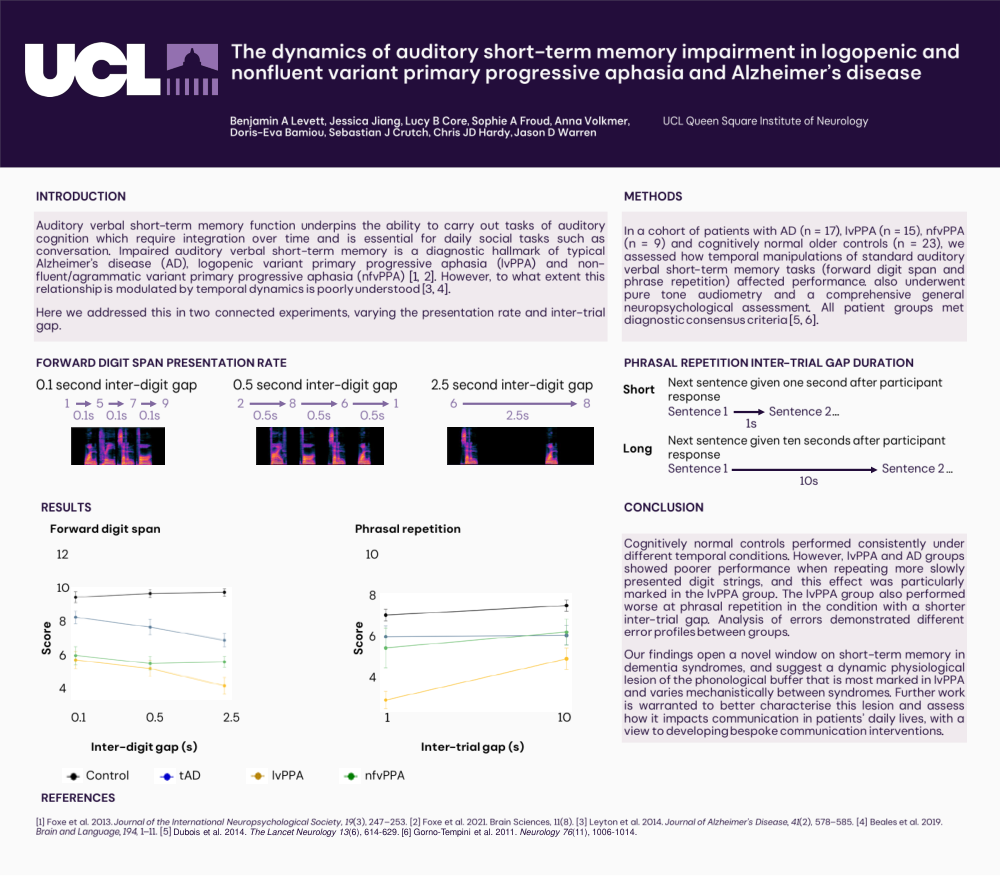
Auditory verbal short-term memory function underpins the ability to carry out tasks of auditory cognition which require integration over time and is essential for daily social tasks such as conversation. Impaired auditory verbal short-term memory is a diagnostic hallmark of typical Alzheimer’s disease (AD), logopenic variant primary progressive aphasia (lvPPA) and non-fluent/agrammatic variant primary progressive aphasia (nfvPPA) [1, 2]. However, to what extent this relationship is modulated by temporal dynamics is poorly understood [3, 4].
Here we addressed this in two connected experiments, varying the presentation rate and inter-trial gap.
METHODS
In a cohort of patients with AD (n = 17), lvPPA (n = 15), nfvPPA (n = 9) and cognitively normal older controls (n = 23), we assessed how temporal manipulations of standard auditory verbal short-term memory tasks (forward digit span and phrase repetition) affected performance. also underwent pure tone audiometry and a comprehensive general neuropsychological assessment. All patient groups met diagnostic consensus criteria [5, 6].
CONCLUSION
Cognitively normal controls performed consistently under different temporal conditions. However, lvPPA and AD groups showed poorer performance when repeating more slowly presented digit strings, and this effect was particularly marked in the lvPPA group. The lvPPA group also performed worse at phrasal repetition in the condition with a shorter inter-trial gap. Analysis of errors demonstrated different error profiles between groups.
Our findings open a novel window on short-term memory in dementia syndromes, and suggest a dynamic physiological lesion of the phonological buffer that is most marked in lvPPA and varies mechanistically between syndromes. Further work is warranted to better characterise this lesion and assess how it impacts communication in patients’ daily lives, with a view to developing bespoke communication interventions.
REFERENCES
[1] Foxe et al. 2013. Journal of the International Neuropsychological Society, 19(3), 247–253. [2] Foxe et al. 2021. Brain Sciences, 11(8). [3] Leyton et al. 2014. Journal of Alzheimer’s Disease, 41(2), 578–585. [4] Beales et al. 2019. Brain and Language, 194, 1–11. [5] Dubois et al. 2014. The Lancet Neurology 13(6), 614-629. [6] Gorno-Tempini et al. 2011. Neurology 76(11), 1006-1014.
Comments
Email is required but is not shown publicly.
Loading comments...