4,068 posters, 219 videos, 101 topics, 69 sessions, 14,365 authors, 6,128 institutions
ePostersLive by SciGen Technologies S.A. All rights reserved.
Alzheimer's Association International Conference 2026
July 12-15, 2026 | London, United Kingdom, and Online

5487
Brain Volume And Cognition Modulated By Cognitive Reserve In Different Neurodegenerative Disorders
Poster Presenter
Authors
Kenia Campanholo, Manuela MSF e Silva, Artur M Coutinho, Carlos Alberto Buchpiguel, Geraldo Bussato-Filho, Débora G de Souza, Eduardo Zimmer, Daniele de Paula Faria
Affiliations
Laboratory of Nuclear Medicine (LIM43), Department of Radiology and Oncology, Faculdade de Medicina FMUSP, Universidade de São Paulo, São Paulo, SP, Brazil, Laboratory of Psychiatric Neuroimaging (LIM21), Psychiatric Institute, Faculdade de Medicina da Universidade de São Paulo, São Paulo, SP, Brazil., Universidade Federal do Rio Grande do Sul (UFRGS), Porto Alegre, RS, Brazil
Part of Topic
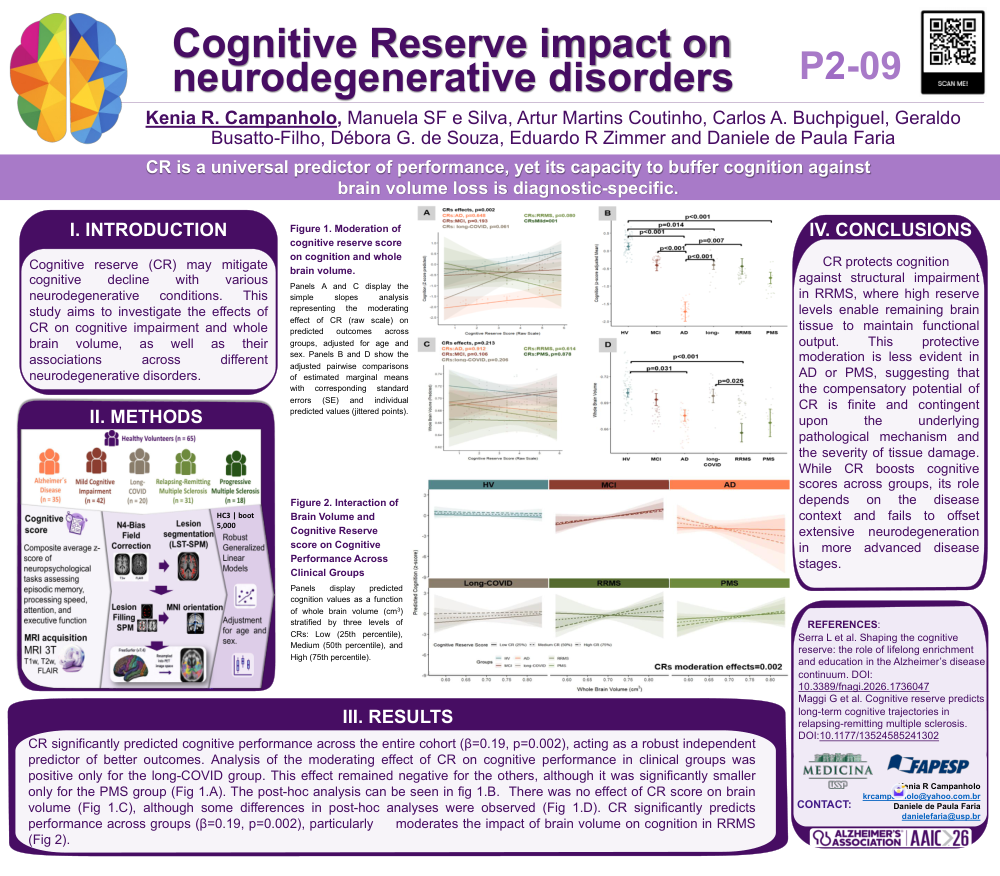
Background. Cognitive reserve (CR) may mitigate cognitive decline with various neurodegenerative conditions. This study aims to investigate the effects of CR on cognitive impairment and whole brain volume, as well as their associations across different neurodegenerative disorders.
Methods. We evaluated 65 healthy volunteers (HV) and 146 peoples with: Alzheimer’s Disease (AD, n=35), Mild Cognitive Impairment (MCI, n=42), long-COVID (n=20), Relapsing-Remitting (RRMS, n=31), and Progressive Multiple Sclerosis (PMS, n=18). A global Cognition score was calculated as the composite average z-score of neuropsychological tasks assessing episodic memory, processing speed, attention, and executive function. Brain volume (FreeSurfer/neuroComBat) was normalized to total intracranial volume. CR score was quantified using education and occupational complexity. Robust Generalized Linear Models were employed, adjusting for age and sex.
Results. CR significantly predicted cognitive performance across the entire cohort (β=0.19, p=0.002), acting as a robust independent predictor of better outcomes. Analysis of the moderating effect of CR scores on cognitive performance in clinical groups was positive only for the long-COVID group. This effect remained negative for the others, although it was significantly smaller only for the PMS group (Figure 1.A). The pairwise post-hoc analysis can be seen in figure 1.B. There was no effect of CR score on brain volume (Figure 1.C), although some differences in post-hoc analyses were observed (Figure 1.D). CR significantly predicts performance across groups (β=0.19, p=0.002), particularly moderates the impact of brain volume on cognition in RRMS (Figure 2).
Conclusions. CR acts as a universal predictor of performance, yet its capacity to buffer cognition against brain volume loss is diagnostic-specific. Our findings confirm that CR protects cognition against structural impairment primarily in RRMS, where high reserve levels enable remaining brain tissue to maintain functional output. Conversely, this protective moderation is less evident in AD or PMS, suggesting that the compensatory potential of CR is finite and contingent upon the underlying pathological mechanism and the severity of tissue damage. Therefore, while CR independently boosts cognitive scores across all groups, its role as a structural buffer depends on the specific disease context, failing to offset extensive neurodegeneration in more aggressive or advanced stages.
Comments
Email is required but is not shown publicly.
Loading comments...