4,068 posters, 219 videos, 101 topics, 69 sessions, 14,365 authors, 6,128 institutions
ePostersLive by SciGen Technologies S.A. All rights reserved.
Alzheimer's Association International Conference 2026
July 12-15, 2026 | London, United Kingdom, and Online

9769
The South Asian Middle-aged Risk Tracking For Brain Health Study: Participants’ Characteristics And Effects Of Metabolic Impairment
Poster Presenter
Authors
Yun Cai, Akankshi Oberoi, Rebecca West, Auriel Willette, Sharon Sanz Simon, Luciana Fonseca, Jack Tsao, Yian Gu, Ariana Nayak, Mahalakshmi Akkinepalli, Shruti Kedharnath, Yuna Aitha, Michal Schnaider Beeri
Affiliations
Krieger Klein Alzheimer’s Research Center, Brain Health Institute, Rutgers University, Department of Neurology, Columbia University
Part of Topic
The South Asian Middle-Aged Risk Tracking for Brain Health (SAMARTH) study: Participants’ characteristics and effects of metabolic impairment
BACKGROUND
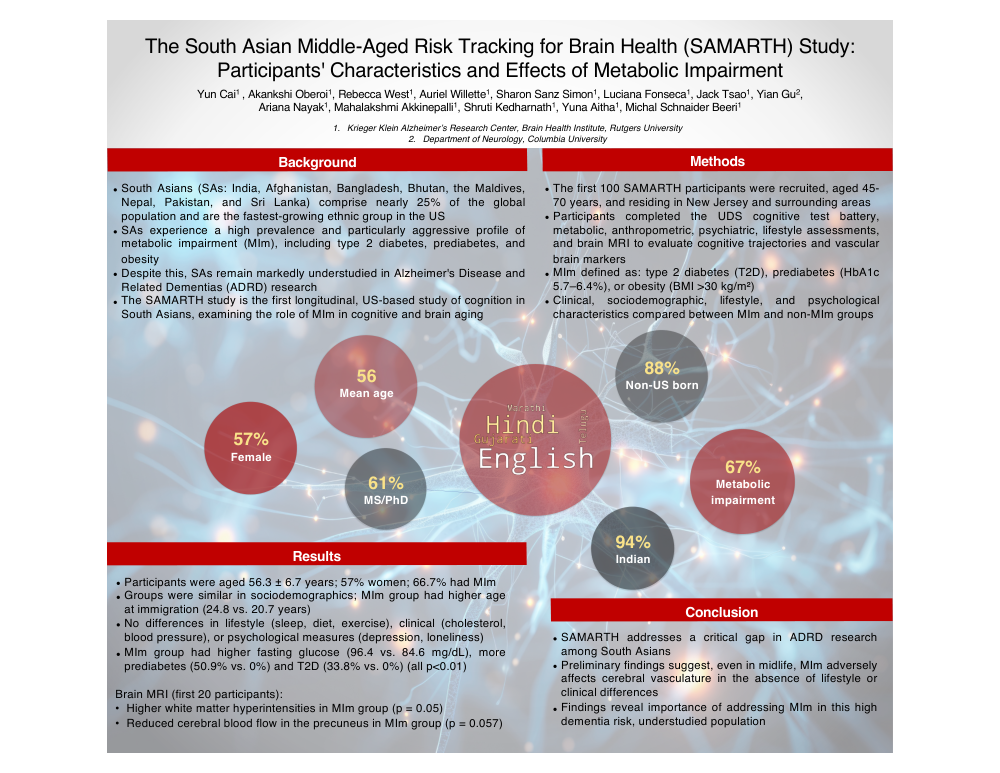
South Asians (SAs; India, Afghanistan, Bangladesh, Bhutan, the Maldives, Nepal, Pakistan, and Sri Lanka) comprise nearly 25% of the global population and represent the fastest-growing ethnic group in the United States. They also experience a high prevalence and a particularly aggressive profile of metabolic impairment (MIm). Despite this, SAs remain markedly understudied in ADRD. The South Asian Middle-Aged Risk Tracking for Brain Health (SAMARTH) study is the first longitudinal, US-based study of cognition in SAs, designed to examine the role of MIm in cognitive and brain aging.
METHODS
We recruited the first 100 SAMARTH participants, aged 45–70 years, residing in New Jersey and surrounding areas. Participants completed the UDS cognitive test battery along with metabolic, anthropometric, psychiatric, lifestyle assessments, and brain MRI, to evaluate cognitive trajectories and vascular brain markers. Recruitment sources included partnerships with community leaders, NGOs, and recruitment companies; radio and television programs, community events, and health camps; social media advertising; and electronic medical records. Participants were categorized as having or not having MIm, defined as type 2 diabetes (T2D), prediabetes (HbA1c 5.7–6.4%), or obesity (BMI >30 kg/m²). Clinical, sociodemographic, lifestyle, and psychological characteristics were compared between groups.
RESULTS
Participants were aged 56.3±6.7 years; 57% were women; 66.7% had MIm. Groups were broadly similar in sociodemographics but those with MIm had a higher age at immigration (24.8 vs. 20.7 years). The groups did not differ in lifestyle (sleep, diet, smoking, and exercise), clinical (cholesterol, systolic and diastolic blood pressure), or psychological measures (depression, loneliness). By definition, the MIm group had higher fasting glucose (96.4 vs. 84.6 mg/dL), more prediabetes (50.9% vs. 0%), and more T2D (33.8% vs. 0%) (all p<0.01). MRI of the first 20 participants who were scanned revealed lower white matter hyperintensities (p=0.05) and reduced cerebral blood flow in the precuneus (p=0.057) in MIm participants.
CONCLUSION
Our cohort addresses a critical gap in ADRD research among South Asians. These preliminary findings suggest that, even in midlife, MIm, in the absence of differences in other lifestyle or clinical factors, adversely affects cerebral vasculature. These findings suggest the importance of addressing MIm in this high dementia risk, understudied population.
Comments
Email is required but is not shown publicly.
Loading comments...