4,068 posters, 219 videos, 101 topics, 69 sessions, 14,365 authors, 6,128 institutions
ePostersLive by SciGen Technologies S.A. All rights reserved.
Alzheimer's Association International Conference 2026
July 12-15, 2026 | London, United Kingdom, and Online

4429
Integrating Genetic Biomarkers To Improve Diagnosis In Young-onset Dementia: Insights From The MiND Study
Poster Presenter
Authors
Affiliations
Part of Topic
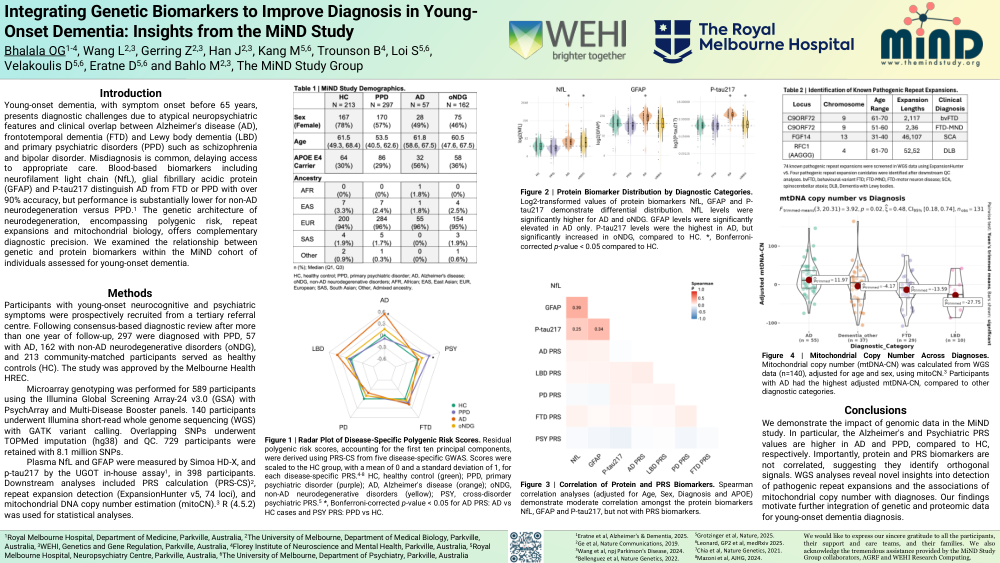
Integrating Genetic Biomarkers to Improve Diagnosis in YoungOnset
Dementia:
Insights
from
the
MiND
Study
Bhalala OG
1-4
, Wang L
2,3
, Gerring Z
2,3
, Han J
2,3
, Kang M
5,6
, Trounson B
4
, Loi S
5,6
,
Velakoulis D
5,6
, Eratne D
5,6
and Bahlo M
2,3
, The MiND Study Group
Introduction
Young-onset dementia, with symptom onset before 65 years,
presents diagnostic challenges due to atypical neuropsychiatric
features and clinical overlap between Alzheimer's disease (AD),
frontotemporal dementia (FTD) and Lewy body dementia (LBD)
and primary psychiatric disorders (PPD) such as schizophrenia
and bipolar disorder. Misdiagnosis is common, delaying access
to appropriate care. Blood-based biomarkers including
neurofilament light chain (NfL), glial fibrillary acidic protein
(GFAP) and P-tau217 distinguish AD from FTD or PPD with over
90% accuracy, but performance is substantially lower for non-AD
neurodegeneration versus PPD.
1
The genetic architecture of
neurodegeneration, encompassing polygenic risk, repeat
expansions and mitochondrial biology, offers complementary
Figure 2 | Protein Biomarker Distribution by Diagnostic Categories.
Log2-transformed values of protein biomarkers NfL, GFAP and Ptau217
demonstrate differential distribution. NfL levels were
significantly higher for AD and oNDG. GFAP levels were significantly
elevated in AD only. P-tau217 levels were the highest in AD, but
significantly increased in oNDG, compared to HC. *, Bonferroni-
diagnostic precision. We examined the relationship between
genetic and protein biomarkers within the MiND cohort of
individuals assessed for young-onset dementia.
corrected p-value < 0.05 compared to HC.
Methods
Participants with young-onset neurocognitive and psychiatric
symptoms were prospectively recruited from a tertiary referral
centre. Following consensus-based diagnostic review after more
than one year of follow-up, 297 were diagnosed with PPD, 57
with AD, 162 with non-AD neurodegenerative disorders (oNDG),
and 213 community-matched participants served as healthy
controls (HC). The study was approved by the Melbourne Health
HREC.
Figure 4 | Mitochondrial Copy Number Across Diagnoses.
Mitochondrial copy number (mtDNA-CN) was calculated from WGS
data (n=140), adjusted for age and sex, using mitoCN.
Microarray genotyping was performed for 589 participants
3
Participants
with AD had the highest adjusted mtDNA-CN, compared to other
diagnostic categories.
using the Illumina Global Screening Array-24 v3.0 (GSA) with
PsychArray and Multi-Disease Booster panels. 140 participants
underwent Illumina short-read whole genome sequencing (WGS)
with GATK variant calling. Overlapping SNPs underwent
TOPMed imputation (hg38) and QC. 729 participants were
retained with 8.1 million SNPs.
Conclusions
Plasma NfL and GFAP were measured by Simoa HD-X, and
p-tau217 by the UGOT in-house assay
1
, in 398 participants.
Figure 1 | Radar Plot of Disease-Specific Polygenic Risk Scores. Residual
polygenic risk scores, accounting for the first ten principal components,
were derived using PRS-CS from five disease-specific GWAS. Scores were
scaled to the HC group, with a mean of 0 and a standard deviation of 1, for
each disease-specific PRS.
4-8
HC, healthy control (green); PPD, primary
Downstream analyses included PRS calculation (PRS-CS)
2
,
We demonstrate the impact of genomic data in the MiND
study. In particular, the Alzheimer's and Psychiatric PRS
values are higher in AD and PPD, compared to HC,
respectively. Importantly, protein and PRS biomarkers are
not correlated, suggesting they identify orthogonal
signals. WGS analyses reveal novel insights into detection
of pathogenic repeat expansions and the associations of
repeat expansion detection (ExpansionHunter v5, 74 loci), and
mitochondrial DNA copy number estimation (mitoCN).
3
psychiatric disorder (purple); AD, Alzheimer's disease (orange); oNDG,
non-AD neurodegenerative disorders (yellow); PSY, cross-disorder
psychiatric PRS.
R (4.5.2)
5
*, Bonferroni-corrected p-value < 0.05 for AD PRS: AD vs
Figure 3 | Correlation of Protein and PRS Biomarkers. Spearman
correlation analyses (adjusted for Age, Sex, Diagnosis and APOE)
demonstrate moderate correlation amongst the protein biomarkers
NfL, GFAP and P-tau217, but not with PRS biomarkers.
was used for statistical analyses.
HC cases and PSY PRS: PPD vs HC.
mitochondrial copy number with diagnoses. Our findings
motivate further integration of genetic and proteomic data
for young-onset dementia diagnosis.
1
The University of Melbourne, Department of Medical Biology, Parkville,
Australia,
Royal Melbourne Hospital, Department of Medicine, Parkville, Australia,
2
Royal
Melbourne Hospital, Neuropsychiatry Centre, Parkville, Australia,
1
Eratne et al, Alzheimer's & Dementia, 2025.
3
WEHI, Genetics and Gene Regulation, Parkville, Australia,
5
Grotzinger et al, Nature, 2025.
4
Florey Institute of Neuroscience and Mental Health, Parkville, Australia,
2
Ge et al, Nature Communications, 2019.
5
6
Leonard, GP2 et al, medRxiv 2025.
We would like to express our sincere gratitude to all the participants,
their support and care teams, and their families. We also
6
The University of Melbourne, Department of Psychiatry, Parkville, Australia
3
Wang et al, npj Parkinson's Disease, 2024.
7
Chia et al, Nature Genetics, 2021.
4
Bellenguez et al, Nature Genetics, 2022.
8
acknowledge the tremendous assistance provided by the MiND Study
Group collaborators, AGRF and WEHI Research Computing.
Mazoni et al, AJHG, 2024.
Comments
Email is required but is not shown publicly.
Loading comments...