4,068 posters, 219 videos, 101 topics, 69 sessions, 14,365 authors, 6,128 institutions
ePostersLive by SciGen Technologies S.A. All rights reserved.
Alzheimer's Association International Conference 2026
July 12-15, 2026 | London, United Kingdom, and Online

10068
Linking The Clinical Dementia Rating Scale (CDR-SB) And The 13-item Alzheimer’s Disease Assessment Scale-Cognitive Subscale
Poster Presenter
Authors
Part of Topic
Linking the Clinical Dementia Rating Scale-Sum of Boxes and the 13-Item Version of the Alzheimer’s Disease Assessment Scale-Cognitive Subscale
Kott, Alan, MUDr.; Wang, Xingmei, MS; Miller, David S., MD, MA
Signant Health
Background
Associations between the 13-item ADAS-Cog (score range 0–85) and the CDR-Sum of Boxes (CDR-SoB, 0–18) have been described in prior research, yet a crosswalk linking these instruments has not been published. This study aims to fill this gap by applying equipercentile linking to systematically compare the CDR‑SoB and the 13‑item ADAS‑Cog, providing a framework for reconciling discrepancies between these cognitive scales.
Methods
This post hoc analysis pooled data from 12 clinical trials containing repeated measures of both the CDR‑SoB and the 13‑item ADAS‑Cog. To address within‑participant correlations, we applied a bootstrap resampling procedure (1,000 iterations), randomly selecting one observation per participant per iteration. For each iteration, percentile ranks were computed and matched between the instruments. Score equivalents were derived as the minimum and maximum ADAS‑Cog values corresponding to each CDR‑SoB score, aggregated across iterations using median estimates. Crosswalk validation was performed by correlating observed CDR-SoB scores with their percentile-linked ADAS-Cog equivalents.
Results
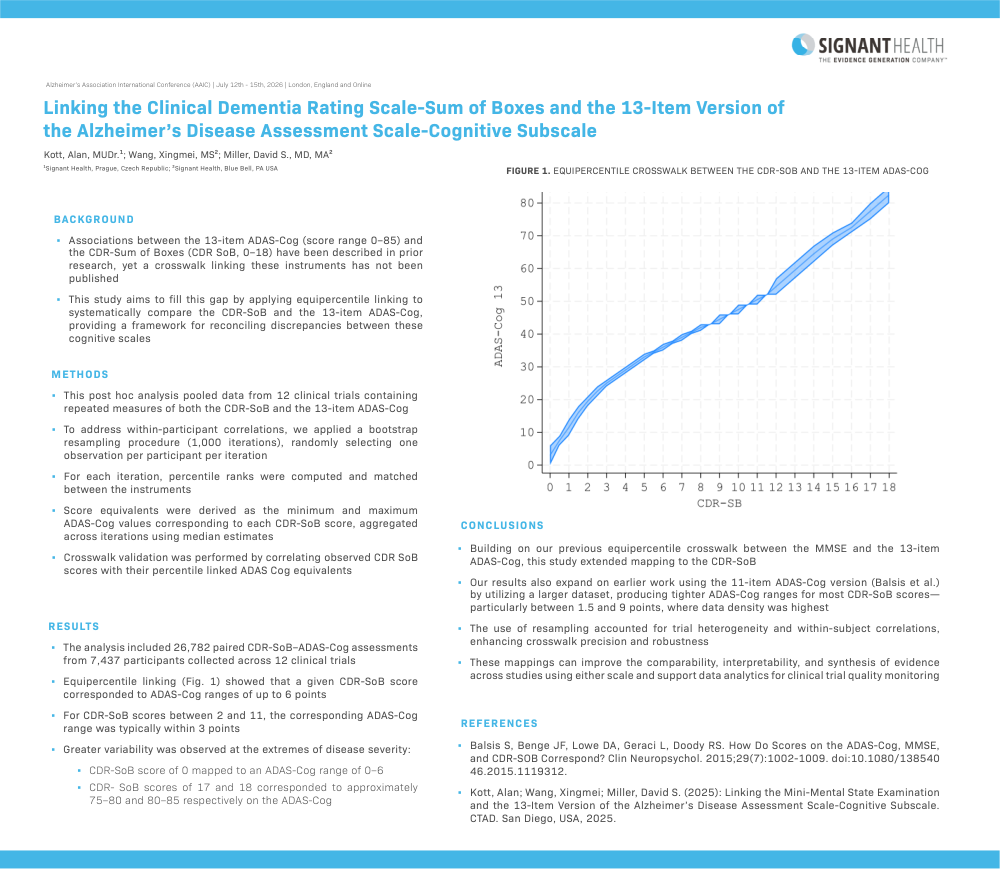
The analysis included 26,782 paired CDR‑SoB–ADAS‑Cog assessments from 7,437 participants collected across 12 clinical trials. Equipercentile linking showed that a given CDR‑SoB score corresponded to ADAS‑Cog ranges up to 6 points; however, for CDR‑SoB scores between 2 and 11, the corresponding ADAS‑Cog range was typically within 3 points. Greater variability was observed at the extremes of disease severity: a CDR‑SoB score of 0 mapped to an ADAS‑Cog range of 0–6, while CDR scores of 17 and 18 corresponded to approximately 75–80 and 80–85 on the ADAS‑Cog, respectively.
Conclusions
Building on our previous equipercentile crosswalk between the MMSE and the 13‑item ADAS‑Cog, this study extended mapping to the CDR‑SoB. Our results also expand on earlier work using the 11‑item ADAS‑Cog version (Balsis et al.) by utilizing a larger dataset, producing tighter ADAS‑Cog ranges for most CDR‑SoB scores—particularly between 1.5 and 9 points, where data density was highest. The use of resampling accounted for trial heterogeneity and within‑subject correlations, enhancing crosswalk precision and robustness. These mappings can improve the comparability, interpretability, and synthesis of evidence across studies using either scale and support data analytics for clinical trial quality monitoring.
References Balsis S, Benge JF, Lowe DA, Geraci L, Doody RS. How Do Scores on the ADAS-Cog, MMSE, and CDR-SOB Correspond? Clin Neuropsychol. 2015;29(7):1002-1009. doi:10.1080/13854046.2015.1119312.
Kott, Alan; Wang, Xingmei; Miller, David S. (2025): Linking the Mini-Mental State Examination and the 13-Item Version of the Alzheimer’s Disease Assessment Scale-Cognitive Subscale. CTAD. San Diego, USA, 2025.
Comments
Email is required but is not shown publicly.
Loading comments...