4,068 posters, 219 videos, 101 topics, 69 sessions, 14,365 authors, 6,128 institutions
ePostersLive by SciGen Technologies S.A. All rights reserved.
Alzheimer's Association International Conference 2026
July 12-15, 2026 | London, United Kingdom, and Online

9003
Automated Speech Analysis Of Event Recall In The California Cognitive Assessment Battery
Poster Presenter
Authors
Kathleen Hall, Michael Blank, Kristin Geraci, Andrew Boghossian, Isabella Jaramillo, Peter Pebler, David Woods
Affiliations
null,
Part of Topic
Introduction: Speech and language biomarkers (SLBs) are increasingly being studied and employed for early detection of cognitive decline. However, many commonly used speech tasks (picture description, logical memory recall) produce limited and predictable responses with formulaic lexical content and constrained structural variety, reducing sensitivity of higher-order linguistic measures. We introduce an autobiographical event recall task in the California Cognitive Assessment Battery (CCAB) that elicits richer, more ecologically valid speech samples for automated language analysis. CCAB also collects data from a wide range of cognitive tasks, allowing for interpretation of speech and language biomarkers alongside more traditional measures of cognition.
Methods: The CCAB 'Story Telling' event recall task was administered to 572 healthy adults during ongoing normative data collection. Participants completed a range of other cognitive tasks. 59.3% of participants were female, with a mean age of 42.5 years ± 14.4. Participants were tested in their own homes using a tablet computer with circumaural headphones and a head-mounted microphone. Instructions and stimuli were delivered using text-to-speech (TTS) with intensities adjusted to the participant's auditory threshold. Responses were automatically transcribed using consensus automatic speech recognition (CASR), with transcription accuracy exceeding 98%. An examiner remotely monitored participant performance over audio and visual feeds. Participants were asked to verbally describe a significant personal event from the prior two weeks. Speech metrics were automatically extracted using response audio files and transcripts. Measures included acoustic variables, timing information, lexical and semantic indices, and syntactic complexity information. Metrics were generated using Praat and NLTK.
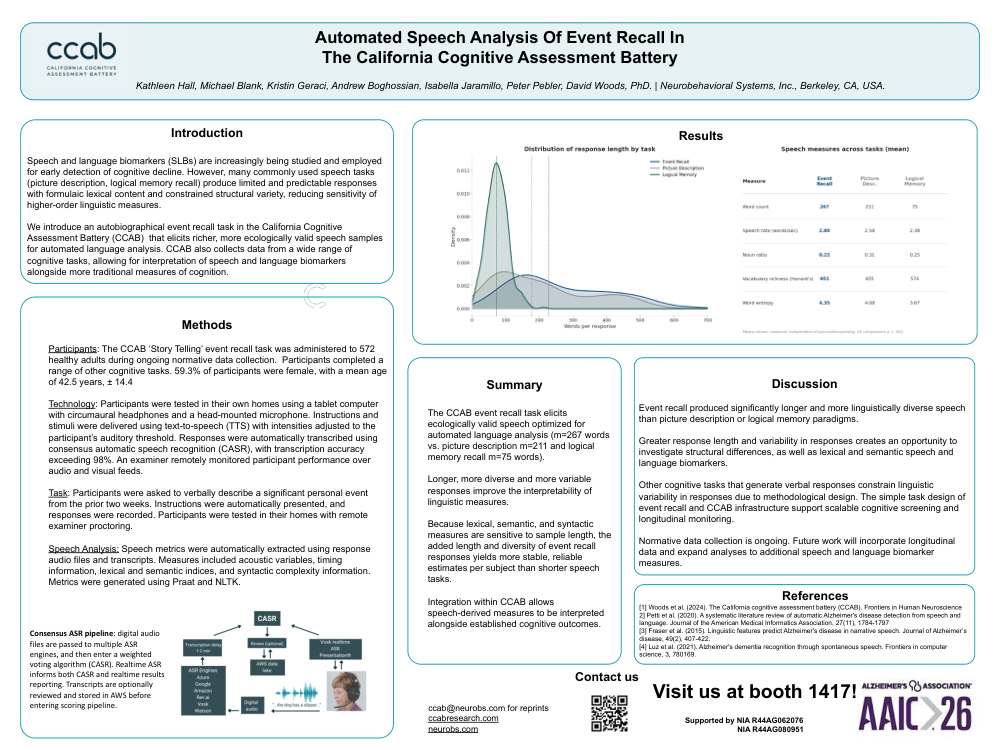
Results: Event recall produced significantly longer and more linguistically diverse speech than picture description or logical memory paradigms. Mean word count: Event Recall 267, Picture Description 211, Logical Memory 75. Speech rate (words/sec): Event Recall 2.80, Picture Description 2.58, Logical Memory 2.58. Noun ratio: Event Recall 0.22, Picture Description 0.31, Logical Memory 0.25. Vocabulary richness (Honore's): Event Recall 651, Picture Description 635, Logical Memory 574. Word entropy: Event Recall 4.35, Picture Description 4.08, Logical Memory 3.67. All comparisons p < .001.
Summary: The CCAB event recall task elicits ecologically valid speech optimized for automated language analysis (mean 267 words vs. picture description mean 211 and logical memory recall mean 75 words). Longer, more diverse and more variable responses improve the interpretability of linguistic measures. Because lexical, semantic, and syntactic measures are sensitive to sample length, the added length and diversity of event recall responses yields more stable, reliable estimates per subject than shorter speech tasks. Integration within CCAB allows speech-derived measures to be interpreted alongside established cognitive outcomes.
Discussion: Event recall produced significantly longer and more linguistically diverse speech than picture description or logical memory paradigms. Greater response length and variability in responses creates an opportunity to investigate structural differences, as well as lexical and semantic speech and language biomarkers. Other cognitive tasks that generate verbal responses constrain linguistic variability in responses due to methodological design. The simple task design of event recall and CCAB infrastructure support scalable cognitive screening and longitudinal monitoring. Normative data collection is ongoing. Future work will incorporate longitudinal data and expand analyses to additional speech and language biomarker measures.
Comments
Email is required but is not shown publicly.
Loading comments...