4,068 posters, 219 videos, 101 topics, 69 sessions, 14,365 authors, 6,128 institutions
ePostersLive by SciGen Technologies S.A. All rights reserved.
Alzheimer's Association International Conference 2026
July 12-15, 2026 | London, United Kingdom, and Online

10430
Low Levels Of Anxiety Associated With Enhanced Cognitive Functions In A Cohort Of Cognitively Unimpaired Elderly
Part of Topic
Title: Low Levels Of Anxiety Associated With Enhanced Cognitive Functions In A Cohort Of Cognitively Unimpaired Elderly
Andrew Orefice1, Nunzio Pomara1,2, Chelsea Reichert Plaska1,2
1Geriatric Psychiatry Division, Nathan Kline Institute, Orangeburg, NY, USA
2Department of Psychiatry, NYU Grossman School of Medicine, New York, NY, USA.
Introduction
- Major Depressive Disorder (MDD) and Generalized Anxiety Disorder (GAD) increase the risk of future cognitive decline and Alzheimer’s disease (AD).
- Other established risk factors, such as female-sex and ε4-carrier status may influence this relationship.
- Below threshold symptoms of depression (subsyndromal depression or SSD) and anxiety (subsyndromal anxiety or SSA), may also increase the risk of AD.
- Both SSA and SSD are common in community-dwelling elderly and more common than MDD or GAD.
- While some studies have looked at the role of SSD in AD-risk, few studies have examined if SSA is associated with increased AD-risk.
- Hypothesis:
- SSA would be associated with worse cognition
Methods
- Participants were enrolled in the Memory Education and Research Initiative (MERI) program and completed a neuropsychological battery, clinical and psychiatric evaluation, and blood draw for determination of AD biomarkers.
- The clinical measures that were used were clinician administered 15-item Hamilton Anxiety Rating (HAM-A) and 21-item Depression (HAM-D).
- Select cognitive assessments were chosen from the MERI battery, which are implicated in AD: Episodic memory (auditory verbal learning test, AVLT; AVLT-Total score indicates correct number of words remembered across 5 trials of 15 words each, max score = 75 words; AVLT-Delayed score indicates correct number of words remember after a 20 minute delay, max score = 15) and Executive function (Trail making test B, TMTB: score is time to complete in seconds, max score = 360 seconds).
Inclusion & Exclusion criteria:
- Participants were included if cognitively unimpaired (CU) as defined by MMSE>23 at Baseline, and age 50-85. For both groups, participants were excluded if HAM-D ≥ 18 to remove anyone with MDD.
Group Definitions:
- SSA = HAM-A: 2 to 10 and No-SSA = HAM-A: 0 or 1.
Statistics:
- Analysis of variance (ANOVA) to examine influence of SSA, sex and genotype status (ε4-positive/negative) on HAM-A/HAM-D and on cognition.
- Pearsons’s correlations were run to examine associations with HAM-A/HAM-D.
Results
Affect Measures
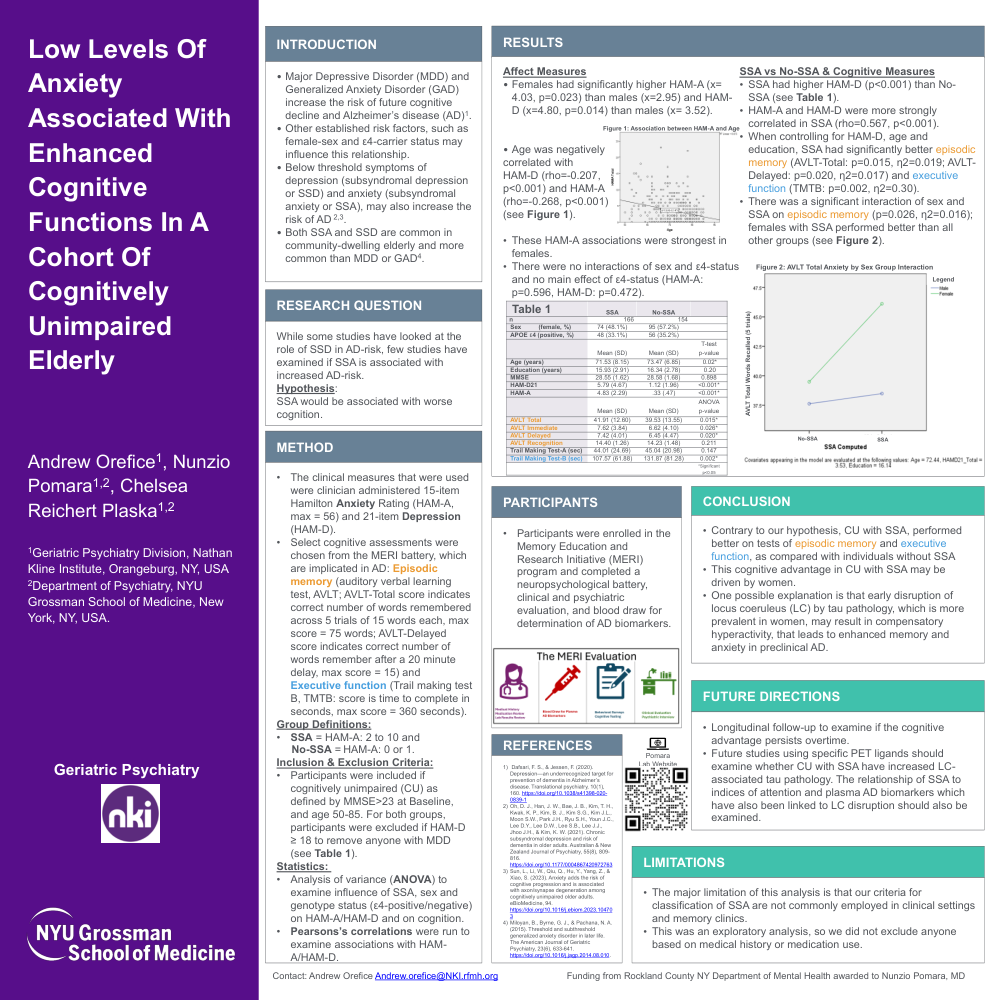
- Females had significantly higher HAM-A (p=0.023) and HAM-D (p=0.014) than males
- Age was negatively correlated with HAM-D (rho=-0.207, p<0.001) and HAM-A (rho=-0.268, p<0.001)
- These HAM-A associations were strongest in females.
- There were no interactions of sex and ε4-status and no main effect of ε4-status (HAM-A: p=0.596, HAM-D: p=0.472).
SSA vs No-SSA & Cognitive Measures
- SSA had higher HAM-D (p<0.001) than No-SSA.
- HAM-A and HAM-D were more strongly correlated in SSA (rho=0.567, p<0.001).
- When controlling for HAM-D, age and education, SSA had significantly better episodic memory (AVLT-Total: p=0.015, η2=0.019; AVLT-Delayed: p=0.020, η2=0.017) and executive function (TMTB: p=0.002, η2=0.30)
- There was a significant interaction of sex and SSA on episodic memory (p=0.026, η2=0.016); females with SSA performed better than all other groups.
Conclusion
- Contrary to our hypothesis, CU with SSA, performed better on tests of episodic memory and executive function, as compared with individuals without SSA
- This cognitive advantage in CU with SSA may be driven by women.
- One possible explanation is that early disruption of locus coeruleus (LC) by tau pathology, which is more prevalent in women, may result in compensatory hyperactivity, that leads to enhanced memory and anxiety in preclinical AD.
Future Directions
- Longitudinal follow-up to examine if the cognitive advantage persists overtime.
- Future studies using specific PET ligands should examine whether CU with SSA have increased LC-associated tau pathology. The relationship of SSA to indices of attention and plasma AD biomarkers which have also been linked to LC disruption should also be examined
Limitations
- The major limitation of this analysis is that our criteria for classification of SSA and SSD are not commonly employed in clinical settings and memory clinics
- This was an exploratory analysis, so we did not exclude anyone based on medical history or medication use.
1) Dafsari, F. S., & Jessen, F. (2020). Depression—an underrecognized target for prevention of dementia in Alzheimer’s disease. Translational psychiatry, 10(1), 160. https://doi.org/10.1038/s41398-020-0839-1
2) Oh, D. J., Han, J. W., Bae, J. B., Kim, T. H., Kwak, K. P., Kim, B. J., Kim S.G., Kim J.L., Moon S.W., Park J.H., Ryu S.H., Youn J.C., Lee D.Y., Lee D.W., Lee S.B., Lee J.J., Jhoo J.H., & Kim, K. W. (2021). Chronic subsyndromal depression and risk of dementia in older adults. Australian & New Zealand Journal of Psychiatry, 55(8), 809-816. https://doi.org/10.1177/0004867420972763
3) Sun, L., Li, W., Qiu, Q., Hu, Y., Yang, Z., & Xiao, S. (2023). Anxiety adds the risk of cognitive progression and is associated with axon/synapse degeneration among cognitively unimpaired older adults. eBioMedicine, 94. https://doi.org/10.1016/j.ebiom.2023.104703
4) Miloyan, B., Byrne, G. J., & Pachana, N. A. (2015). Threshold and subthreshold generalized anxiety disorder in later life. The American Journal of Geriatric Psychiatry, 23(6), 633-641. https://doi.org/10.1016/j.jagp.2014.08.010.
Comments
Email is required but is not shown publicly.
Loading comments...