4,068 posters, 219 videos, 101 topics, 69 sessions, 14,365 authors, 6,128 institutions
ePostersLive by SciGen Technologies S.A. All rights reserved.
Alzheimer's Association International Conference 2026
July 12-15, 2026 | London, United Kingdom, and Online

10811
Locus Coeruleus System Measures As A Predictor Of Subjective Experiences In Subtle Cognitive Decline And Mild Cognitive Impairment
Poster Presenter
Authors
Jordan Kozuki, Zachary Goodman, Amira Marshall, Gabriela Franca, Eric Granholm, Mark Bondi
Affiliations
Part of Topic
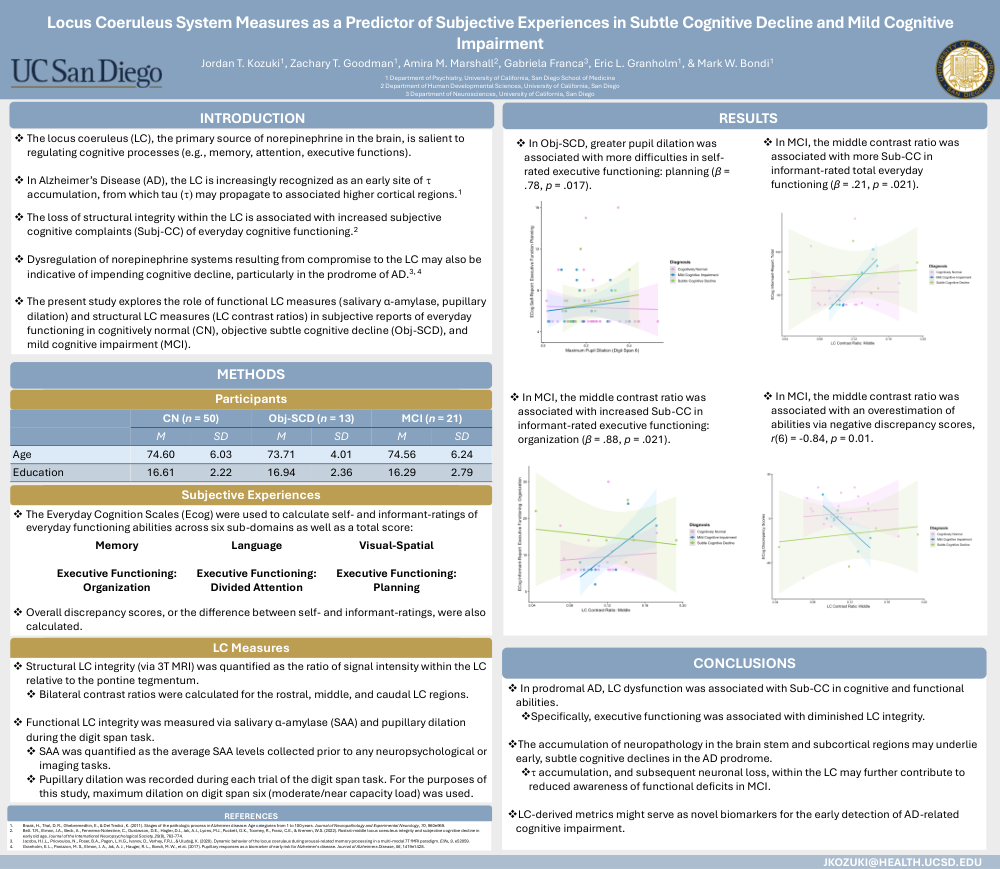
Introduction: The locus coeruleus (LC), the primary source of norepinephrine in the brain, is salient to regulating cognitive processes (e.g., memory, attention, executive functions). In Alzheimer’s Disease (AD), the LC is increasingly recognized as an early site of t accumulation, from which tau (t) may propagate to associated higher cortical regions. The loss of structural integrity within the LC is associated with increased subjective cognitive complaints (Subj-CC) of everyday cognitive functioning. Dysregulation of norepinephrine systems resulting from compromise to the LC may also be indicative of impending cognitive decline, particularly in the prodrome of AD. The present study explores the role of functional LC measures (salivary α-amylase, pupillary dilation) and structural LC measures (LC contrast ratios) in subjective reports of everyday functioning in cognitively normal (CN), objective subtle cognitive decline (Obj-SCD), and mild cognitive impairment (MCI).
Methods: Participants were classified using the Jak/Bondi actuarial-neuropsychological criteria, in which impairment was defined as scores falling at least one standard deviation below normative references on two or more measures within a cognitive domain. Participants were classified as mild cognitive impairment (MCI; n = 21) f they demonstrated at least two impairments in a domain, objective subtle cognitive decline (Obj-SCD; n = 13) if they demonstrated exactly two impairments in two separate domains, or cognitively normal (CN; n= 50) if they demonstrated fewer than two impairments. The Everyday Cognition Scales (Ecog) were used to calculate self- and informant-ratings of everyday functioning abilities across six sub-domains as well as a total score. Overall discrepancy scores, or the difference between self- and informant-ratings, were also calculated. Structural LC integrity (via 3T MRI) was quantified as the ratio of signal intensity within the LC relative to the pontine tegmentum. Bilateral contrast ratios were calculated for the rostral, middle, and caudal LC regions. Functional LC integrity was measured via salivary α-amylase (SAA) and pupillary dilation during the digit span task. SAA was quantified as the average SAA levels collected prior to any neuropsychological or imaging tasks. Pupillary dilation was recorded during each trial of the digit span task. For the purposes of this study, maximum dilation on digit span six (moderate/near capacity load) was used.
Comments
Email is required but is not shown publicly.
Loading comments...