4,068 posters, 219 videos, 101 topics, 69 sessions, 14,365 authors, 6,128 institutions
ePostersLive by SciGen Technologies S.A. All rights reserved.
Alzheimer's Association International Conference 2026
July 12-15, 2026 | London, United Kingdom, and Online

7084
Key Drivers Of Severity In Alzheimer’S Disease And Frontotemporal Dementia Identified Through Machine Learning In A Latin American Cohort
Poster Presenter
Authors
Cristian Munoz, Carmen Domínguez, Fernando Henríquez, Patricia Lillo, Gonzalo Farías, Cecilia González, David Martínez-Pernia, Cecilia Okuma, Michael Hornberger, Nilton Custodio, Rosa Montesinos, Belén Custodio, Graciela Muniz-Terrera, Teresita Ramos, María Cristina Besnier, Mauricio Cerda, Andrea Slachevsky
Affiliations
Institute of Biomedical Sciances, Faculty of Medicine, University of Chile, Neuropsychology and Clinical Neuroscience Laboratory (LANNEC), Interdisciplinary Nucleus for Physiology, Biophysics and Pathophysiology– Institute of Biomedical Science, Neuroscience and East Neuroscience Departments, Faculty of Medicine, University of Chile, Department of Neuroscience, Faculty of Medicine, Universidad de Chile, Cognitive Neuroscience Center (CNC), Universidad de San Andres, Buenos Aires, Argentina, Department of Neurology South, Faculty of Medicine; Universidad de Chile, Santiago, Chile, Geroscience Center for Brain Health and Metabolism (GERO), Clinical Neurosciences, Clinical and Experimental Sciences, Faculty of Medicine, University of Southampton, Southampton, UK, Cognitive Impairment and Dementia Prevention Unit, Peruvian Institute of Neurosciences, Lima, Peru, Department of Social Medicine, Heritage College of Osteopathic Medicine, Ohio University, USA, Department of Computer Science, Faculty of Physical and Mathematical Sciences, University of Chile, Santiago, Chile
Part of Topic
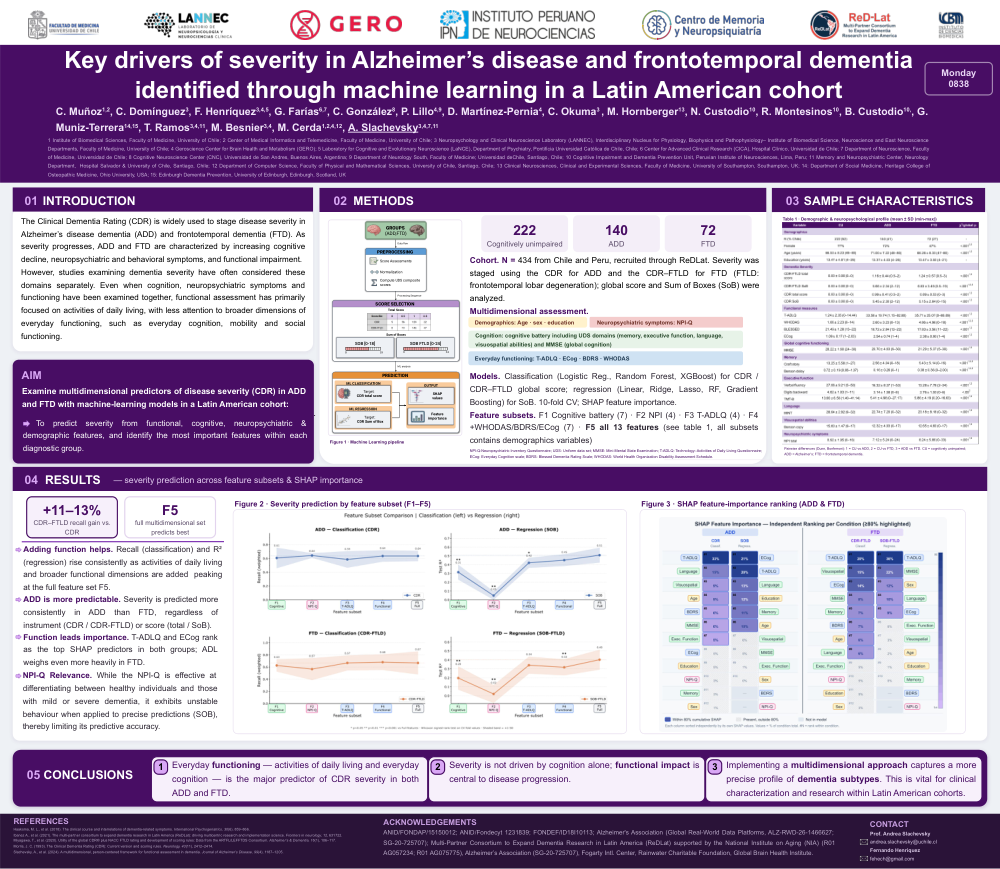
Background: The Clinical Dementia Rating (CDR) is widely used to stage disease severity in Alzheimer’s disease dementia (ADD) and frontotemporal dementia (FTD). However, prior research has predominantly emphasized cognitive and neuropsychiatric domains as predictors, with comparatively limited attention to functional abilities. Consequently, evidence integrating cognitive, neuropsychiatric, and functional dimensions to predict disease severity remains scarce, particularly in Latin American (LA) populations. This study aimed to examine multidimensional predictors of disease severity, as measured by the CDR, in ADD and FTD subjects using machine learning (ML) models in a LA cohort.
Methods: A total of 434 Chilean and Peruvian participants from the ReDLat and Fondecyt DEFEND (Data-drivEn assessment of Functioning in NeuroCognitive disorders) studies were included: 222 cognitively unimpaired (CU), 140 with ADD, and 72 with FTD. Participants were assessed with the CDR and CDR-FTLD (total and sum-of-boxes, or SoB, scores), measures of cognition (global cognition, memory, language, executive function, and visuospatial abilities), neuropsychiatric symptoms (NPI-Q), and functional ability (T-ADLQ, ECog, WHODAS, and BLESSED) (Table 1). For each pathology, ML classification models (XGBoost, Logistic Regression, Random Forest) predicted total scores, and ML regression models (Gradient Boosting, Random Forest, Lasso) predicted SoB scores. Models were trained on 75% of the data and evaluated on the remaining 25% using 5-fold cross-validation.
Results: In ADD, multidimensional models achieved an F1-score of 0.71±0.04 and an R² of 0.59±0.04, while in FTD, performance reached an F1-score of 0.69±0.05 and an R² of 0.42±0.11, using CDR-FTLD total scores for classification and CDR-SoB for regression (Figure 1). Functional measures (T-ADLQ and ECog) emerged as the most robust predictors of disease severity across both conditions (Figure 2).
Conclusion: Across multiple ML models and measures of disease severity, multidimensional measures of functional ability, integrating ADL (T-ADLQ) and daily life cognition (ECog), emerged as the most robust and consistent predictors of dementia severity, outperforming neuropsychiatric variables and most cognitive measures, with the MMSE as the sole cognitive exception. Together, these findings highlight the central importance of multidimensional functional assessments for clinical evaluation and predictive modeling of dementia severity and underscore the need to test their applicability across diverse populations.
Comments
Email is required but is not shown publicly.
Loading comments...