4,068 posters, 219 videos, 101 topics, 69 sessions, 14,365 authors, 6,128 institutions
ePostersLive by SciGen Technologies S.A. All rights reserved.
Alzheimer's Association International Conference 2026
July 12-15, 2026 | London, United Kingdom, and Online

9473
Education As A Protective Factor For Cognitive Decline After Head Injury: Findings From LASI-DAD
Poster Presenter
Part of Topic
Title:
Education As A Protective Factor For Cognitive Decline After Head Injury: Findings From LASI-DAD
Key Takeaway:
Formal education may enhance cognitive reserve, helping individuals recover better and experience less cognitive decline after a head injury.
Introduction:
Education is widely recognized as an important determinant of cognitive functioning, with an evidence suggesting that individuals with formal education perform better in cognitive tests. In contrast, head injury is a well-established risk factor for cognitive impairment, however, limited evidence exists on whether education protects cognitive decline following head injury. Hence, this study aims to assess whether formal education is associated with better cognitive functioning among individuals with a history of head injury.
Methodology:
Data from Wave 2 (2022- 2024) of the Harmonized Longitudinal Aging Study in India Diagnostic Assessment of Dementia (LASI-DAD) were used for this study. Participants were categorized based on self-reported history of head injury and educational status (Formal education vs no formal education). Descriptive statistics, chi square and the Mann-Whitney U test were used to analyze the data using SPSS version 31.0
Results:
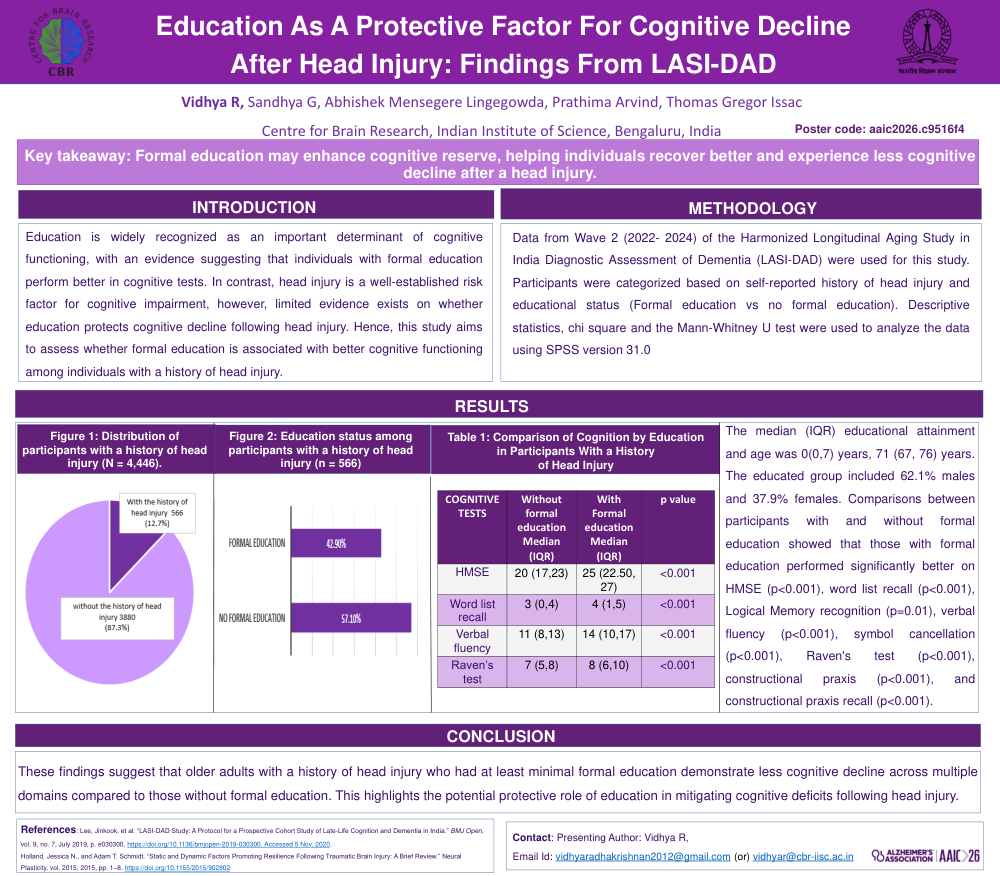
The median (IQR) educational attainment and age was 0(0,7) years, 71 (67, 76) years. The educated group included 62.1% males and 37.9% females. Comparisons between participants with and without formal education showed that those with formal education performed significantly better on HMSE (p<0.001), word list recall (p<0.001), Logical Memory recognition (p=0.01), verbal fluency (p<0.001), symbol cancellation (p<0.001), Raven's test (p<0.001), constructional praxis (p<0.001), and constructional praxis recall (p<0.001).
Conclusion:
These findings suggest that older adults with a history of head injury who had at least minimal formal education demonstrate less cognitive decline across multiple domains compared to those without formal education. This highlights the potential protective role of education in mitigating cognitive deficits following head injury.
References:
Lee, Jinkook, et al. “LASI-DAD Study: A Protocol for a Prospective Cohort Study of Late-Life Cognition and Dementia in India.” BMJ Open, vol. 9, no. 7, July 2019, p. e030300, https://doi.org/10.1136/bmjopen-2019-030300. Accessed 5 Nov. 2020.
Holland, Jessica N., and Adam T. Schmidt. “Static and Dynamic Factors Promoting Resilience Following Traumatic Brain Injury: A Brief Review.” Neural Plasticity, vol. 2015, 2015, pp. 1–8, https://doi.org/10.1155/2015/902802
Comments
Email is required but is not shown publicly.
Loading comments...