4,068 posters, 219 videos, 101 topics, 69 sessions, 14,365 authors, 6,128 institutions
ePostersLive by SciGen Technologies S.A. All rights reserved.
Alzheimer's Association International Conference 2026
July 12-15, 2026 | London, United Kingdom, and Online

4957
Characterizing Auditory Dysfunction In Mild Cognitive Impairment: Rationale And Design Of An Ongoing Clinical Phenotyping Study
Poster Presenter
Part of Topic
Video
Title: Characterizing auditory dysfunction in mild cognitive impairment: rationale and design of an ongoing clinical phenotyping study - The SAPHIR Study
Authors: Laura Breda (Cilcare), Cecile Nicoud, Mathieu Schue, Frédérique Defosse, Hugo Laullier, Francesca Rapido, Audrey Gabelle (Montpellier University Hospital, France)
Background:
Hearing loss is increasingly recognized as a major potentially modifiable risk factor for dementia.1 Beyond age-related threshold elevation, altered auditory processing, particularly impaired speech intelligibility in noisy environments, has been linked to increased cognitive load and early cognitive decline.2
Cochlear synaptopathy, defined by the degeneration of synapses between inner hair cells and auditory nerve fibers, has been proposed as a peripheral mechanism underlying degraded auditory signal transmission despite preserved pure-tone audiometry.3,4 However, comprehensive auditory phenotyping across the cognitive continuum remains limited. Improved characterization of auditory dysfunction may therefore provide critical insights into the auditory–cognitive interface in individuals at risk for Alzheimer’s disease.
Methods:
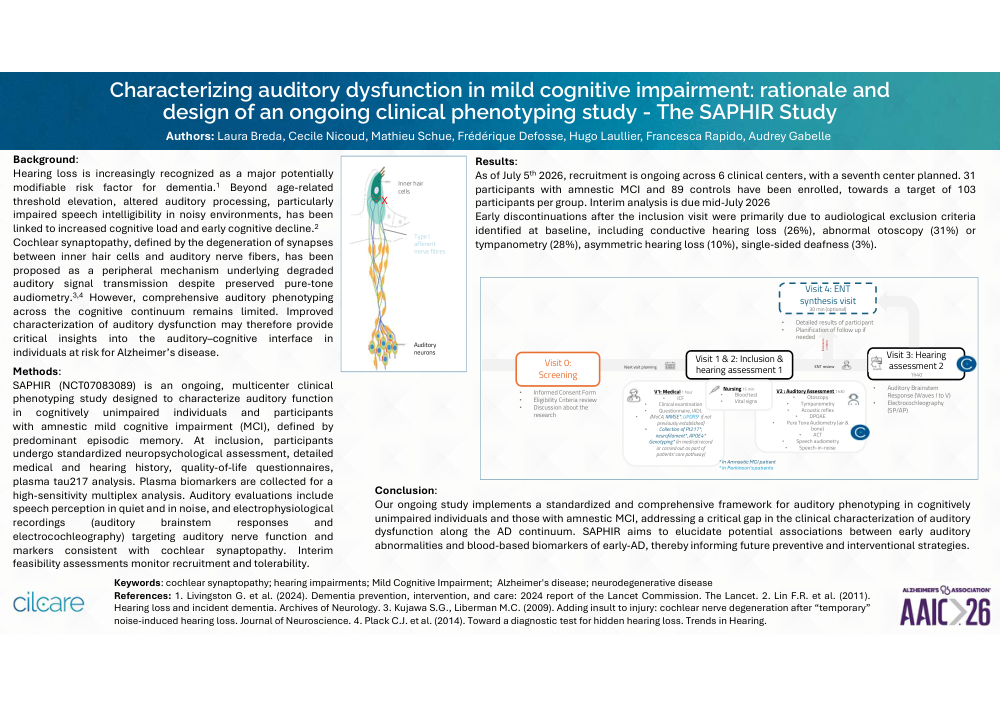
SAPHIR (NCT07083089) is an ongoing, multicenter clinical phenotyping study designed to characterize auditory function in cognitively unimpaired individuals and participants with amnestic mild cognitive impairment (MCI), defined by predominant episodic memory. At inclusion, participants undergo standardized neuropsychological assessment, detailed medical and hearing history, quality-of-life questionnaires, plasma tau217 analysis. Plasma biomarkers are collected for a high-sensitivity multiplex analysis. Auditory evaluations include speech perception in quiet and in noise, and electrophysiological recordings (auditory brainstem responses and electrocochleography) targeting auditory nerve function and markers consistent with cochlear synaptopathy. Interim feasibility assessments monitor recruitment and tolerability.
Results:
As of July 5th 2026, recruitment is ongoing across 6 clinical centers, witha sixth center planned. 31 participants with amnestic MCI and 89 controls have been enrolled, towards a target of 103 participants per group. Interim analysis is due mid-July 2026. Early discontinuations after the inclusion visit were primarily due to audiological exclusion criteria identified at baseline, including conductive hearing loss (26%), abnormal otoscopy (31%) or tympanometry (28%), asymmetric hearing loss (10%), single-sided deafness (3%).
Conclusion:
Our ongoing study implements a standardized and comprehensive framework for auditory phenotyping in cognitively unimpaired individuals and those with amnestic MCI, addressing a critical gap in the clinical characterization of auditory dysfunction along the AD continuum. SAPHIR aims to elucidate potential associations between early auditory abnormalities and blood-based biomarkers of early-AD, thereby informing future preventive and interventional strategies.
Keywords: cochlear synaptopathy; hearing impairments; Mild Cognitive Impairment; Alzheimer's disease; neurodegenerative disease
References: 1. Livingston G. et al. (2024). Dementia prevention, intervention, and care: 2024 report of the Lancet Commission. The Lancet. 2. Lin F.R. et al. (2011). Hearing loss and incident dementia. Archives of Neurology. 3. Kujawa S.G., Liberman M.C. (2009). Adding insult to injury: cochlear nerve degeneration after “temporary” noise-induced hearing loss. Journal of Neuroscience. 4. Plack C.J. et al. (2014). Toward a diagnostic test for hidden hearing loss. Trends in Hearing.
Comments
Email is required but is not shown publicly.
Loading comments...