4,068 posters, 219 videos, 101 topics, 69 sessions, 14,365 authors, 6,128 institutions
ePostersLive by SciGen Technologies S.A. All rights reserved.
Alzheimer's Association International Conference 2026
July 12-15, 2026 | London, United Kingdom, and Online

9801
Cortical Thickness Alterations And Bilingualism In Primary Progressive Aphasia
Poster Presenter
Authors
Part of Topic
INTRODUCTION:
Primary Progressive Aphasia (PPA) includes language-led neurodegenerative syndromes with distinct atrophy patterns: anterior temporal in semantic variant (svPPA) and left inferior frontal/insular in nonfluent/agrammatic variant (PNFA) (Gorno-Tempini et al., 2004; Vandenberghe, 2016). Bilingualism has been proposed as a cognitive reserve factor delaying onset or reducing neurodegeneration in dementia (Alladi et al., 2017; de Leon et al., 2020), but evidence in PPA remains limited and inconsistent. Case studies and reviews suggest variable outcomes depending on language network and proficiency (Zanini et al., 2011; Karpathiou et al., 2018; Grasso et al., 2023). This study examines whether bilingualism influences the relationship between cortical thickness and cognitive measures.
This study aimed to: (1) characterise cortical thickness differences between bilingual and monolingual PPA patients using whole-brain surface-based morphometry; (2) examine whether cortical thickness in regions implicated in bilingual language control predicts cognitive performance across the PPA cohort; and (3) test whether bilingualism moderates the relationship between cortical thickness and cognition.
METHODS:
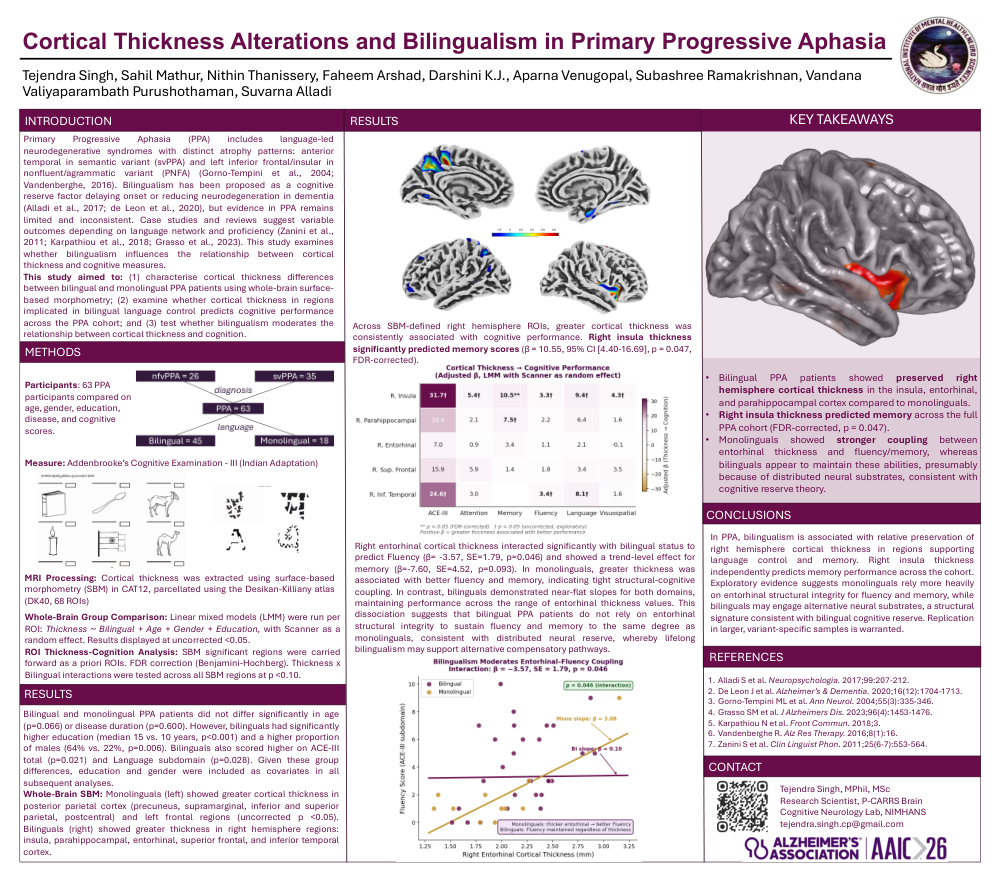
Participants: 63 PPA participants compared on age, gender, education, disease, and cognitive scores.
Measure: Addenbrooke's Cognitive Examination - III (Indian Adaptation)
MRI Processing: Cortical thickness was extracted using surface-based morphometry (SBM) in CAT12, parcellated using theDesikan-Killiany atlas (DK40, 68 ROIs)
Whole-Brain Group Comparison: Linear mixed models (LMM) were run per ROI: Thickness ~ Bilingual + Age + Gender + Education, with Scanner as a random effect. Results displayed at uncorrected <0.05.
ROI Thickness-Cognition Analysis: SBM significant regions were carried forward as a priori ROIs. FDR correction (Benjamini-Hochberg). Thickness x Bilingual interactions were tested across all SBM regions at p <0.10.
RESULTS:
Bilingual and monolingual PPA patients did not differ significantly in age (p=0.066) or disease duration (p=0.600). However, bilinguals had significantly higher education (median 15 vs. 10 years, p<0.001) and a higher proportion of males (64% vs. 22%, p=0.006). Bilinguals also scored higher on ACE-III total (p=0.021) and Language subdomain (p=0.028). Given these group differences, education and gender were included as covariates in all subsequent analyses.
Whole-Brain SBM: Monolinguals (left) showed greater cortical thickness in posterior parietal cortex (precuneus, supramarginal, inferior and superior parietal, postcentral) and left frontal regions (uncorrected p <0.05). Bilinguals (right) showed greater thickness in right hemisphere regions: insula, parahippocampal, entorhinal, superior frontal, and inferior temporal cortex.
Across SBM-defined right hemisphere ROIs, greater cortical thickness was consistently associated with cognitive performance. Right insula thickness significantly predicted memory scores (β = 10.55, 95% CI [4.40-16.69], p = 0.047, FDR-corrected).
Right entorhinal cortical thickness interacted significantly with bilingual status to predict Fluency (β= -3.57, SE=1.79, p=0.046) and showed a trend-level effect for memory (β=-7.60, SE=4.52, p=0.093). In monolinguals, greater thickness was associated with better fluency and memory, indicating tight structural-cognitive coupling. In contrast, bilinguals demonstrated near-flat slopes for both domains, maintaining performance across the range of entorhinal thickness values. This dissociation suggests that bilingual PPA patients do not rely on entorhinal structural integrity to sustain fluency and memory to the same degree as monolinguals, consistent with distributed neural reserve, whereby lifelong bilingualism may support alternative compensatory pathways.
CONCLUSIONS:
In PPA, bilingualism is associated with relative preservation of right hemisphere cortical thickness in regions supporting language control and memory. Right insula thickness independently predicts memory performance across the cohort. Exploratory evidence suggests monolinguals rely more heavily on entorhinal structural integrity for fluency and memory, while bilinguals may engage alternative neural substrates, a structural signature consistent with bilingual cognitive reserve. Replication in larger, variant-specific samples is warranted.
REFERENCES:
Comments
Email is required but is not shown publicly.
Loading comments...