4,068 posters, 219 videos, 101 topics, 69 sessions, 14,365 authors, 6,128 institutions
ePostersLive by SciGen Technologies S.A. All rights reserved.
Alzheimer's Association International Conference 2026
July 12-15, 2026 | London, United Kingdom, and Online

3304
Beyond Nearest Genes: Prioritization Across Identified Alzheimer Disease Risk Regions
Poster Presenter
Authors
Part of Topic
Video
Beyond Nearest Genes: Prioritization Across Identified Alzheimer's Disease Risk Regions
Paulina Gonzalez Orozco1, Valentina Bermudez1, Kristy Miskimen1, Audrey Lynn1, Yeunjoo Song1, William S. Bush1, Martin R. Eden2, Margaret A. Pericak-Vance2, Jeffery M. Vance2, Jonathan L. Haines1.
1Department of Population and Quantitative Health Sciences, Case Western Reserve University School of Medicine, Cleveland, OH, USA, 2Hussman Institute for Human Genomics, University of Miami, Miami, FL, USA.
Background
Large-scale GWAS have identified many Alzheimer disease and related dementia risk loci, but the causal genes underlying many signals remain unresolved. Traditional nearest-gene annotation can miss biologically relevant genes located elsewhere within the associated chromosomal region.
Objective
To move beyond nearest-gene annotation by defining full Alzheimer disease risk regions and systematically prioritizing protein-coding genes for downstream fine-mapping and functional validation.
Method
Step 1: Paper results (Bellenguez et al., 2022)
Table 1 had 33 previously known Alzheimer-associated loci & Table 2 had 42 newly discovered loci. Total of 83 sentinel SNPs (variants).
Step 2: Combine variants
Each SNP has a nearest gene listed.
Removing duplicates → 75 unique nearest-gene regions (the loci).
Step 3: Define locus boundaries
Defined a ±1 Mb window around each SNP. Overlapping ±1 Mb windows were merged into larger regions.
Step 4: Regions
Created individual tabs (V1–V69) regions. Used UCSC Genome Browser to extract the complete set of protein-coding genes within each region.
Step 5: Prioritization
Extracted information (genes, location, tier, evidence, etc) to categorize we utilized exhaustive manual literature curation across seven functional domains
Results
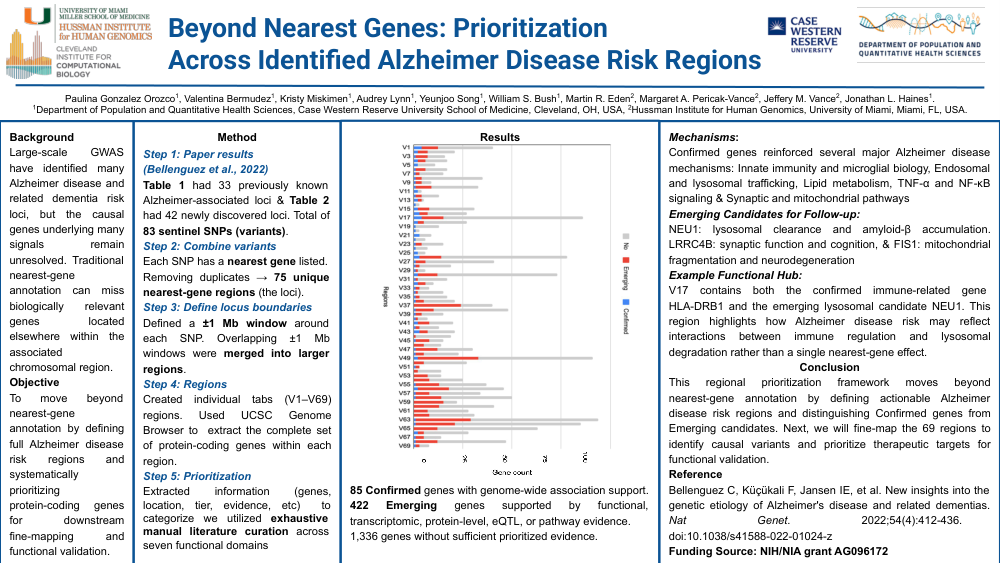
85 Confirmed genes with genome-wide association support.
422 Emerging genes supported by functional, transcriptomic, protein-level, eQTL, or pathway evidence.
1,336 genes without sufficient prioritized evidence.
Mechanisms:
Confirmed genes reinforced several major Alzheimer disease mechanisms:
Innate immunity and microglial biology
Endosomal and lysosomal trafficking
Lipid metabolism
TNF-α and NF-κB signaling & Synaptic
and mitochondrial pathways
Emerging Candidates for Follow-up:
NEU1: lysosomal clearance and amyloid-β accumulation.
LRRC4B: synaptic function and cognition
FIS1: mitochondrial fragmentation and neurodegeneration
Example Functional Hub:
V17contains both the confirmed immune-related gene HLA-DRB1 and the emerging lysosomal candidate NEU1. This region highlights how Alzheimer disease risk may reflect interactions between immune regulation and lysosomal degradation rather than a single nearest-gene effect.
Conclusion
This regional prioritization framework moves beyond nearest-gene annotation by defining actionable Alzheimer disease risk regions and distinguishing Confirmed genes from Emerging candidates. Next, we will fine-map the 69 regions to identify causal variants and prioritize therapeutic targets for functional validation.
Reference
Bellenguez C, Küçükali F, Jansen IE, et al. New insights into the genetic etiology of Alzheimer's disease and related dementias. Nat Genet. 2022;54(4):412-436. doi:10.1038/s41588-022-01024-z
Funding Source: NIH/NIA grant AG096172
Comments
Email is required but is not shown publicly.
Loading comments...