4,068 posters, 219 videos, 101 topics, 69 sessions, 14,365 authors, 6,128 institutions
ePostersLive by SciGen Technologies S.A. All rights reserved.
Alzheimer's Association International Conference 2026
July 12-15, 2026 | London, United Kingdom, and Online

9727
Acceptability Of Remote Cognitive And Clinical Follow-up Assessment In The Oxford Brain Health Clinic
Poster Presenter
Authors
Jasmine Blane, Sijia Zhao, Grace Gillis, Jess Owen, Anna Lucas, Shona Forster, Sameera Shabir, Masud Husain, Clare Mackay
Affiliations
University of Oxford, University of Oxford, Oxford Health NHS Foundation Trust, Oxford Health NHS Foundation Trust, Oxford Health BRC Dementia Advisory Group, University of Oxford, Oxford University Hospitals NHS Foundation Trust
Part of Topic
Acceptability of remote cognitive and clinical follow-up assessment in the Oxford Brain Health Clinic
Jasmine Blane1,2, S Zhao3, G Gillis1,2, J Owen2, A Lucas4, S Forster1, S Shabir1, M Husain3,5, CE Mackay1
1University of Oxford, Dept of Psychiatry, 2Oxford Health NHS Foundation Trust, 3University of Oxford, Nuffield Dept of Clinical Neurosciences, 4Oxford Health BRC Dementia Advisory Group, 5Oxford University Hospitals NHS Foundation Trust
Poster number: Monday-0821
Background:
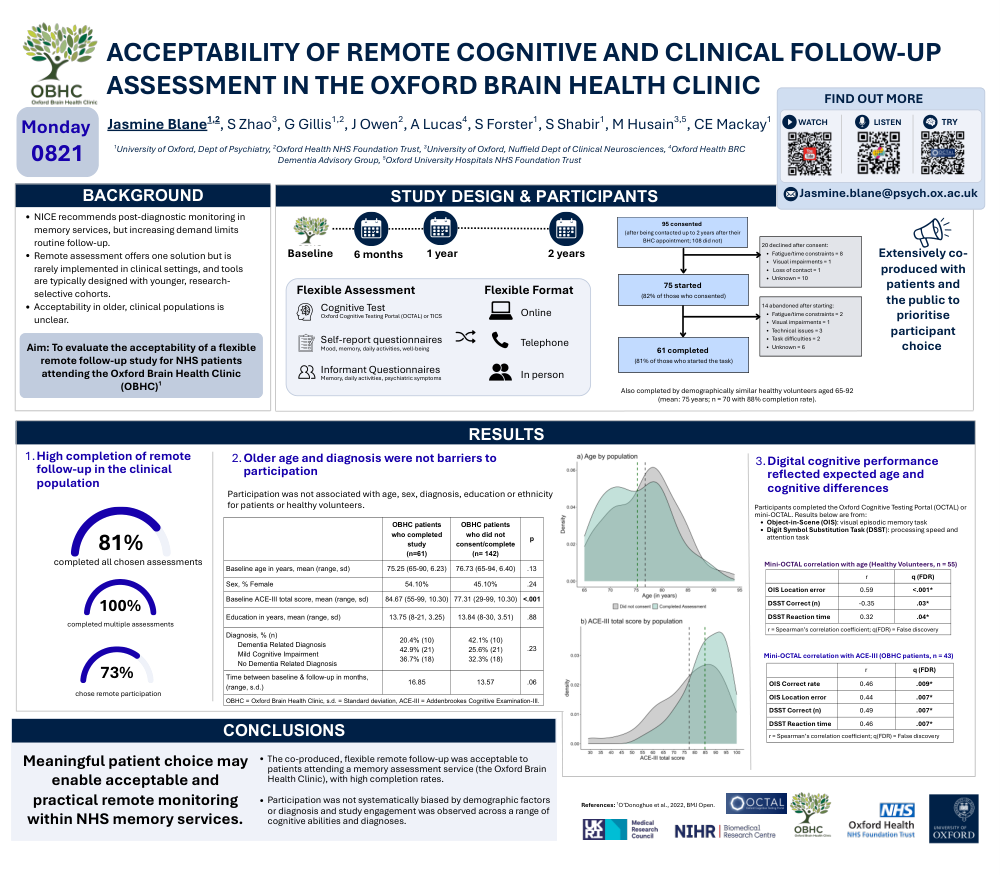
- NICE recommends post-diagnostic monitoring in memory services, but increasing demand limits routine follow-up.
- Remote assessment offers one solution but is rarely implemented in clinical settings, and tools are typically designed with younger, research-selective cohorts.
- Acceptability in older, clinical populations is unclear.
Aim: To evaluate the acceptability of a flexible remote follow-up study for NHS patients attending the Oxford Brain Health Clinic (OBHC; O’Donoghue et al., 2022).
Study Design & Participants:
To maximise acceptability, the OBHC follow-up was extensively co-produced with patient and public involvement to prioritise patient choice. A flexible consent model allowed patients to choose the assessment type and modality (online, telephone, in person) at 6-, 12-, and/or 24-month post-baseline. Patients could complete self-report questionnaires, a cognitive assessment, and/or have a study partner complete informant questionnaire. The cognitive assessment was conducted using either the Telephone Interview for Cognitive Status (TICS) or the Oxford Cognitive Testing Portal (OCTAL/mini-OCTAL; Zhao et al., 2025), a browser-based platform that assesses multiple cognitive domains. Of the 96 patients who consented 81% completed all assessments. Withdrawal reasons included fatigue, visual impairments, technical issues. The study was also completed by demographically similar healthy volunteers aged 65-92 (mean: 75 years; n = 70 with 88% completion rate).
Results:
- 1. High completion of remote follow-up in the clinical population
- 81% of patients completed all chosen assessments
- 100% of those completed multiple assessments
- 73% chose remote participation
- 2. Older age and diagnosis were not barriers to participation.
Participation was not associated with age, sex, diagnosis, education or ethnicity for patients or healthy volunteers.
|
OBHC patients who completed (n=61) |
OBHC patients who did not consent/complete (n= 142) |
p |
|
|
Baseline age in years, mean (range, sd) |
75.25 (65-90, 6.23) |
76.73 (65-94, 6.40) |
.13 |
|
Sex, % Female |
54.10% |
45.10% |
.24 |
|
Baseline ACE-III total score, mean (range, sd) |
84.67 (55-99, 10.30) |
77.31 (29-99, 10.30) |
<.001 |
|
Education in years, mean (range, sd) |
13.75 (8-21, 3.25) |
13.84 (8-30, 3.51) |
.88 |
|
Diagnosis, % (n) Dementia Related Diagnosis Mild Cognitive Impairment No Dementia Related Diagnosis |
20.4% (10) 42.9% (21) 36.7% (18) |
42.1% (10) 25.6% (21) 32.3% (18) |
.23 |
|
Time between baseline & follow-up in months, (range, s.d.) |
16.85 |
13.57 |
.06 |
|
OBHC = Oxford Brain Health Clinic, s.d. = Standard deviation, ACE-III = Addenbrookes Cognitive Examination-III. |
|||
- Digital cognitive performance reflected expected age and cognitive differences
Participants who complete the assessments online completed the Oxford Cognitive Testing Portal (OCTAL) or mini-OCTAL. Results below are from:
- Object-in-Scene (OIS): visual episodic memory task
- Digit Symbol Substitution Task (DSST): processing speed and attention task
Mini-OCTAL correlation with age (Healthy Volunteers, n = 55)
|
r |
q (FDR) |
|
|
OIS Location error (delayed) |
0.59 |
<.001* |
|
DSST Correct (n) |
-0.35 |
.03* |
|
DSST Reaction time (n) |
0.32 |
.04* |
|
r = Spearman’s correlation coefficient; q(FDR) = False discovery rate adjusted p-value. |
||
Mini-OCTAL correlation with ACE-III (OBHC patients, n = 43)
|
r |
q (FDR) |
|
|
OIS Correct rate (delayed) |
0.46 |
.009* |
|
OIS Location error (delayed) |
0.44 |
.007* |
|
DSST Correct (n) |
0.49 |
.007* |
|
DSST Reaction time (n) |
0.46 |
.007* |
|
r = Spearman’s correlation coefficient; q(FDR) = False discovery rate adjusted p-value. |
||
Conclusions:
Meaningful patient choice may enable acceptable and practical remote monitoring within NHS memory services.
The co-produced, flexible remote follow-up was acceptable to patients attending a memory assessment service (the Oxford Brain Health Clinic), with high completion rates.
- Participation was not systematically biased by demographic factors or diagnosis and study engagement was observed across a range of cognitive abilities and diagnoses.
Comments
Email is required but is not shown publicly.
Loading comments...