4,068 posters, 219 videos, 101 topics, 69 sessions, 14,365 authors, 6,128 institutions
ePostersLive by SciGen Technologies S.A. All rights reserved.
Alzheimer's Association International Conference 2026
July 12-15, 2026 | London, United Kingdom, and Online

8815
Decomposing Patient-caregiver Discrepancy To Measure Anosognosia
Poster Presenter
Authors
Part of Topic
Introduction
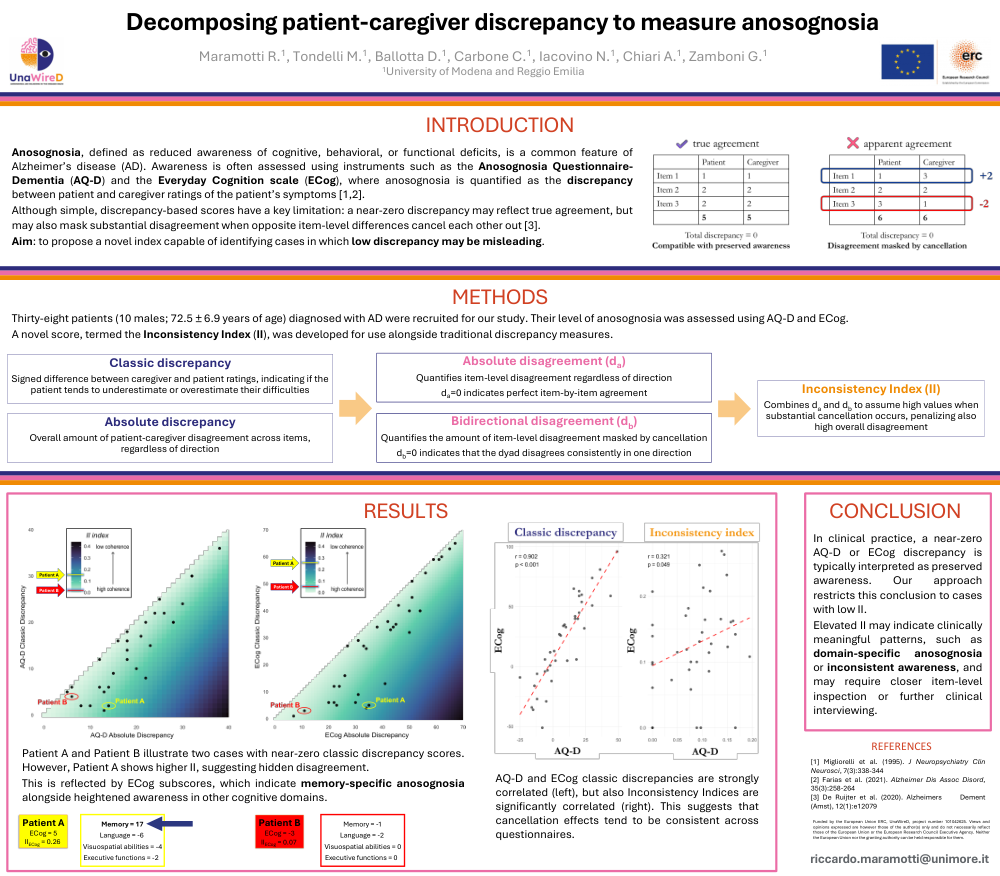
Anosognosia, defined as reduced awareness of cognitive, behavioral, or functional deficits, is a common feature of Alzheimer’s disease (AD). Awareness is often assessed using instruments such as the Anosognosia Questionnaire-Dementia (AQ-D) and the Everyday Cognition scale (ECog), where anosognosia is quantified as the discrepancy between patient and caregiver ratings of the patient’s symptoms [1,2]. Although simple, discrepancy-based scores have a key limitation: a near-zero discrepancy may reflect true agreement, but may also mask substantial disagreement when opposite item-level differences cancel each other out [3].
Aim: to propose a novel index capable of identifying cases in which low discrepancy may be misleading.
Methods
Thirty-eight patients (10 males; 72.5 ± 6.9 years of age) diagnosed with AD were recruited for our study. Their level of anosognosia was assessed using AQ-D and ECog. A novel score, termed the Inconsistency Index (II), was developed for use alongside traditional discrepancy measures.
Results
Patient A and Patient B illustrate two cases with near-zero classic discrepancy scores. However, Patient A shows higher II, suggesting hidden disagreement. This is reflected by ECog subscores, which indicate memory-specific anosognosia alongside heightened awareness in other cognitive domains.
AQ-D and ECog classic discrepancies are strongly correlated (left), but also Inconsistency Indices are significantly correlated (right). This suggests that cancellation effects tend to be consistent across questionnaires.
Conclusions
In clinical practice, a near-zero AQ-D or ECog discrepancy is typically interpreted as preserved awareness. Our approach restricts this conclusion to cases with low II. Elevated II may indicate clinically meaningful patterns, such as domain-specific anosognosia or inconsistent awareness, and may require closer item-level inspection or further clinical interviewing.
Comments
Email is required but is not shown publicly.
Loading comments...