4,068 posters, 219 videos, 101 topics, 69 sessions, 14,365 authors, 6,128 institutions
ePostersLive by SciGen Technologies S.A. All rights reserved.
Alzheimer's Association International Conference 2026
July 12-15, 2026 | London, United Kingdom, and Online

5058
Exploring Phenotypic Heterogeneity Of Early-and Late-onset Alzheimer's Disease: A Neuropsychological Data-driven Approach
Poster Presenter
Authors
Part of Topic
Video
Exploring Phenotypic Heterogeneity of Early- And Late-Onset Alzheimer's Disease: A Neuropsychological Data-Driven Approach
Jaume Torres-Coll1, Agnès Perez-Millán1,2, Axel Rigol1, Magdalena Castellví1, Bea Bosch1,3, Marta M. Sánchez1, Víctor Patricio-Toribio1, Jordi Juncà-Parella1,3, Georgina Rubio1, Claudia Morante-Serra1, Laura Mir1, Neus Falgàs1,3, Sergi Borrego-Écija1,3, Núria Guillen1,3, Diana Esteller1, Isabel Martin1, Miquel Massons1, Paula Canasto1, Raquel Sánchez-Valle1,3, Mircea Balasa1,3, Albert Lladó1,3, Adrià Tort-Merino1,3.
1 Alzheimer’s Disease and other Cognitive Disorders unit, Hospital Clínic de Barcelona, Fundació de Recerca Clínic Barcelona – Institut d’Investigacions Biomèdiques August Pi i Sunyer (IDIBAPS), Universitat de Barcelona, Barcelona, Spain
2 eHealth Center, Faculty of Computer Science, Multimedia and Telecommunications, Universitat Oberta de Catalunya, 08016 Barcelona, Spain
3 Centro de Investigación Biomédica en Red en Enfermedades Neurodegenerativas (CIBERNED), Madrid, Spain
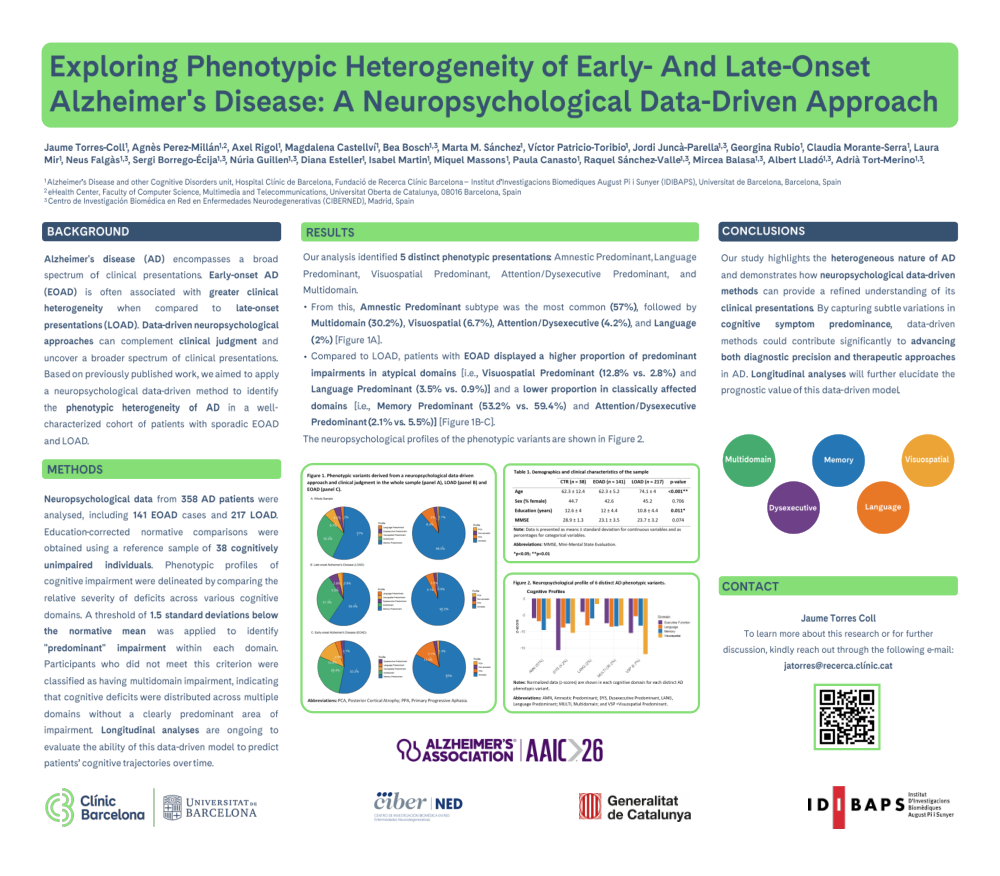
Background: Alzheimer's disease (AD) encompasses a broad spectrum of clinical presentations. Early-onset AD (EOAD) is often associated with greater clinical heterogeneity when compared to late-onset presentations (LOAD). Data-driven neuropsychological approaches can complement clinical judgment and uncover a broader spectrum of clinical presentations. Based on previously published work, we aimed to apply a neuropsychological data-driven method to identify the phenotypic heterogeneity of AD in a well-characterized cohort of patients with sporadic EOAD and LOAD.
Methods: Neuropsychological data from 358 AD patients were analysed, including 141 EOAD cases and 217 LOAD. Education-corrected normative comparisons were obtained using a reference sample of 38 cognitively unimpaired individuals. Phenotypic profiles of cognitive impairment were delineated by comparing the relative severity of deficits across various cognitive domains. A threshold of 1.5 standard deviations below the normative mean was applied to identify "predominant" impairment within each domain. Participants who did not meet this criterion were classified as having multidomain impairment, indicating that cognitive deficits were distributed across multiple domains without a clearly predominant area of impairment. Longitudinal analyses are ongoing to evaluate the ability of this data-driven model to predict patients’ cognitive trajectories over time.
Results: Our analysis identified 5 distinct phenotypic presentations: Amnestic Predominant, Language Predominant, Visuospatial Predominant, Attention/Dysexecutive Predominant, and Multidomain. From this, Amnestic Predominant subtype was the most common (57%), followed by Multidomain (30.2%), Visuospatial (6.7%), Attention/Dysexecutive (4.2%), and Language (2%) [Figure 1A]. Compared to LOAD, patients with EOAD displayed a higher proportion of predominant impairments in atypical domains [i.e., Visuospatial Predominant (12.8% vs. 2.8%) and Language Predominant (3.5% vs. 0.9%)] and a lower proportion in classically affected domains [i.e., Memory Predominant (53.2% vs. 59.4%) and Attention/Dysexecutive Predominant (2.1% vs. 5.5%)] [Figure 1B-C]. The neuropsychological profiles of the phenotypic variants are shown in Figure 2.
Conclusions: Our study highlights the heterogeneous nature of AD and demonstrates how neuropsychological data-driven methods can provide a refined understanding of its clinical presentations. By capturing subtle variations in cognitive symptom predominance, data-driven methods could contribute significantly to advancing both diagnostic precision and therapeutic approaches in AD. Longitudinal analyses will further elucidate the prognostic value of this data-driven model.
Comments
Email is required but is not shown publicly.
Loading comments...