4,068 posters, 219 videos, 101 topics, 69 sessions, 14,365 authors, 6,128 institutions
ePostersLive by SciGen Technologies S.A. All rights reserved.
Alzheimer's Association International Conference 2026
July 12-15, 2026 | London, United Kingdom, and Online

6608
Sex Differences In White Matter And Cognition In Cerebral Autosomal Dominant Arteriopathy
Poster Presenter
Part of Topic
Abstract:
Background: Cerebral autosomal dominant arteriopathy with subcortical infarcts and leukoencephalopathy (CADASIL) is a hereditary small-vessel disease characterized by marked sex differences, with males showing worse clinical outcomes, reduced brain volume, and a higher burden of lacunar infarcts than females. The objective of this study was to investigate whether biological sex modulates the relationship between white matter microstructure and cognition in individuals with CADASIL.
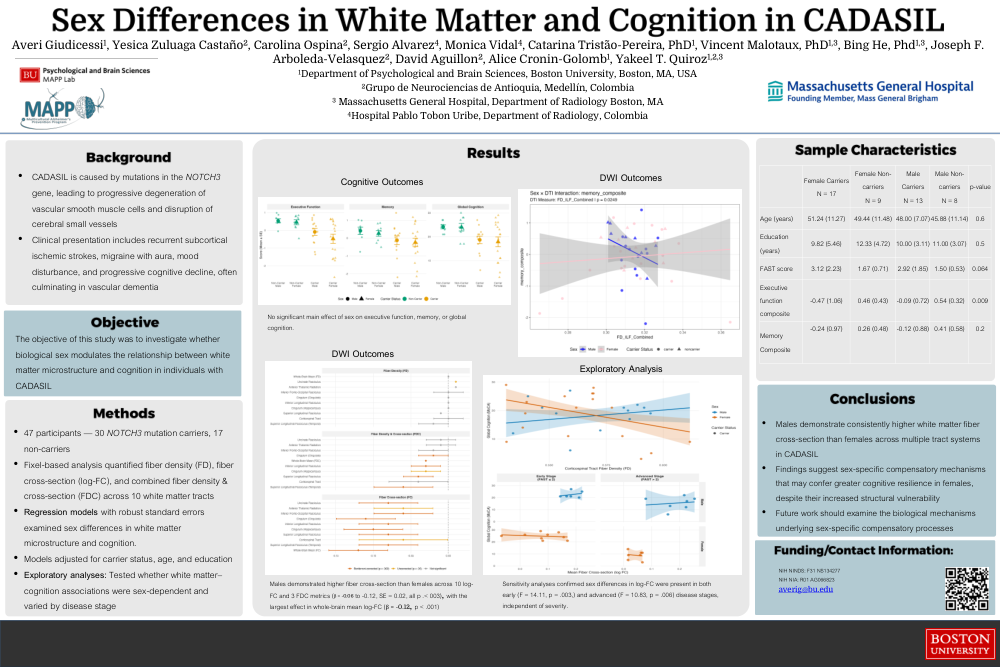
Methods: We studied 47 participants (30 Notch3 mutation carriers, 17 non-carriers; mean age=49.1 ± 10.1) with diffusion-weighted imaging and neuropsychological assessment. Fixel-based analysis quantified fiber density (FD), fiber cross-section (log-FC), and their combined measure (FDC) in 10 white matter tracts from the Johns Hopkins University atlas. Regression models with robust standard errors assessed sex differences in white matter microstructure and cognition (executive function, memory, global cognition), adjusting for carrier status, age, and education, with Bonferroni correction for multiple comparisons. Exploratory analyses examined whether associations between white matter and cognition were sex-dependent and differed by disease stage.
Results: Males demonstrated higher fiber cross-section than females across 10 log-FC and 3 FDC metrics (β = -0.06 to -0.12, SE = 0.02, all p ≤ .003, partial η² = 0.31-0.60), with the largest effect in whole-brain mean log-FC (β = -0.12, p < .001, η² = 0.60). Despite these structural differences, cognition did not differ by sex (all domains p > .31, all partial η² ≤ 0.07). Fiber density metrics showed no sex differences (all p > .05). Sensitivity analyses confirmed sex differences in log-FC were present in both early (F = 14.11, p = .003, η² = 0.56) and advanced (F = 10.83, p = .006, η² = 0.63) disease stages, independent of severity. Exploratory analyses further revealed that in advanced disease, whole-brain log-FC was associated with global cognition in females (r = .62) but not in males (r = .16).
Conclusion: Males demonstrate consistently higher white matter fiber cross-section than females across multiple tract systems in CADASIL, but this apparent structural advantage is not accompanied by better cognitive performance. Instead, these findings suggest sex-specific compensatory mechanisms that may confer greater cognitive resilience in females despite increased structural vulnerability.
Comments
Email is required but is not shown publicly.
Loading comments...